Quick Answer
Rocky Mountain Spotted Fever (RMSF) caused by Rickettsia rickettsii is the most severe tick-borne disease in North America, affecting both dogs and humans. This guide covers the classic triad, petechiae, neurologic signs, empiric doxycycline dosing before confirmatory testing, and the consequences of delayed treatment.
Key Takeaways
- ✓RMSF is caused by Rickettsia rickettsii, causing endothelial vasculitis with fever, thrombocytopenia, petechiae, and potentially fatal multi-organ failure.
- ✓Serology (IFA) is negative in the first week — initiate doxycycline empirically based on clinical signs; do not wait for confirmation.
- ✓Doxycycline 10 mg/kg IV q12h is standard dosing; clinical response (fever resolution) expected within 24-48 hours.
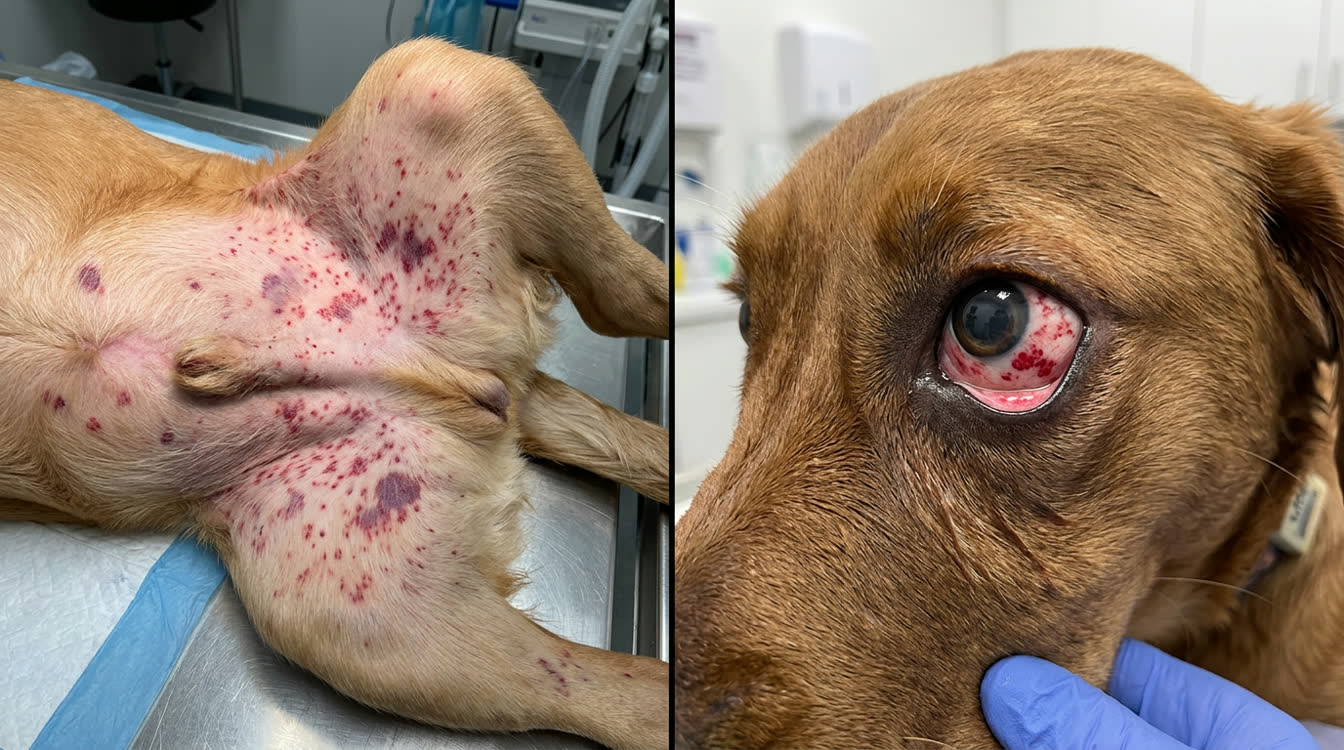
- ✓Petechiae on the abdomen, oral mucosa, sclera, and pinnae are hallmarks of rickettsial vasculitis — recognize this pattern immediately.
- ✓Most common in southeastern and south-central US (North Carolina, Oklahoma, Arkansas) — not primarily in Rocky Mountain states.
- ✓RMSF is the most lethal tick-borne disease in North America for humans; dogs are sentinels for household tick exposure risk.
RMSF: A True Veterinary Emergency — Clinical Signs and Pathogenesis
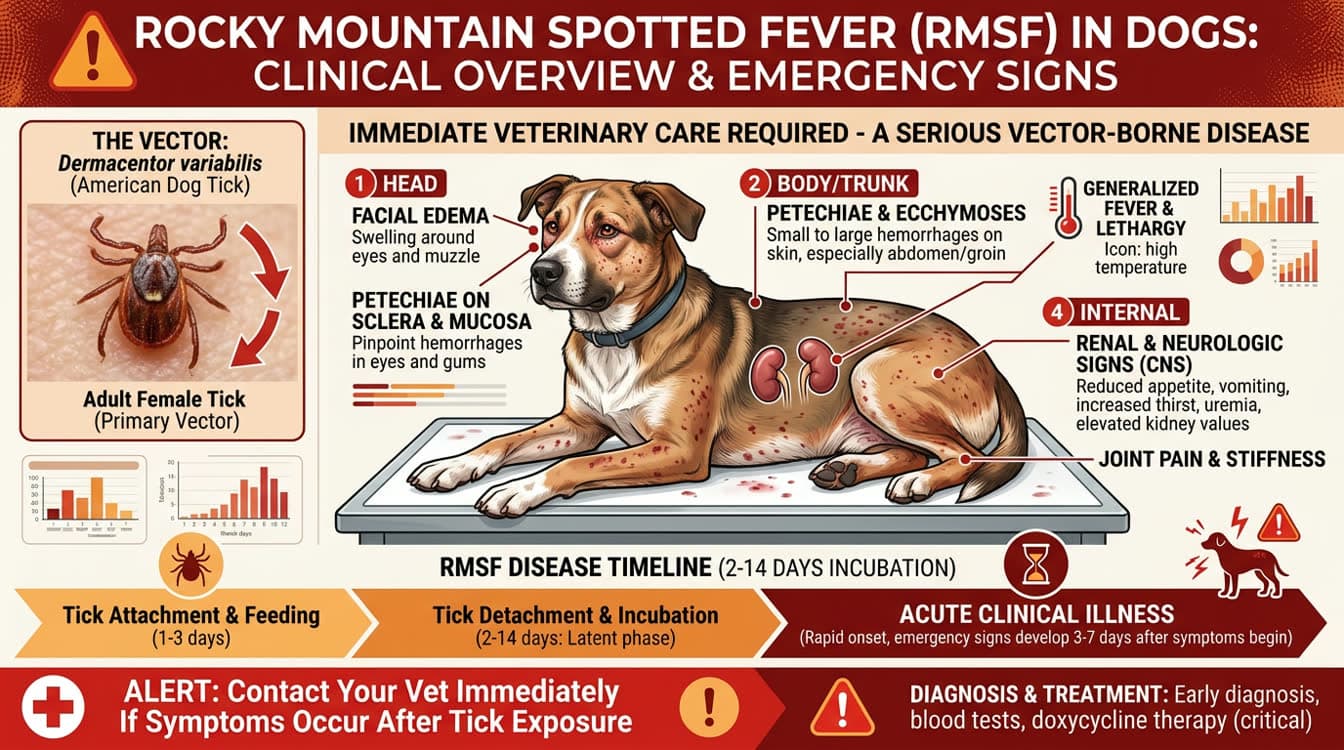
Rocky Mountain Spotted Fever is caused by Rickettsia rickettsii, an obligate intracellular gram-negative bacterium transmitted by Dermacentor variabilis (American dog tick) in eastern US and Dermacentor andersoni (Rocky Mountain wood tick) in western US. Amblyomma cajennense (cayenne tick) is an important vector in Mexico, Central and South America, and the southwestern US.
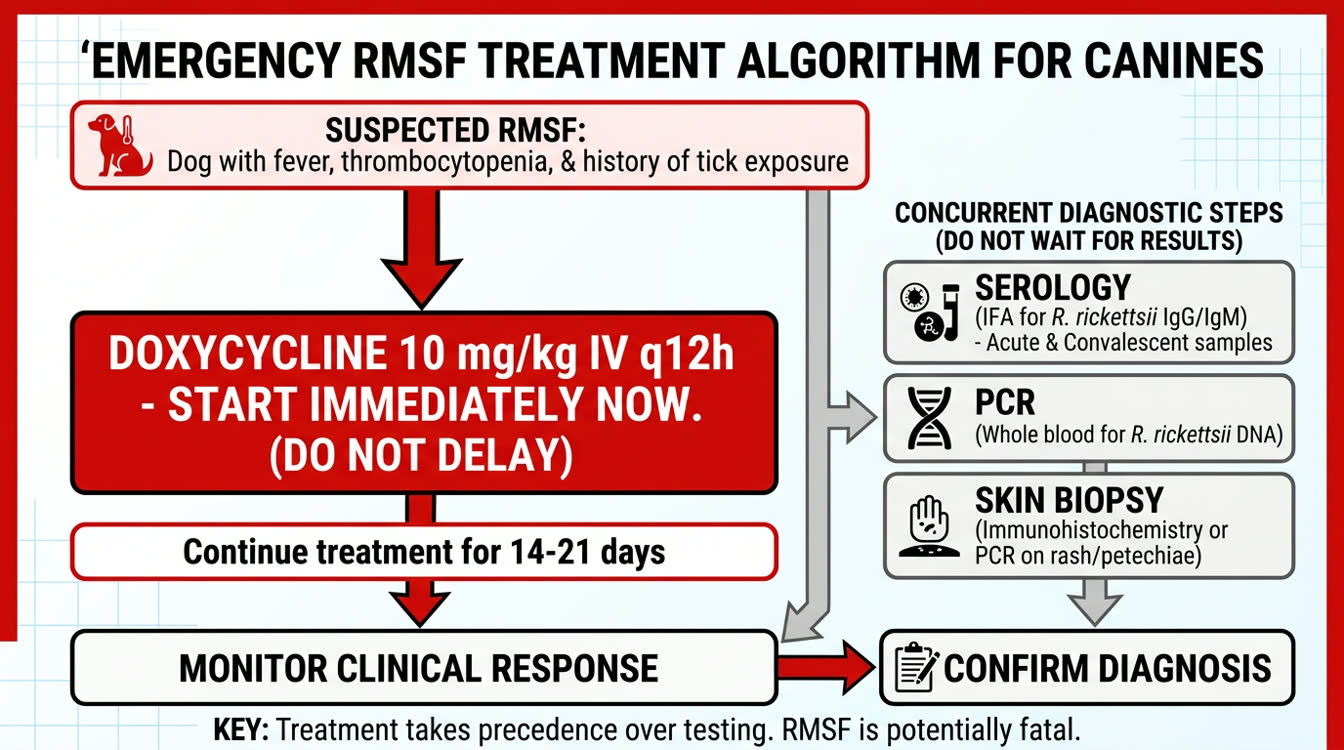
The Critical Rule: Treat Before Waiting for Serology RMSF is rapidly fatal if untreated. Confirmatory IFA serology is typically negative in the first week of illness. Do NOT delay doxycycline while waiting for laboratory confirmation in a clinically compatible case.
Pathogenesis
- Increased vascular permeability (edema, hemorrhage)
- Platelet consumption and thrombocytopenia (activated endothelium)
- Multi-organ dysfunction (kidneys, lungs, brain, heart)
Clinical Signs (Onset 2-14 Days Post-Tick Bite)
- Classic triad: fever (39.5-41.5 C), thrombocytopenia, vasculitic lesions
- Fever: rapid onset, often > 40.5 C
- Petechiae and ecchymoses: oral mucous membranes, sclera, ventral abdomen, pinnae — hallmark of vasculitis
- Neurologic signs: vestibular dysfunction, ataxia, stupor, meningism, seizures (CNS vasculitis)
- Edema: facial, limb, scrotal (permeability)
- Epistaxis, melena: hemorrhagic diathesis
- Polyarthritis: acute joint pain, reluctance to walk
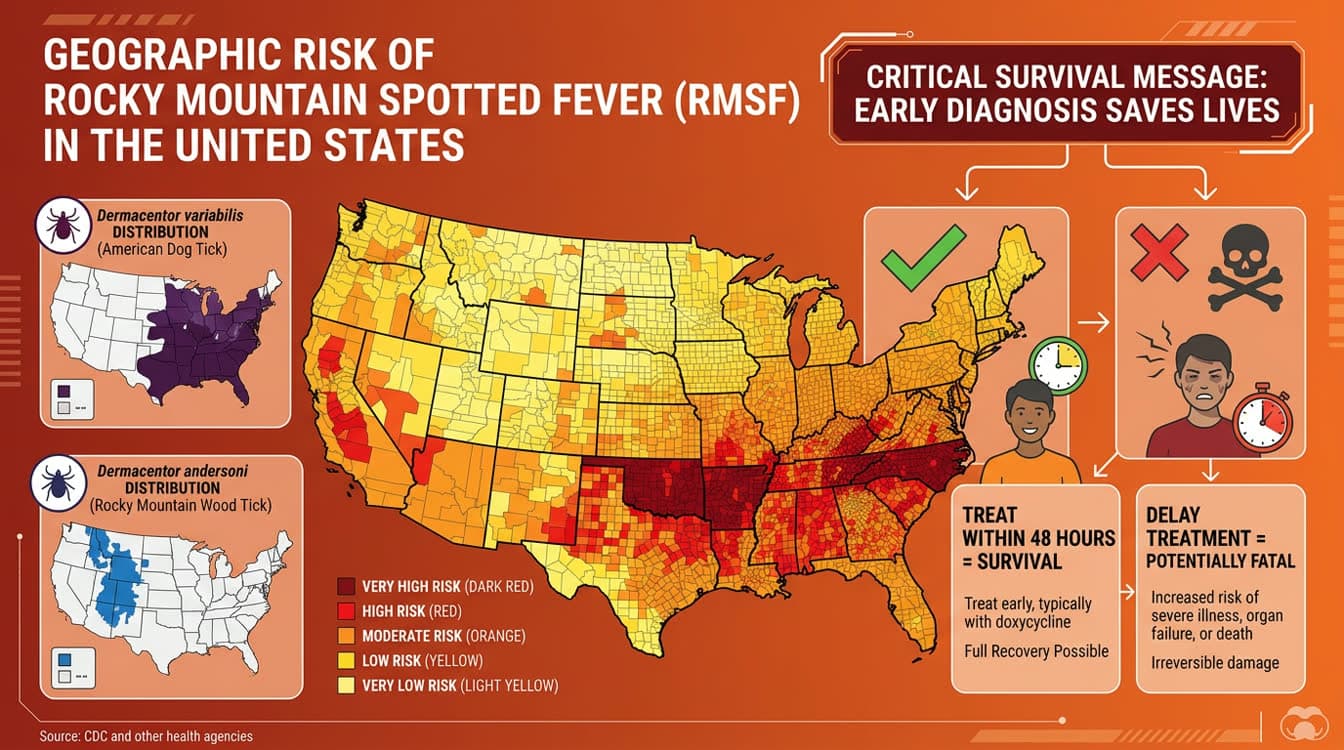
The RMSF Paradox of Geographic Name Despite the name, RMSF is most common in the south-central and southeastern US (North Carolina, Oklahoma, Arkansas, Tennessee, Missouri). Only a small percentage of cases occur in the Rocky Mountain region.
CBC and Chemistry Changes
- Thrombocytopenia: platelets 10,000-100,000/uL
- Normocytic normochromic anemia (hemolysis, inflammation)
- Elevated BUN/creatinine (renal vasculitis)
- Hyponatremia, hypoalbuminemia (increased vascular permeability)
- Elevated ALT, ALP (hepatic involvement)
Diagnosis and Empiric Doxycycline: Never Wait for Serology
The Treatment Imperative In a dog with acute fever, thrombocytopenia, petechiae, and known tick exposure in an endemic area, initiate doxycycline immediately. Case fatality rates increase dramatically with each day of treatment delay.
Diagnostic Testing
- IFA serology (indirect fluorescent antibody): gold standard but negative in first week; fourfold rise in paired titers (acute and convalescent 2-3 weeks apart) confirms diagnosis
- PCR on whole blood (EDTA): positive during acute febrile phase before treatment; sensitivity 70-90%
- Skin punch biopsy of petechiae: immunostaining for R. rickettsii; useful when petechiae are present
Empiric Doxycycline Protocol
- Dose: 10 mg/kg PO or IV q12h (q24h acceptable in non-critically ill)
- Route: IV preferred for critically ill, vomiting patients
- Duration: 14-21 days minimum; continue 5-7 days past fever resolution
Response to Treatment
- Fever typically resolves within 24-48 hours of doxycycline initiation
- Failure to defervescence within 48-72 hours: reconsider diagnosis, consider concurrent infections
- Dramatic clinical response to doxycycline is supportive of rickettsial diagnosis in itself
Supportive Care
- IV fluid therapy: isotonic crystalloids 10-20 mL/kg/h titrated to blood pressure; avoid over-hydration (edema risk from vasculitis)
- Platelet transfusions: whole blood or platelet-rich plasma if active hemorrhage with platelets < 20,000/uL
- Blood pressure monitoring: hypotension from vasodilation; phenylephrine or norepinephrine if refractory
- Antipyretics: generally avoided (fever may be suppressing bacterial replication); use only if extreme hyperthermia (> 41.5 C)
Prognosis, Complications and Zoonotic Risk to Humans
Prognosis
- Untreated or delayed treatment (> 3-5 days): mortality 20-30% or higher
- Treated within 48 hours: most dogs recover fully with appropriate doxycycline therapy
- Neurologic involvement: recovery possible but may be incomplete; seizures, vestibular signs may persist
- Renal failure (oliguric): significantly worsens prognosis; dialysis rarely available in veterinary practice
Complications of Severe RMSF
- Acute kidney injury: BUN > 80 mg/dL, creatinine > 3.0 mg/dL; fluid therapy titration critical
- Disseminated intravascular coagulation (DIC): PT/aPTT prolonged, fibrinogen decreased, d-dimers elevated; fresh frozen plasma and blood transfusion
- Pulmonary infiltrates: interstitial pneumonia from vasculitis; oxygen supplementation
- Necrosis: distal extremity necrosis from thrombosis (tail, digits, pinnae) — rare in dogs, more common in humans
Zoonotic Significance
- R. rickettsii is a Category B bioterrorism agent and important public health concern
- RMSF is the most lethal tick-borne disease in North America for humans (case fatality 3-5% with treatment; > 20% without)
- Dogs are NOT a direct source of human infection (humans get RMSF from tick bites, not from dogs)
- Dogs serve as critical sentinels for tick exposure in endemic areas
- Any dog diagnosed with RMSF should prompt a household tick inspection and human physician notification
Prevention
- Isoxazoline products: fluralaner (Bravecto), afoxolaner (NexGard), sarolaner (Simparica) rapidly kill Dermacentor ticks
- Manual tick removal: Dermacentor ticks must attach for 2-6 hours to transmit R. rickettsii (shorter transmission window than Ixodes for Lyme/Anaplasma)
- Year-round prevention in endemic regions (south-central and southeastern US)
Follow-Up
- Repeat serology (IFA) 2-3 weeks after initial presentation to confirm fourfold titer rise (retrospective confirmation)
- CBC recheck at 7 and 14 days: platelet and renal recovery monitoring
- Azotemia follow-up: serum chemistry at 1 month if renal involvement noted acutely
Frequently Asked Questions
Should I wait for serology before treating RMSF in dogs?
No. IFA serology is typically negative during the first week of RMSF illness (before antibodies develop). In a dog with acute fever, thrombocytopenia, petechiae, and tick exposure in an endemic area, start doxycycline immediately. Delay in treatment significantly increases mortality. Retrospective serology with paired titers 2-3 weeks apart can confirm the diagnosis.
What is the doxycycline dose for RMSF in dogs?
Doxycycline 10 mg/kg IV or PO q12h is the standard dose for RMSF. For critically ill or vomiting patients, IV doxycycline (5 mg/kg diluted in 250 mL 0.9% NaCl over 1 hour) is preferred. Treatment continues for 14-21 days, or 5-7 days past fever resolution.
Which tick transmits Rocky Mountain Spotted Fever?
In the eastern US, Dermacentor variabilis (American dog tick) is the primary vector. In the western US, Dermacentor andersoni (Rocky Mountain wood tick) transmits RMSF. Amblyomma cajennense (cayenne tick) is an important vector in the southwestern US and Latin America. Transmission requires tick attachment for at least 2-6 hours.
Can humans get RMSF from infected dogs?
Humans do not get RMSF directly from infected dogs. However, infected ticks on dogs can detach and seek new hosts, including humans. Dogs serve as important sentinels for tick exposure in endemic areas. A dog diagnosed with RMSF should prompt household tick inspection and human physician notification.
Where in the US is RMSF most common in dogs?
Despite its name, RMSF is most common in the southeastern and south-central United States, particularly North Carolina, Oklahoma, Arkansas, Tennessee, and Missouri. These states account for more than half of all reported cases. The Rocky Mountain states account for only a minority of cases.
References
- Breitschwerdt EB, et al. Rickettsia rickettsii transmission by a lone star tick, Amblyomma americanum. Emerg Infect Dis. 2011;17(5):751-758.
- Gasser AM, et al. Rocky Mountain spotted fever in the United States: a systematic review. Am J Trop Med Hyg. 2009;80(6):1005-1011.
- Piranda EM, et al. Experimental infection of Rhipicephalus sanguineus ticks with the bacterium Rickettsia rickettsii, using experimentally infected dogs. Vector Borne Zoonotic Dis. 2011;11(1):29-36.