Quick Answer
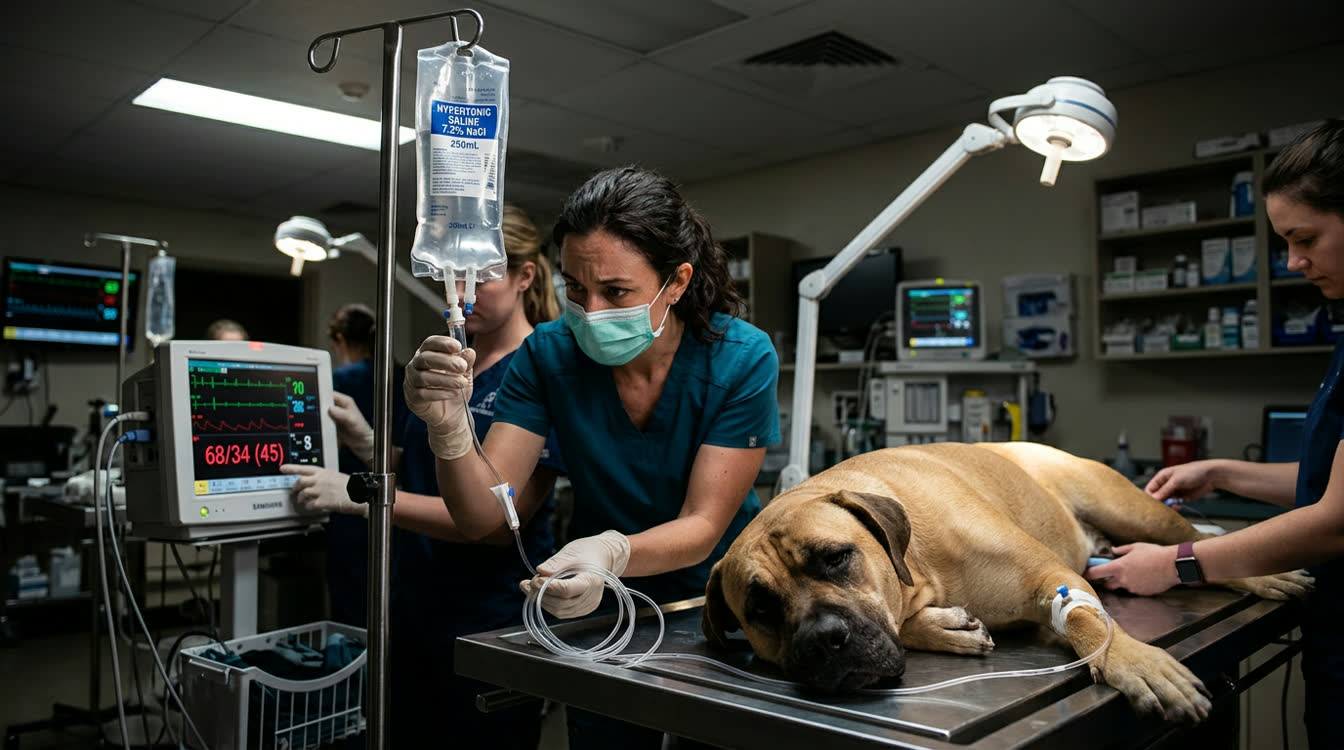
Hypertonic saline (7.2–7.5% NaCl) provides rapid volume expansion by drawing intracellular fluid into the vascular space with a small-volume bolus. This guide covers dosing for hemorrhagic shock and head trauma in dogs, combination with colloids, contraindications (hypernatremia, dehydration), and monitoring protocols.
Key Takeaways
- ✓Hypertonic saline (7.2% NaCl) at 4–5 mL/kg IV produces equivalent plasma volume expansion to 30–40 mL/kg of isotonic crystalloid using small volume.
- ✓Administer at no faster than 1 mL/kg/minute; rapid infusion causes bradycardia and potential hemolysis.
- ✓Head trauma is a key indication: 4–5 mL/kg IV reduces intracranial pressure by osmotically drawing edema fluid from the brain.
- ✓Absolute contraindications include pre-existing hypernatremia (Na+ >155 mEq/L), severe dehydration, and oliguric renal failure.
- ✓Monitor serum sodium 30–60 minutes post-administration; peak Na+ should not exceed 165 mEq/L; maximum 10 mL/kg total per 24 hours.
- ✓Combining HTS with colloids (hetastarch) extends the duration of volume expansion from 30–60 minutes to 2–3 hours.
Mechanism of Action, Osmotic Effect and Volume Expansion Rationale
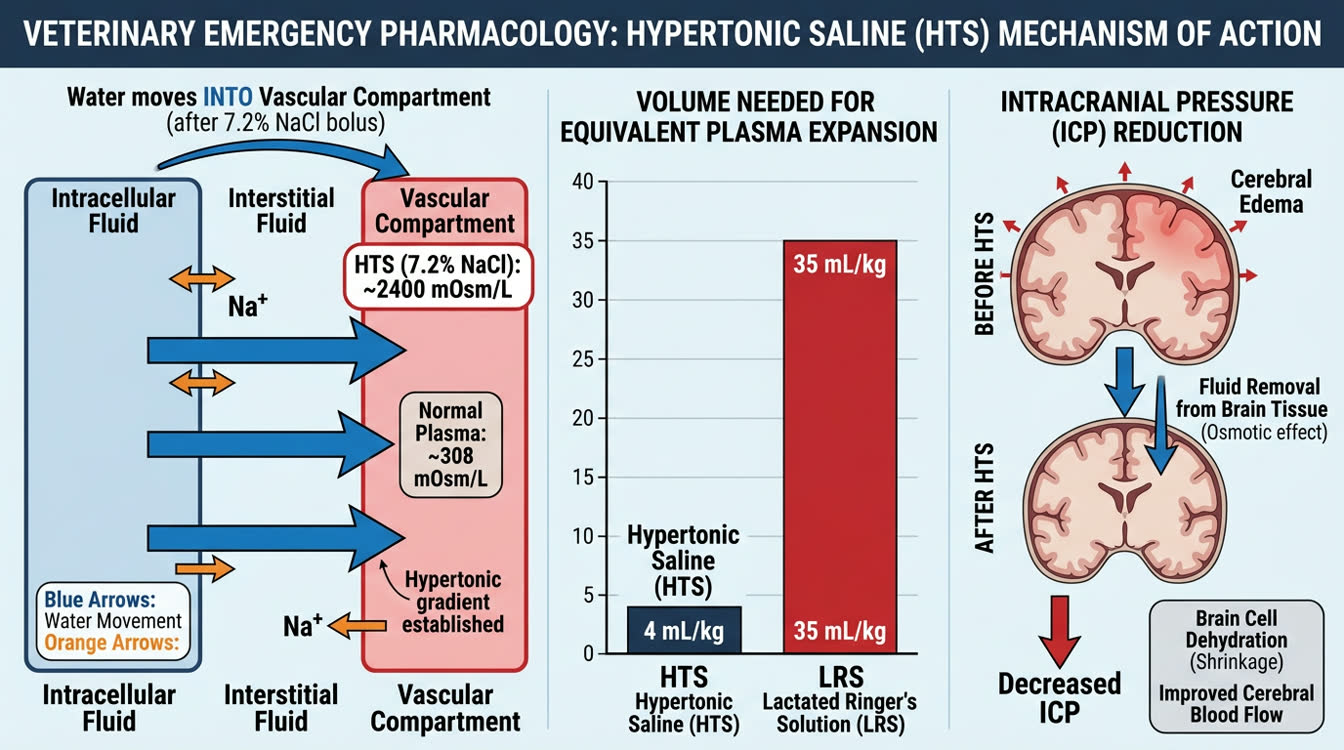
Hypertonic saline (HTS) contains sodium chloride at concentrations far exceeding plasma osmolality (308 mOsm/kg), creating a powerful osmotic gradient that rapidly redistributes fluid from the intracellular and interstitial compartments into the intravascular space.
Mechanism of Volume Expansion:
- Normal saline (0.9% NaCl): 308 mOsm/L; no osmotic gradient relative to plasma
- Hypertonic saline (7.2–7.5%): 2,400–2,565 mOsm/L — ~8x plasma osmolality
- Osmotic gradient pulls water from intracellular compartment and interstitium into the vasculature
- Volume effect: A 4–5 mL/kg bolus of 7.2% NaCl produces equivalent plasma volume expansion to 30–45 mL/kg of isotonic crystalloid
- Maximal volume expansion occurs within 15–30 minutes; effect lasts 30–60 minutes
Additional Mechanisms Beyond Volume Expansion:
- Negative inotropy reversal: Sodium influx into myocardial cells transiently improves cardiac contractility
- Vasodilation of pre-capillary sphincters: Improves microcirculatory flow in organs
- Immunomodulation: Hypertonic saline suppresses neutrophil activation and inflammatory cytokine release — relevant in trauma and SIRS
- Intracranial pressure (ICP) reduction: Creates osmotic gradient across the blood-brain barrier, drawing edema fluid from swollen brain tissue into circulation
Comparison: Hypertonic Saline vs Isotonic Crystalloid:
| Parameter | Isotonic Crystalloid (LRS) | Hypertonic Saline 7.2% |
|---|---|---|
| Volume to achieve expansion | 30–40 mL/kg | 4–5 mL/kg |
| Duration of effect | 1–2 hours | 30–60 minutes |
| Edema risk | Higher | Lower |
| ICP effect | Neutral or worsening | Reduces ICP |
| Sodium load | Low | High (risk hypernatremia) |
| Administration speed | Over 15–60 min | Over 5–15 min |
Key Clinical Advantage:
- Intracranial hypertension is a concern (head trauma, meningitis)
- Large-volume crystalloids are hemodynamically undesirable (cardiac compromise)
- Rapid field resuscitation is needed before definitive care
Dosing Protocols, Clinical Indications and Administration Technique
Hypertonic saline in veterinary medicine is available as 7.2% NaCl (most common in prepared veterinary products) or 7.5% NaCl. Both are used interchangeably at the same doses.
Standard Dosing for Dogs:
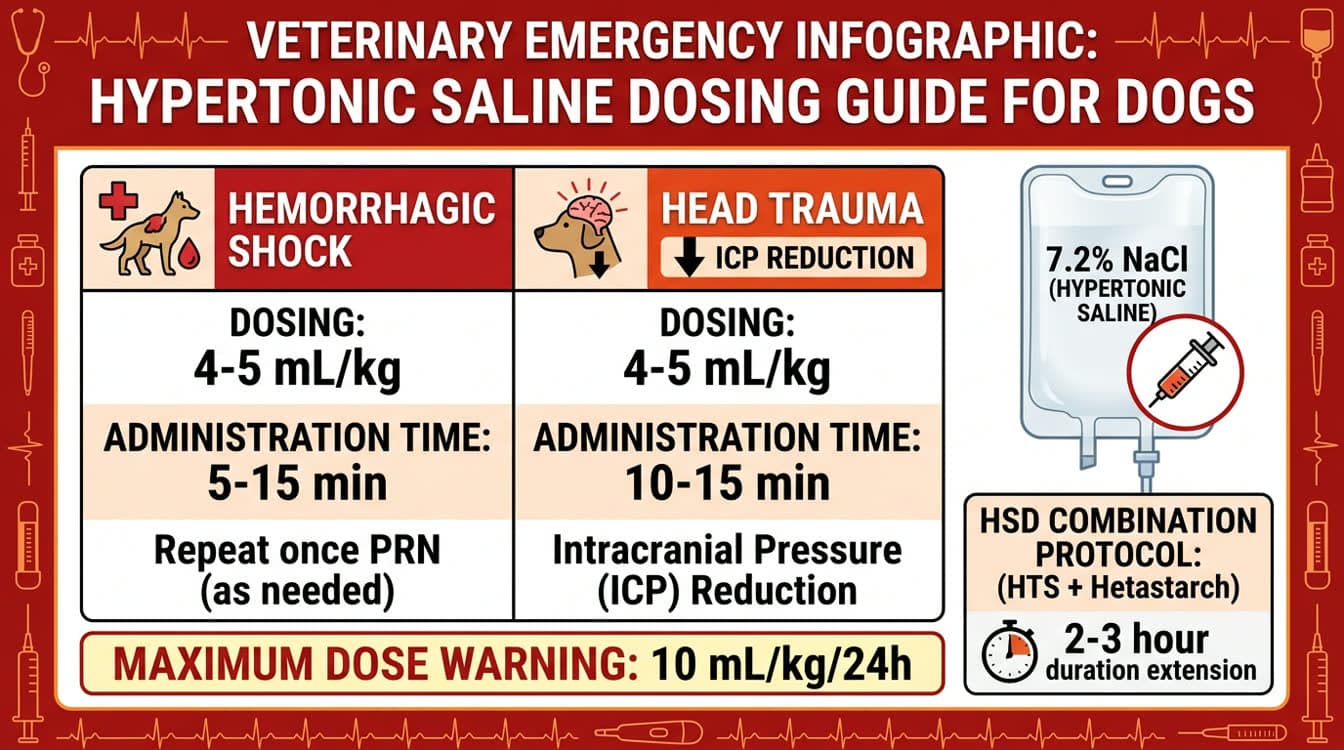
- Hemorrhagic shock / hypovolemic shock: 4–5 mL/kg IV bolus over 5–15 minutes
- Head trauma with suspected raised ICP: 4–5 mL/kg IV over 10–15 minutes; can repeat once after 4–6 hours if needed
- Maximum single dose: 5 mL/kg; maximum total per 24 hours: 10 mL/kg (not to exceed 2 boluses)
- Administration rate: Never give faster than 1 mL/kg/minute (rapid bolus risks acute hypernatremia and bradycardia)
Hypertonic Saline + Colloid (Hypertonic Saline-Dextran, HSD):
- Combining 7.2% NaCl with 6% dextran-70 (or hetastarch) extends the duration of volume expansion from 30–60 min to 2–3 hours
- HSD dose: 4–5 mL/kg IV over 10 min (draws both osmotic and oncotic advantages)
- Commercially available as Hypertonic Saline Dextran 70 (HSD) in some markets; can be prepared by adding hetastarch to HTS
- Superior to HTS alone in sustaining MAP in hemorrhagic shock
Indications in Dogs: 1. Hemorrhagic shock: Trauma, GDV, splenic rupture — initial rapid resuscitation before surgical hemorrhage control; buys time for blood product preparation 2. Head trauma / traumatic brain injury (TBI): Reduces cerebral edema; standard of care in human TBI; increasingly recommended in dogs 3. Hypovolemic shock with volume overload risk: When cardiac or pulmonary disease limits isotonic crystalloid use 4. Smoke inhalation / burn patients: Reduces overall fluid requirements and pulmonary edema formation 5. Gastric dilatation-volvulus pre-surgical stabilization: Rapid volume expansion before anesthetic induction
Preparation When Commercial Product Unavailable:
- Concentrated NaCl injection (23.4% NaCl, 4 mEq/mL) is available from hospital pharmacies
- Dilute to 7.2%: Mix 30.8 mL of 23.4% NaCl + 69.2 mL sterile water = 100 mL of 7.2% NaCl
- Mix thoroughly; confirm concentration calculation before use; label bag clearly
- Use dedicated IV line; flush with saline before and after
Contraindications, Adverse Effects and Post-Administration Monitoring
Despite its clinical utility, hypertonic saline has specific contraindications and monitoring requirements due to the large sodium load and rapid fluid redistribution.
Absolute Contraindications:
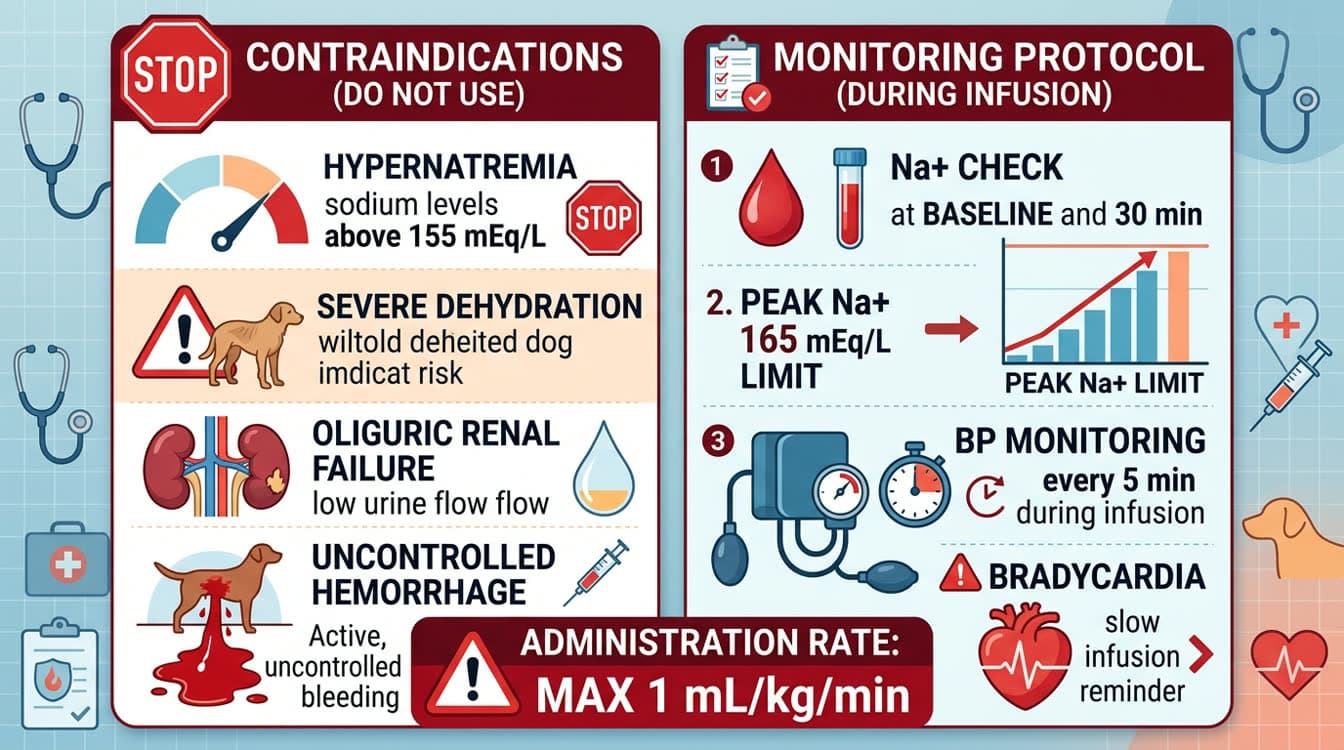
- Pre-existing hypernatremia (serum Na+ >155 mEq/L): HTS will worsen sodium elevation → cerebral dehydration, seizures, osmotic demyelination
- Severe dehydration without hypovolemia: The intracellular compartment is already depleted; osmotic shift will cause critical intracellular dehydration
- Oliguric renal failure with inability to excrete sodium load: Risk of pulmonary edema from retained sodium
- Uncontrolled hemorrhage without surgical access planned: HTS volume expansion increases arterial pressure and can dislodge blood clots, increasing hemorrhage — use hypotensive resuscitation strategy until surgical control
Relative Contraindications:
- Congestive heart failure: risk of volume overload after rapid expansion; use only in severe shock with expert monitoring
- Hypokalemia: rapid sodium shifts worsen hypokalemia; check and treat potassium before HTS
- Thrombocytopenia or coagulopathy: osmotic platelet and clotting factor dilution
Adverse Effects:
- Transient hypernatremia: Expected after bolus; serum Na+ typically peaks at 160–165 mEq/L and returns to baseline within 60–90 minutes as kidneys excrete sodium load
- Bradycardia: Particularly if administered too rapidly (faster than 1 mL/kg/min); slow the infusion rate
- Hemolysis: Rare with rapid IV administration; ensure proper dilution when preparing from concentrate
- Pulmonary edema: If cardiac function compromised; monitor respiratory rate and effort during and after infusion
- Phlebitis: HTS is hyperosmolar; use a large-bore central or peripheral catheter; flush line after administration
Monitoring Protocol:
- Serum sodium: baseline before administration; check 30–60 minutes post-dose
- Blood pressure: Doppler or oscillometric every 5 min during administration; target MAP ≥65 mmHg
- Heart rate and respiratory rate: continuous ECG monitoring during infusion
- Neurological status: For TBI patients, re-assess pupil size, symmetry, and mentation every 15 min after administration
- Urine output: Natriuresis expected in the 30–60 minutes after HTS; ensure urinary output is confirmed (no obstruction)
Post-Administration Fluid Management:
- Follow HTS bolus with isotonic crystalloid maintenance (5–10 mL/kg/hr) to maintain volume without further sodium loading
- Avoid repeat HTS unless serum sodium has returned to <150 mEq/L
- Monitor for rebound hyponatremia 4–6 hours post-administration (rapid sodium clearance in some patients)
Frequently Asked Questions
What is the hypertonic saline dose for hemorrhagic shock in dogs?
The standard hypertonic saline dose for hemorrhagic shock in dogs is 4–5 mL/kg of 7.2% or 7.5% NaCl given intravenously over 5–15 minutes (never faster than 1 mL/kg/minute). This small volume produces volume expansion equivalent to approximately 30–40 mL/kg of isotonic crystalloid. The maximum total daily dose is 10 mL/kg (maximum two boluses).
Can hypertonic saline be used for head trauma in dogs?
Yes. Hypertonic saline at 4–5 mL/kg IV over 10–15 minutes is a standard treatment for traumatic brain injury with suspected intracranial hypertension in dogs. The osmotic gradient across the blood-brain barrier draws edema fluid from swollen brain tissue into the circulation, reducing intracranial pressure. It may be repeated once after 4–6 hours if neurological signs warrant.
When is hypertonic saline absolutely contraindicated in dogs?
Hypertonic saline is absolutely contraindicated in dogs with pre-existing hypernatremia (serum sodium above 155 mEq/L), severe dehydration without true hypovolemia, and oliguric renal failure. These conditions prevent safe sodium excretion or place already depleted intracellular compartments at risk of critical dehydration.
How do you prepare 7.2% hypertonic saline from concentrated NaCl?
To prepare 7.2% NaCl from 23.4% NaCl concentrate (4 mEq/mL): mix 30.8 mL of 23.4% NaCl with 69.2 mL of sterile water for injection to yield 100 mL of 7.2% NaCl. Confirm calculations before use, mix thoroughly, and label clearly. Administer via a dedicated IV line with a large-bore catheter; flush the line before and after administration.
What is the target post-administration sodium level after hypertonic saline in dogs?
After a hypertonic saline bolus, serum sodium typically peaks at 160–165 mEq/L within 30–60 minutes and returns toward baseline as the kidneys excrete the sodium load. A peak serum sodium above 165 mEq/L is the threshold to avoid; do not repeat the bolus if sodium exceeds this level until values normalize below 150 mEq/L.
References
- Muir WW. "Trauma: physiology, pathophysiology, and clinical implications." J Vet Emerg Crit Care. 2006;16(4):253-263.
- Driessen B, Brainard B. "Fluid therapy for the traumatized patient." J Vet Emerg Crit Care. 2006;16(4):276-299.
- Schertel ER, et al. "Evaluation of a hypertonic saline-dextran solution for treatment of dogs with shock induced by gastric dilatation-volvulus." J Am Vet Med Assoc. 1997;210(2):226-230.