Quick Answer
Aortic thromboembolism (FATE) is a catastrophic cardiac complication in cats, most commonly associated with HCM. This guide covers acute recognition, analgesic protocols, limb viability assessment, anticoagulation, and secondary prevention strategies.
Key Takeaways
- ✓FATE presents with the 5 Ps: Pain, Paralysis, Pallor, Pulselessness, and Poikilothermia — most commonly as bilateral hind limb paresis from a saddle thrombus.
- ✓Limb viability assessment guides prognosis: soft muscles and present deep pain response favor recovery; rigid muscles and absent deep pain carry a poor prognosis.
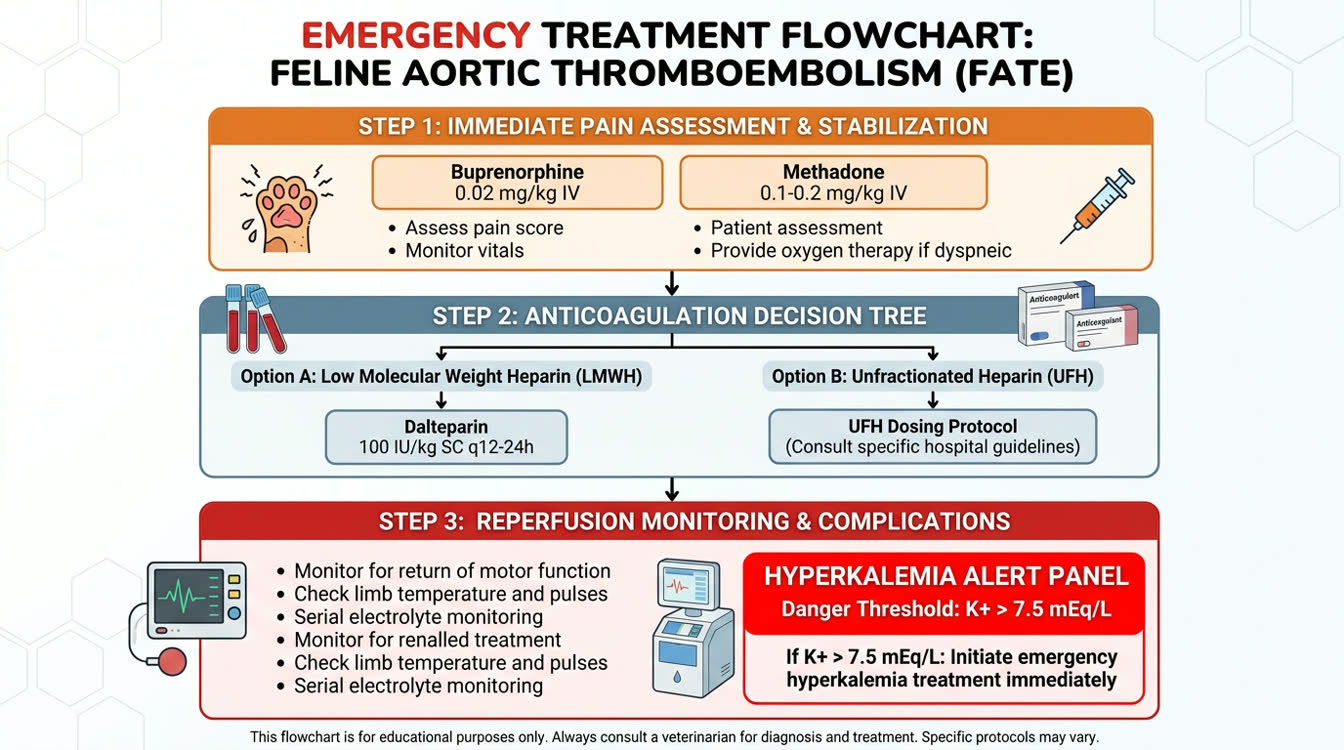
- ✓Aggressive analgesia with buprenorphine (0.02 mg/kg IV q6–8h) or methadone is the immediate treatment priority.
- ✓Anticoagulation with dalteparin 100 IU/kg SC q12–24h prevents clot extension but will not dissolve existing thrombus.
- ✓Hyperkalemia from reperfusion injury can cause fatal arrhythmias — monitor K+ every 4–6 hours during the first 72 hours.
- ✓Clopidogrel 18.75 mg/cat/day is superior to aspirin for secondary prevention based on the FATCAT clinical trial.
Recognizing FATE: The 5 Ps and Clinical Assessment
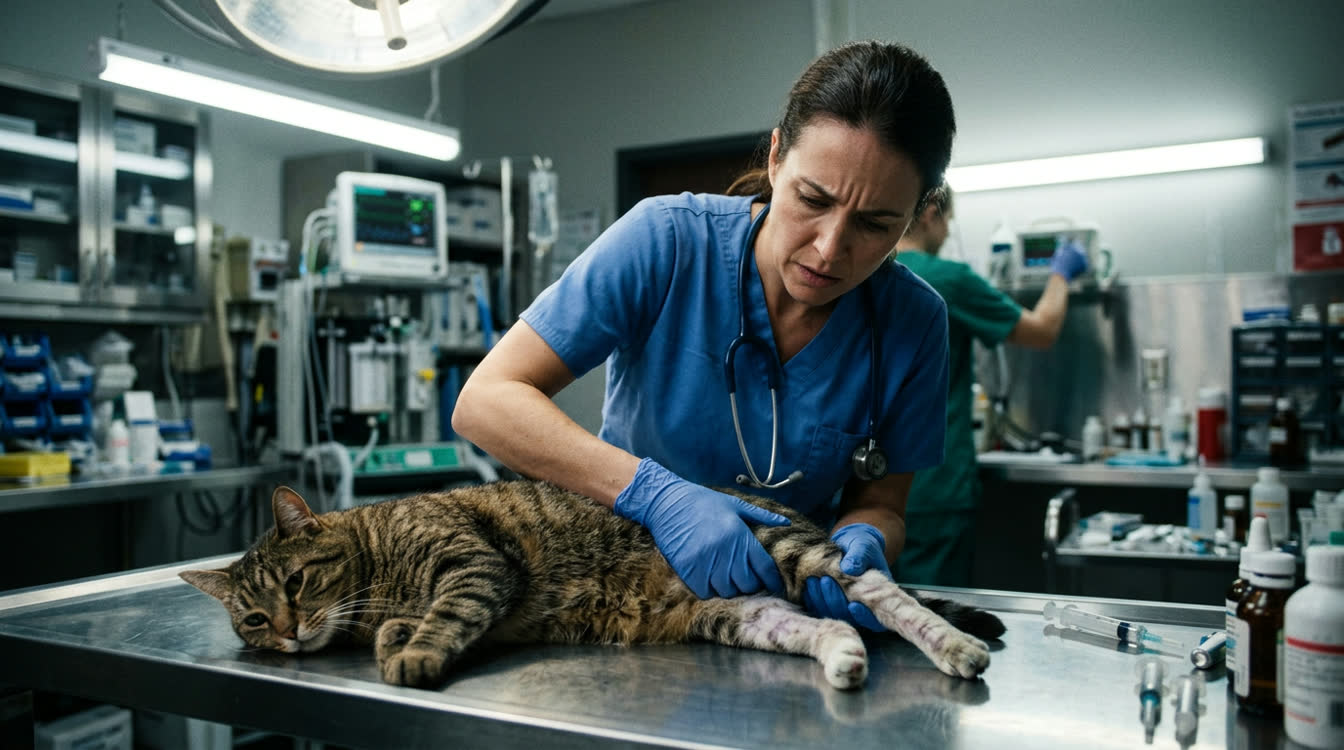
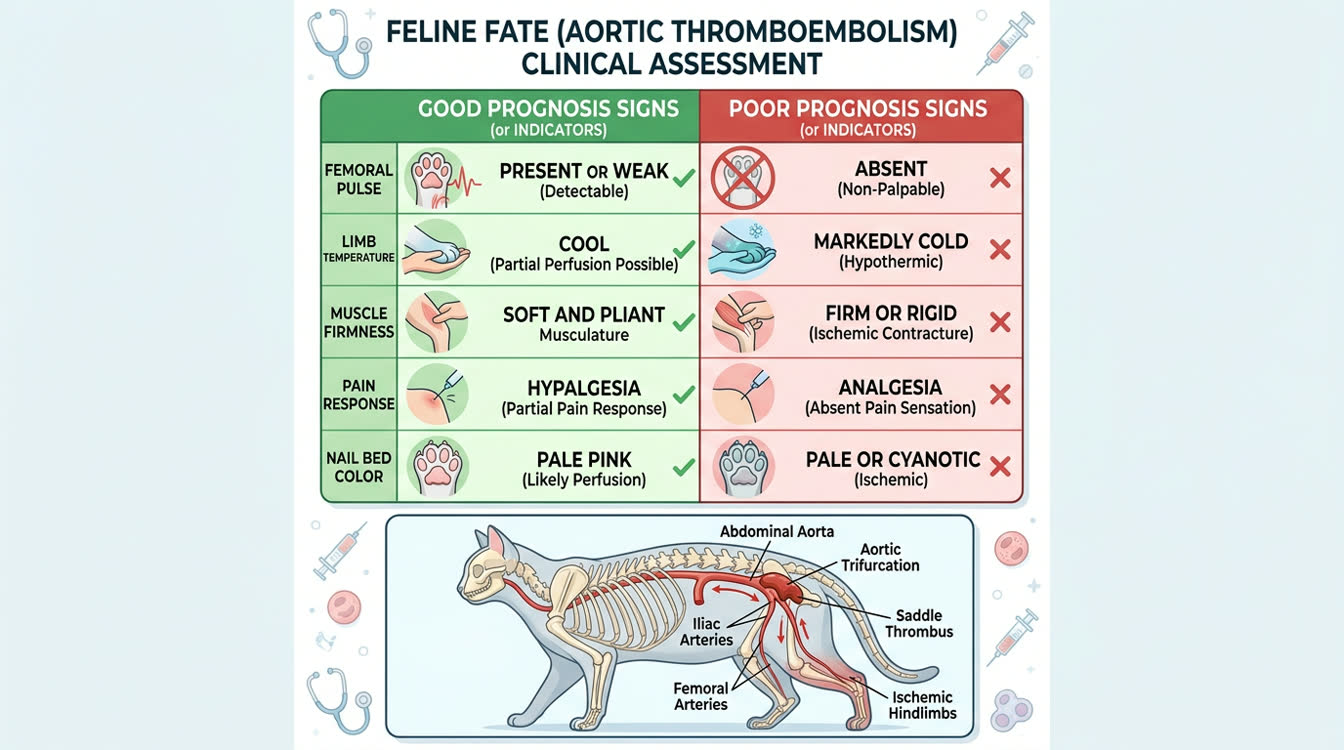
Feline aortic thromboembolism (FATE) occurs when a thrombus — typically originating from the left atrium in a cat with HCM — lodges at the aortic trifurcation (saddle thrombus, 90% of cases) or less commonly at a single iliac artery or forelimb axillary artery.
The Classic "5 Ps" of FATE: 1. Pain — acute onset, often vocalizing, extreme distress 2. Paralysis/Paresis — sudden inability to use one or both hind limbs 3. Pallor — pale or cyanotic nail beds and footpads of affected limbs 4. Pulselessness — absent femoral pulses bilaterally (saddle thrombus) or unilaterally 5. Poikilothermia (Cold) — affected limbs cold compared to unaffected limbs
Limb Viability Assessment:
| Sign | Good Prognosis | Poor Prognosis |
|---|---|---|
| Femoral pulse | Weak/present | Absent |
| Limb temperature | Cool, not icy | Ice cold |
| Muscle firmness | Soft, pliable | Rigid, contracted (Volkmann's ischemia) |
| Pain response | Deep pain present | Absent deep pain |
| Nail bed color | Pink or pale pink | White, purple, or cyanotic |
| Cutaneous trunci reflex | Present | Absent |
Presence of rigid muscle contracture is a strong negative prognostic indicator.
Location of Thrombus:
- Saddle thrombus (aortic trifurcation): 90% of cases — bilateral hind limb signs
- Unilateral iliac: 5% — unilateral hind limb signs
- Brachial/axillary: <5% — forelimb paresis
- Mesenteric or renal: rare, presents with acute abdomen or renal failure
Initial Diagnostics:
- Echocardiography: identifies underlying HCM, LA enlargement, or visible thrombus in LA
- Lactate: markedly elevated (>6 mmol/L indicates severe ischemia)
- BUN, creatinine, potassium: hyperkalemia can develop from ischemic muscle necrosis
- CBC/chemistry: thrombocytopenia if DIC; elevated CK indicates muscle necrosis
- Doppler blood pressure: confirms absent flow in affected limbs
Emergency Treatment: Analgesia, Anticoagulation and Supportive Care
FATE is one of the most painful conditions in veterinary medicine. Aggressive analgesia is a priority alongside cardiovascular stabilization.
Pain Management — Immediate Priority:
Buprenorphine (first choice):
- 0.02 mg/kg IV or IM q6–8h
- Excellent analgesia with minimal cardiovascular depression
- OTM route effective if cat cannot be handled
Butorphanol:
- 0.2–0.4 mg/kg IV/IM q4–6h
- Adequate analgesia for moderate pain; ceiling effect limits use in severe pain
Methadone:
- 0.1–0.2 mg/kg IV/IM q4–6h
- Full mu-agonist; preferred for severe pain; requires monitoring for respiratory depression
Avoid NSAIDs — contraindicated due to renal hypoperfusion from low cardiac output.
Anticoagulation — Heparin Protocol: Low molecular weight heparin (LMWH) or unfractionated heparin (UFH) can prevent thrombus extension and new clot formation, but will NOT dissolve existing clot.
Unfractionated Heparin:
- Loading: 200–300 IU/kg IV once
- Maintenance: 150–250 IU/kg SC q6–8h
- Monitor: activated partial thromboplastin time (aPTT) target 1.5–2.5x baseline
Low Molecular Weight Heparin (preferred — more predictable):
- Dalteparin: 100 IU/kg SC q12–24h
- Enoxaparin: 1–1.5 mg/kg SC q12h
- Anti-Xa monitoring optional; less practical in emergency setting
Thrombolytics (tissue plasminogen activator — tPA):
- Use is controversial; limited veterinary evidence; risk of reperfusion injury and fatal hyperkalemia
- Not recommended routinely
Cardiovascular Support:
- Treat concurrent CHF: furosemide 2–4 mg/kg IV for pulmonary edema
- Oxygen supplementation
- Avoid fluid overload — most cats have underlying CHF
Reperfusion Concerns:
- Severe hyperkalemia (K+ >7.5 mEq/L) — life-threatening arrhythmias
- Myoglobinuria — acute renal failure
- Acid-base collapse
Monitor potassium q4–6h during reperfusion phase and treat hyperkalemia aggressively (calcium gluconate, dextrose/insulin, sodium bicarbonate).
Prognosis Factors and Secondary Prevention with Clopidogrel
Prognosis: FATE carries a guarded short-term prognosis, but cats that survive to discharge can have meaningful quality of life and even return of limb function.
Short-term Mortality (0–7 days):
- 40–60% of cats presented with FATE are euthanized or die during initial hospitalization
- Major reasons: intractable pain, severe concurrent CHF, multiple organ failure, owner decision
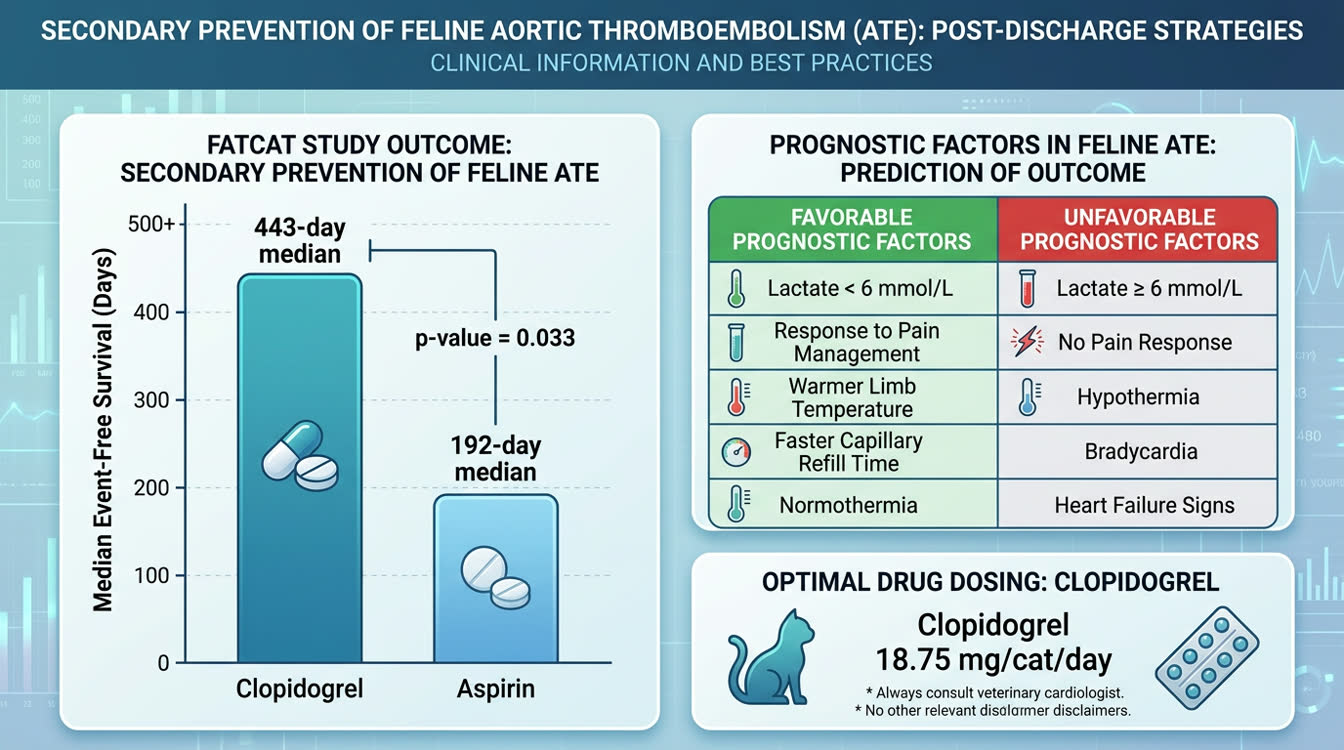
Favorable Prognostic Factors:
- Single limb affected (vs bilateral saddle thrombus)
- Deep pain response present in affected limb(s)
- Body temperature >36.5°C at admission
- No concurrent severe CHF or respiratory distress
- Plasma lactate <6 mmol/L at presentation
- Soft (not rigid) affected limb muscles
Long-term Survival (survivors):
- Median survival in cats discharged from hospital: 117–250 days (studies vary)
- Up to 30–40% of surviving cats regain meaningful limb function within 2–4 weeks
- Recurrence rate without prevention: approximately 25–50% at 1 year
Return of Limb Function:
- Motor and sensory function may return within 72 hours to 4 weeks if ischemia is reversible
- Physical rehabilitation (passive range of motion, hydrotherapy) can accelerate recovery
- Cats with limb contracture at presentation rarely regain function
Secondary Prevention — FATCAT Study Evidence: The FATCAT trial (Hogan et al., 2015) demonstrated that clopidogrel significantly reduces time to first recurrent ATE compared to aspirin.
Clopidogrel (first choice for ATE prevention):
- Dose: 18.75 mg/cat PO once daily (one-quarter of a 75 mg tablet)
- Mechanism: P2Y12 ADP receptor inhibitor — irreversible platelet inhibition
- Superior to aspirin in the FATCAT study (median time to event: 443 days vs 192 days)
Aspirin (alternative if clopidogrel not tolerated):
- 5 mg/cat PO q72h (every 3 days)
- Lower efficacy than clopidogrel per FATCAT; used as second-line
Rivaroxaban (emerging option):
- 1.25 mg/cat PO q24h
- Factor Xa inhibitor; small case series showing promise; monitoring with anti-Xa levels
- Not yet first-line per ACVIM consensus
Concurrent Cardiac Management: Treat underlying HCM at the appropriate stage. LA enlargement reduction (if feasible) reduces new thrombus formation.
Frequently Asked Questions
Can a cat recover limb function after FATE?
Yes, approximately 30–40% of cats that survive to discharge regain meaningful limb function within 2–4 weeks. Favorable signs include a present deep pain response, soft (not rigid) limb muscles, and limb temperature above ice-cold. Passive range of motion exercises and physical rehabilitation help recovery.
Should I try thrombolysis with tPA in a cat with FATE?
Routine tPA use is not recommended. While theoretically beneficial, tPA carries significant risks including fatal reperfusion-induced hyperkalemia, bleeding, and arrhythmias. The evidence base in feline FATE is very limited and outcomes are not clearly superior to supportive care alone.
What is the best drug to prevent recurrent FATE?
Clopidogrel 18.75 mg/cat PO once daily is the first-choice preventive based on the FATCAT study, which showed significantly longer event-free survival compared to aspirin. Begin after the acute episode has stabilized.
Is FATE always associated with HCM?
The majority of FATE cases (~85%) are associated with HCM or another cardiomyopathy. However, any condition causing left atrial enlargement (hyperthyroidism, hypertension, restrictive cardiomyopathy) can predispose to thrombus formation. A small percentage (~15%) occur without identifiable cardiac disease.
What causes the paralysis in FATE — the clot itself or the ischemia?
Primarily ischemia. The thrombus physically obstructs blood flow, but arterial vasospasm distal to the clot (from serotonin and other mediators released by platelets) dramatically worsens tissue ischemia beyond what the physical obstruction alone would cause. This is why vasospasm-targeting treatments have been explored, though evidence is limited.
References
- Hogan DF, et al. (2015). Secondary prevention of cardiogenic arterial thromboembolism in the cat: FATCAT study. J Vet Cardiol. 17(Suppl 1):S306–S317.
- Luis Fuentes V, et al. (2020). ACVIM consensus guidelines for cardiomyopathy management in cats. J Vet Intern Med. 34(3):1062–1077.
- Borgeat K, et al. (2014). Arterial thromboembolism in 250 cats in general practice: 2004–2012. J Vet Intern Med. 28(1):102–108.