Quick Answer
Buprenorphine is a partial mu-opioid agonist used for moderate pain management in dogs and cats. This guide covers species-specific dosing, the oral transmucosal (OTM) route in cats vs dogs, Simbadol extended-release protocol, ceiling effect at high doses, and clinical use in multimodal pain management.
Key Takeaways
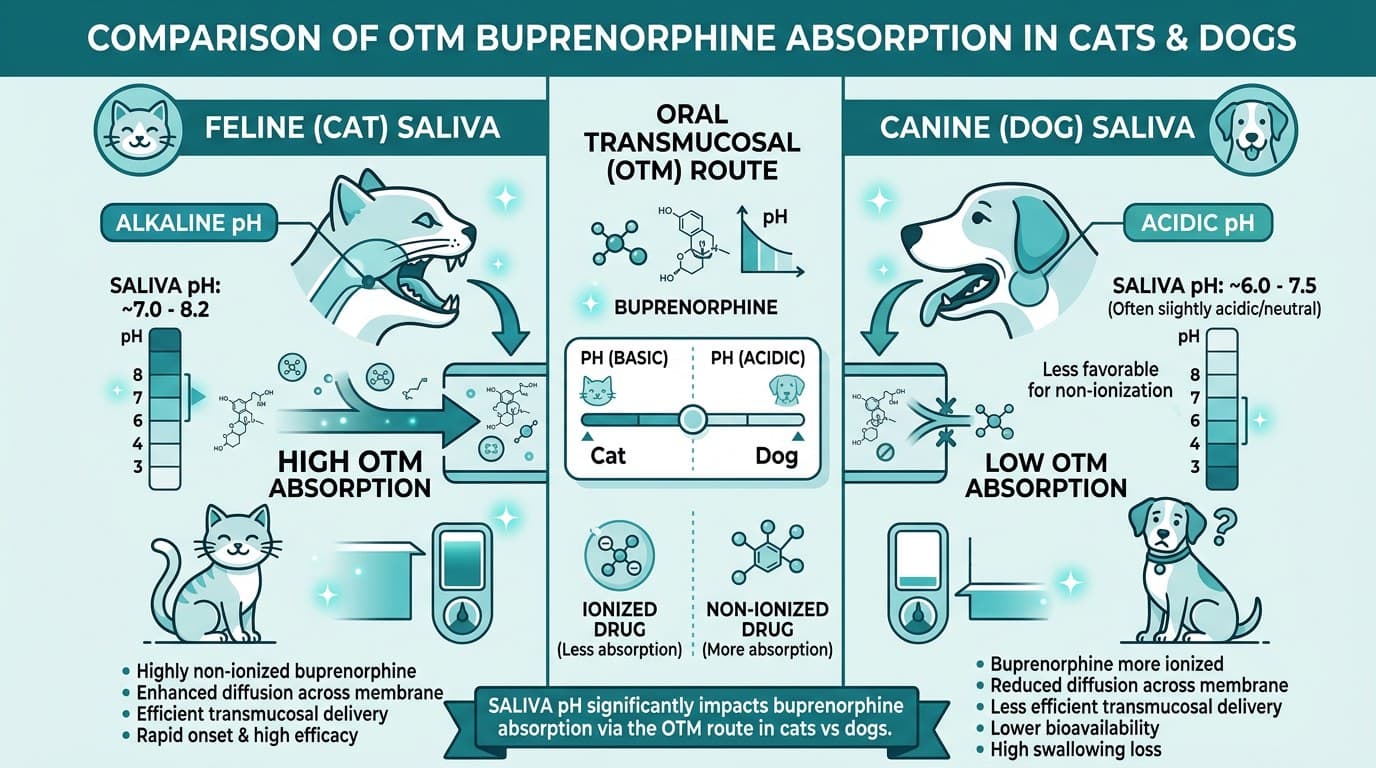
- ✓Dogs: 0.01–0.02 mg/kg IV or IM q6–8h — OTM is NOT effective in dogs due to acidic saliva.
- ✓Cats: 0.01–0.02 mg/kg OTM, IV, or IM q6–8h — OTM achieves ~100% bioavailability due to alkaline saliva.
- ✓Simbadol: 0.24 mg/kg SQ once daily in cats for 24-hour extended postoperative analgesia.
- ✓Partial mu-agonist ceiling effect limits buprenorphine for severe pain — combine with NSAIDs or full opioids.
- ✓DEA Schedule III classification allows more flexible dispensing than Schedule II opioids.
- ✓Naloxone partially reverses buprenorphine but high receptor affinity makes full reversal unreliable.
Pharmacology and Dosing: Partial Mu-Agonist with Ceiling Effect
Buprenorphine is a partial agonist at the mu-opioid receptor and a partial antagonist/agonist at the kappa and delta receptors. Unlike full mu-agonists (morphine, hydromorphone), buprenorphine exhibits a ceiling effect — increasing the dose beyond a certain threshold does not produce proportionally greater analgesia.
Mechanism of Action
- High receptor affinity (>1000x higher than morphine for mu receptor)
- Slow receptor association and dissociation — prolonged duration
- Partial agonism: submaximal analgesic efficacy compared to full mu-agonists
- Ceiling effect: plateau in analgesia and respiratory depression at higher doses
Standard Dosing — Dogs
| Route | Dose | Frequency | Notes |
|---|---|---|---|
| IV | 0.01–0.02 mg/kg | q6–8h | Dilute; give slowly over 1 min |
| IM | 0.01–0.02 mg/kg | q6–8h | Onset 15–30 min |
| OTM | NOT effective | — | Dogs have acidic saliva; poor bioavailability |
Standard Dosing — Cats
| Route | Dose | Frequency | Notes |
|---|---|---|---|
| IV | 0.01–0.02 mg/kg | q6–8h | Onset 5 min |
| IM | 0.01–0.02 mg/kg | q6–8h | Onset 15–30 min |
| OTM | 0.01–0.02 mg/kg | q6–8h | Nearly 100% bioavailability |
Why OTM Works in Cats but Not Dogs The oral transmucosal route leverages the pH of the oral environment. Buprenorphine is a weakly basic molecule that crosses mucous membranes in its uncharged form. Cat saliva has an alkaline pH (~8.0), which keeps buprenorphine uncharged and promotes rapid buccal absorption. Dog saliva is acidic (pH ~6.5), which ionizes the drug and prevents absorption. OTM buprenorphine in dogs achieves only 20–30% bioavailability — insufficient for reliable pain control.
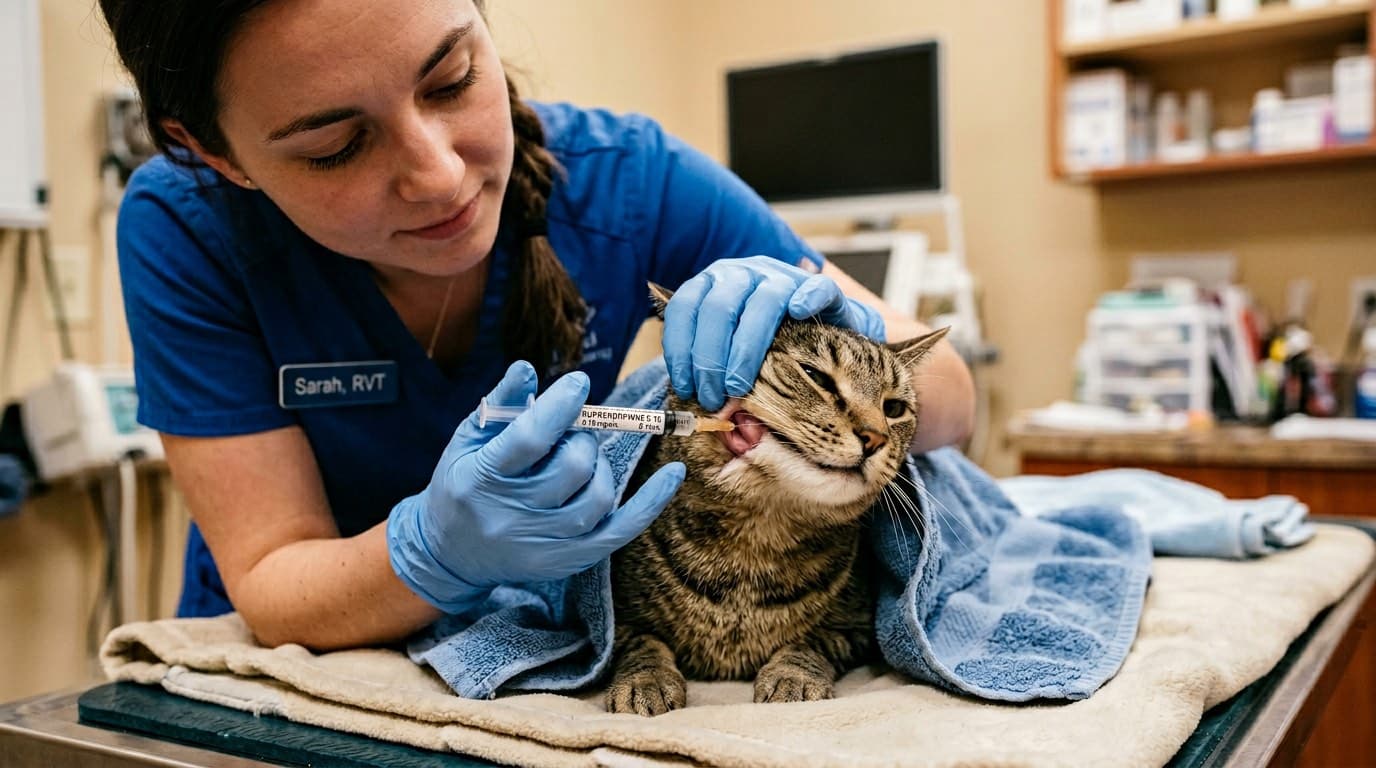
Administration Technique (Cat OTM) 1. Use the 0.3 mg/mL injectable formulation 2. Draw appropriate volume into a syringe (no needle) 3. Apply slowly to buccal mucosa (cheek pouch), alternating sides 4. Cat should not swallow the drug — hold muzzle gently for 1–2 minutes
Simbadol (Buprenorphine SR): 24-Hour Extended Release in Cats
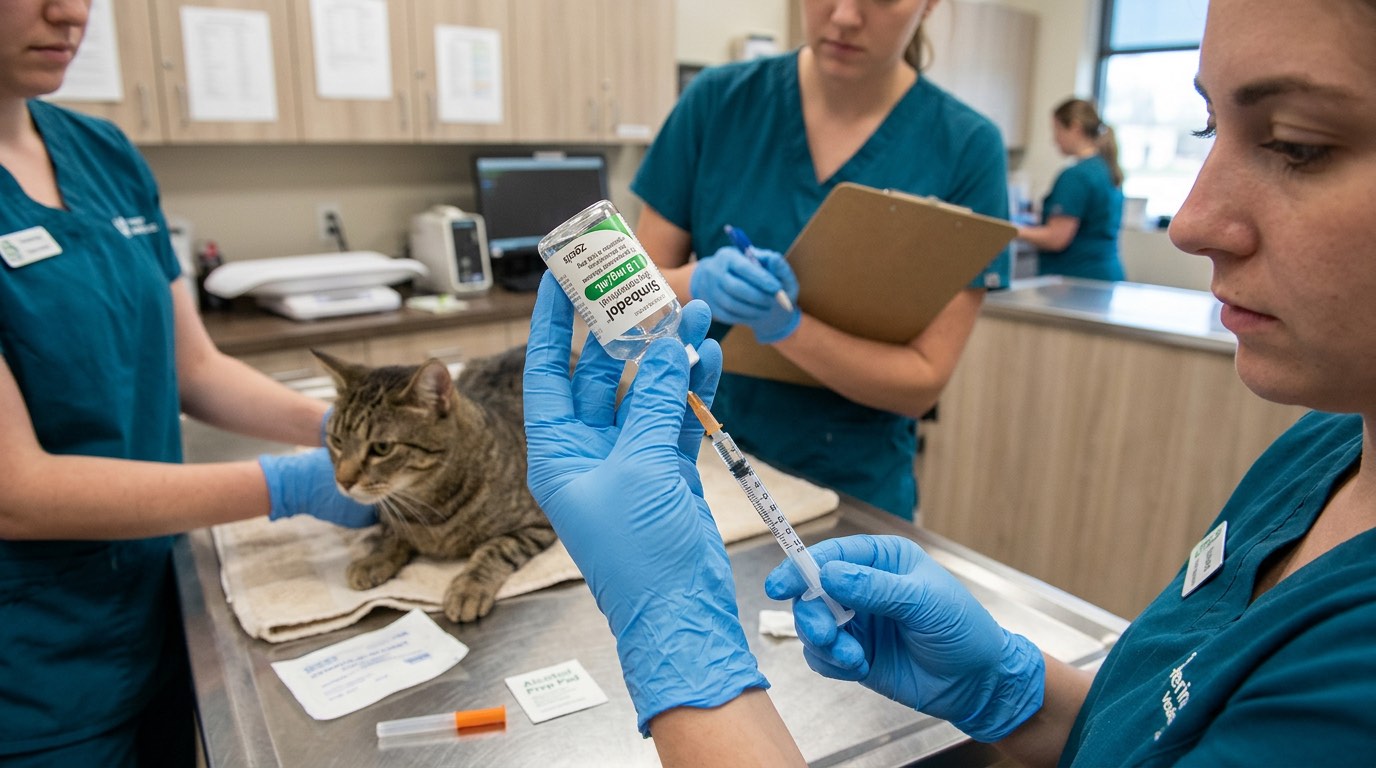
Simbadol (Buprenorphine Sustained Release) Simbadol is an FDA-approved extended-release buprenorphine formulation (1.8 mg/mL) specifically designed for subcutaneous administration in cats. It provides 24 hours of postoperative analgesia from a single injection.
Simbadol Dosing
| Species | Dose | Route | Duration | Frequency |
|---|---|---|---|---|
| Cat | 0.24 mg/kg (0.13 mL/kg) | SQ | 24 hours | Once daily x3 days max |
*Note: This is equivalent to 0.12 mg/kg of buprenorphine base in the 1.8 mg/mL concentration.*
Clinical Indications for Simbadol
- Post-operative pain management (spay, neuter, orthopedic procedures)
- Reduces need for frequent re-dosing in cats
- Particularly useful in cats that are difficult to medicate orally
Administration Notes
- Administer SQ only — not IM, not IV
- Use within 30 days of opening (store in refrigerator 2–8°C)
- Do not use in cats <5 months old or <2.5 kg
- Can cause sedation and decreased activity for first 24 hours (expected effect)
Ceiling Effect — Clinical Relevance
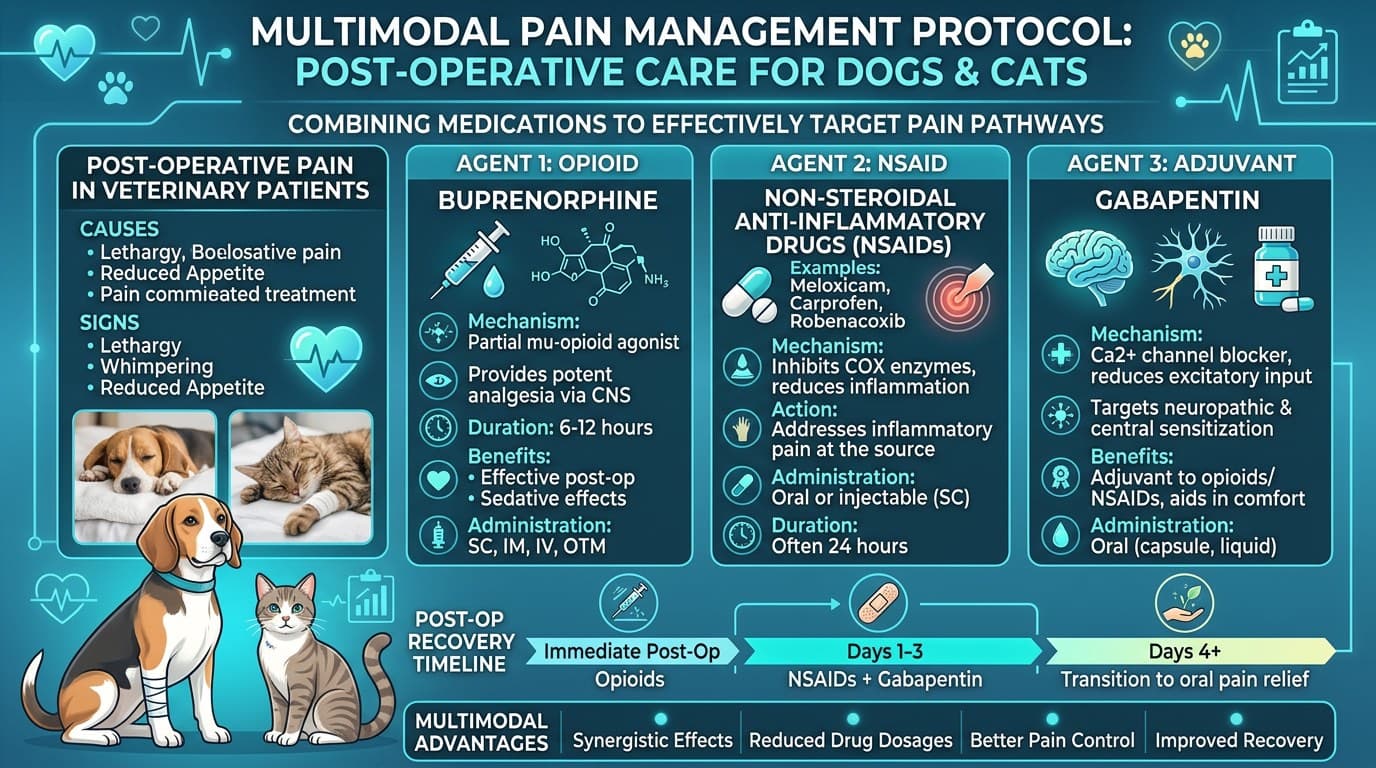
- Combine with NSAIDs (carprofen, meloxicam) for multimodal analgesia
- Consider full mu-agonists (morphine, hydromorphone, fentanyl) for severe acute pain
- Gabapentin 5–10 mg/kg PO BID can be added for neuropathic/chronic pain component
Buprenorphine + Acepromazine Protocol
- Dogs: buprenorphine 0.01–0.02 mg/kg IM + acepromazine 0.025–0.05 mg/kg IM (same syringe)
- Cats: buprenorphine 0.01–0.02 mg/kg IM + acepromazine 0.025–0.05 mg/kg IM
- Allow 15–30 minutes before induction for full effect
Clinical Applications: Multimodal Pain, DEA Scheduling, and Monitoring
DEA Scheduling and Controlled Substance Regulations
- Less stringent record-keeping requirements than Schedule II
- Can be refilled up to 5 times (for outpatient prescriptions)
- Can be prescribed over the phone by a veterinarian
- Lower liability for diversion penalties
Despite Schedule III status, veterinary practices must maintain controlled substance logs, perform regular inventory counts, and store buprenorphine in a locked DEA-compliant cabinet.
Multimodal Pain Management Protocols
*Post-operative (Routine Soft Tissue, e.g., Spay/Neuter)*
| Drug | Dose | Route | Timing |
|---|---|---|---|
| Buprenorphine | 0.01–0.02 mg/kg | IM/OTM | Pre-op, repeat q6–8h x24h |
| Meloxicam (dogs) | 0.2 mg/kg loading | PO | Day 1 post-op |
| Meloxicam (dogs) | 0.1 mg/kg | PO SID | Days 2–5 |
*Post-operative (Orthopedic)*
| Drug | Dose | Route | Timing |
|---|---|---|---|
| Buprenorphine or Simbadol | 0.01–0.02 mg/kg or 0.24 mg/kg SQ | IM/SQ | Perioperative |
| NSAID | Per protocol | PO | Post-op day 1 onward |
| Gabapentin | 5–10 mg/kg | PO BID | Begin 24h post-op |
Adverse Effects
- Sedation (expected and therapeutic at appropriate doses)
- Bradycardia (monitor heart rate, especially when combined with alpha-2 agonists)
- Respiratory depression (rare at recommended doses; watch in geriatric or compromised patients)
- Euphoria/dysphoria in cats — some cats become vocally distressed; reduce dose
- Constipation with repeated dosing
Naloxone for Reversal
- Naloxone: 0.02–0.04 mg/kg IV; may need to repeat every 30–60 min
- Full reversal is unreliable; supportive care may still be needed
Frequently Asked Questions
Can I send buprenorphine home with my cat for pain management?
Yes. The OTM formulation can be dispensed for home use in cats. Provide the 0.3 mg/mL injectable solution in appropriately filled syringes (without needles) and instruct owners to apply to the cheek pouch. Owner compliance is generally excellent. Alternatively, Simbadol can be administered as a once-daily injection in the clinic for up to 3 days post-operatively.
Why can't I give buprenorphine OTM to my dog?
Dog saliva is acidic (pH ~6.5), which ionizes buprenorphine and prevents buccal absorption. Only 20–30% bioavailability is achieved via OTM in dogs — not enough for reliable analgesia. Dogs require IV or IM administration for effective buprenorphine therapy.
What is the ceiling effect and when does it matter clinically?
The ceiling effect means that increasing buprenorphine beyond the therapeutic dose does not increase analgesia proportionally. This limits its use for severe pain (major orthopedic surgery, trauma). For these cases, full mu-agonists (morphine, fentanyl) or multimodal protocols (buprenorphine + NSAID + gabapentin) are needed.
How does buprenorphine compare to tramadol for cats?
Buprenorphine is significantly more effective than tramadol for cats. Cats lack the CYP2D6 enzyme needed to convert tramadol to its active metabolite (M1), making tramadol unreliable as an analgesic in cats. Buprenorphine OTM is the preferred opioid for moderate pain management in cats.
Is Simbadol the same as regular buprenorphine?
Simbadol (1.8 mg/mL) is a higher-concentration sustained-release formulation of buprenorphine approved specifically for subcutaneous use in cats. The dose (0.24 mg/kg SQ) is different from standard buprenorphine (0.01–0.02 mg/kg). Do not confuse the formulations — administering the standard dose by Simbadol volume would result in underdosing.
References
- Robertson SA, Lascelles BD, Taylor PM, Sear JW. "PK-PD modeling of buprenorphine in cats: intravenous and oral transmucosal administration." J Vet Pharmacol Ther. 2005;28(5):453-460.
- Steagall PV, et al. "Characterization of the antinociceptive effects of buprenorphine in cats." J Vet Pharmacol Ther. 2013;36(5):505-509.
- Plumb DC. "Buprenorphine." In: Plumb's Veterinary Drug Handbook. 10th ed. Wiley-Blackwell; 2023.