Quick Answer
Prednisone is the most widely used corticosteroid in veterinary medicine. This guide covers indication-specific dosing (anti-inflammatory vs. immunosuppressive), tapering protocols, mineralocorticoid effects, and monitoring requirements.
Key Takeaways
- ✓Use prednisolone not prednisone in cats (poor hepatic conversion); either works in dogs
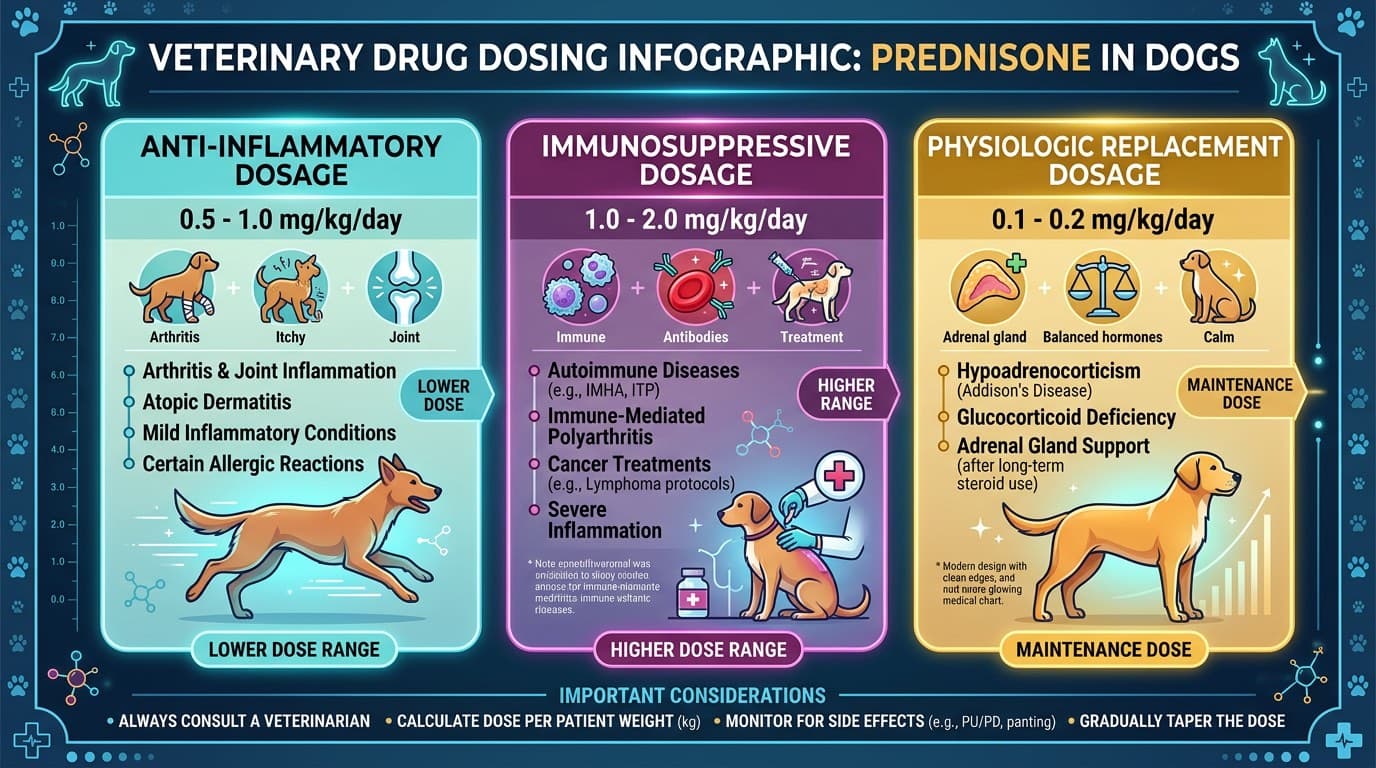
- ✓Anti-inflammatory dose: 0.51 mg/kg/day; Immunosuppressive dose: 12 mg/kg/day; Physiologic replacement: 0.10.2 mg/kg/day
- ✓Taper by 2550% every 24 weeks; final step = every-other-day 24 weeks before discontinuation
- ✓Never abruptly stop after >2 weeks risk of adrenal insufficiency and disease relapse
- ✓Monitor: PU/PD, weight, liver enzymes (ALP), blood glucose, UA with culture every 48 weeks (UTI risk at immunosuppressive doses)
- ✓Avoid concurrent NSAIDs severe GI ulceration risk. Use misoprostol or omeprazole if unavoidable.
Prednisone Pharmacology and Prednisolone: Which to Use?
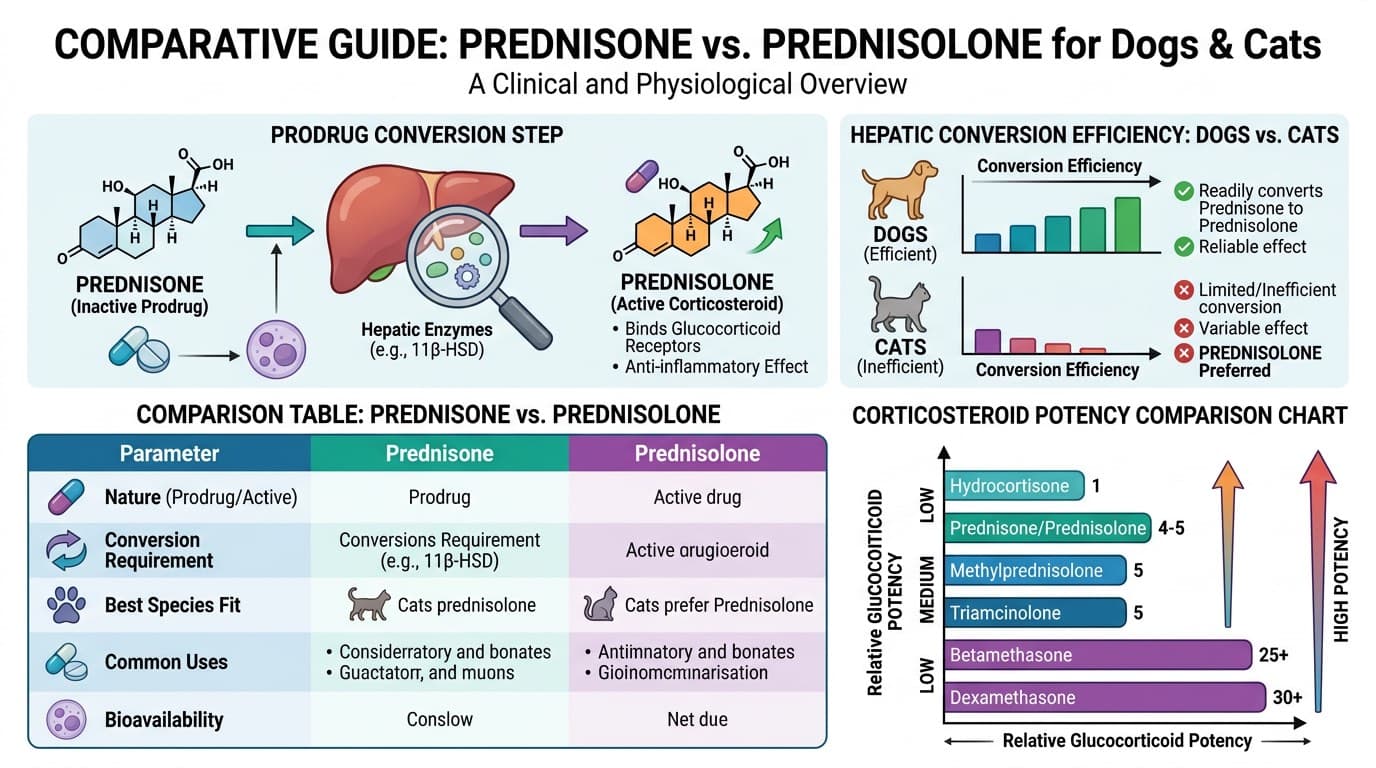
Prednisone is a synthetic glucocorticoid prodrug that must be converted in the liver to its active form, prednisolone, by hepatic 11-beta-hydroxysteroid dehydrogenase.
Prednisone vs. Prednisolone
| Property | Prednisone | Prednisolone |
|---|---|---|
| Active form | Prodrug (requires hepatic conversion) | Active drug |
| Use in dogs | Acceptable (efficient hepatic conversion) | Acceptable |
| Use in cats | Avoid poor hepatic conversion | Preferred in cats |
| Bioavailability (dogs) | ~90% (similar to prednisolone) | ~100% |
| Tablets available | 1 mg, 5 mg, 10 mg, 20 mg, 50 mg | 1 mg, 5 mg, 20 mg |
For dogs: Either prednisone or prednisolone can be used hepatic conversion is efficient in dogs. Some clinicians prefer prednisolone to avoid the conversion step in dogs with hepatic disease.
For cats: Always use prednisolone cats have impaired 11-beta-hydroxysteroid dehydrogenase activity, leading to poor and variable prednisone conversion.
Mechanism of Action Corticosteroids exert their effects via: 1. Glucocorticoid receptors (GR) in virtually all nucleated cells altered gene transcription 2. Inhibition of phospholipase A2 reduced arachidonic acid reduced prostaglandins, leukotrienes, and thromboxanes 3. Reduced inflammatory cytokine production (IL-1, IL-6, TNF-alpha) 4. Decreased capillary permeability reduced edema and exudation 5. Lymphopenia, eosinopenia, neutrophilia (stress leukogram at chronic doses)
Relative Potency Comparison
| Drug | Anti-inflammatory Potency | Mineralocorticoid Potency | Duration |
|---|---|---|---|
| Cortisol (hydrocortisone) | 1 | 1 | 812 hrs |
| Prednisone/Prednisolone | 4 | 0.8 | 1236 hrs |
| Methylprednisolone | 5 | 0.5 | 1236 hrs |
| Dexamethasone | 2530 | Negligible | 3654 hrs |
| Triamcinolone | 5 | Negligible | 1236 hrs |
Prednisone Dosing in Dogs by Indication
The three clinical dose levels:
| Dose Level | Dose (prednisone) | Indications |
|---|---|---|
| Anti-inflammatory | 0.51 mg/kg/day | Allergies, IBD, mild immune conditions, topical step-up, MUE adjunct |
| Immunosuppressive | 12 mg/kg/day (max 80 mg/day) | IMHA, ITP, IMPA, pemphigus, MG, SLE |
| Physiologic replacement | 0.10.2 mg/kg/day | Hypoadrenocorticism (Addison's disease) |
| Pulse/crisis dose | 1030 mg/kg IV (methylprednisolone sodium succinate) | Spinal cord trauma, anaphylaxis (controversial) |
Complete Dosing Reference
*Allergic disease (atopic dermatitis, allergic bronchitis):* Anti-inflammatory: 0.51 mg/kg/day PO 714 days, then taper to lowest effective every-other-day dose.
*Immune-mediated hemolytic anemia (IMHA):* Immunosuppressive induction: 2 mg/kg/day PO (or divided BID in severe cases for more consistent blood levels). Continue until PCV stabilizes >30%, then begin slow taper.
*Immune-mediated thrombocytopenia (ITP):* 2 mg/kg/day PO. Add vincristine 0.02 mg/kg IV once for rapidly failing platelet counts. Taper once platelets >100,000/L 2 consecutive counts.
*Inflammatory bowel disease (IBD):* 12 mg/kg/day PO (start high end if severe hypoalbuminemia). Taper by 25% every 24 weeks based on clinical response and albumin normalization.
*Meningitis/encephalitis (SRMA, GME):* 2 mg/kg/day (SRMA); up to 4 mg/kg/day for aggressive GME. Long-term maintenance with azathioprine or mycophenolate mofetil to allow steroid taper.
Tapering Protocols and Monitoring
Why Tapering Matters Abrupt discontinuation after more than 2 weeks of corticosteroid therapy can cause: 1. Adrenal insufficiency (secondary hypoadrenocorticism) HPA axis suppression with prolonged use 2. Disease relapse especially IMHA, which can rebound catastrophically 3. Steroid withdrawal syndrome vague malaise, anorexia, weakness
General Tapering Principles
- Taper by 2550% every 24 weeks (the faster the original dose, the slower the taper)
- The last step before discontinuation: switch to every-other-day (EOD) dosing for 24 weeks, then stop
- Every-other-day dosing allows HPA axis to begin recovering during the "off" day
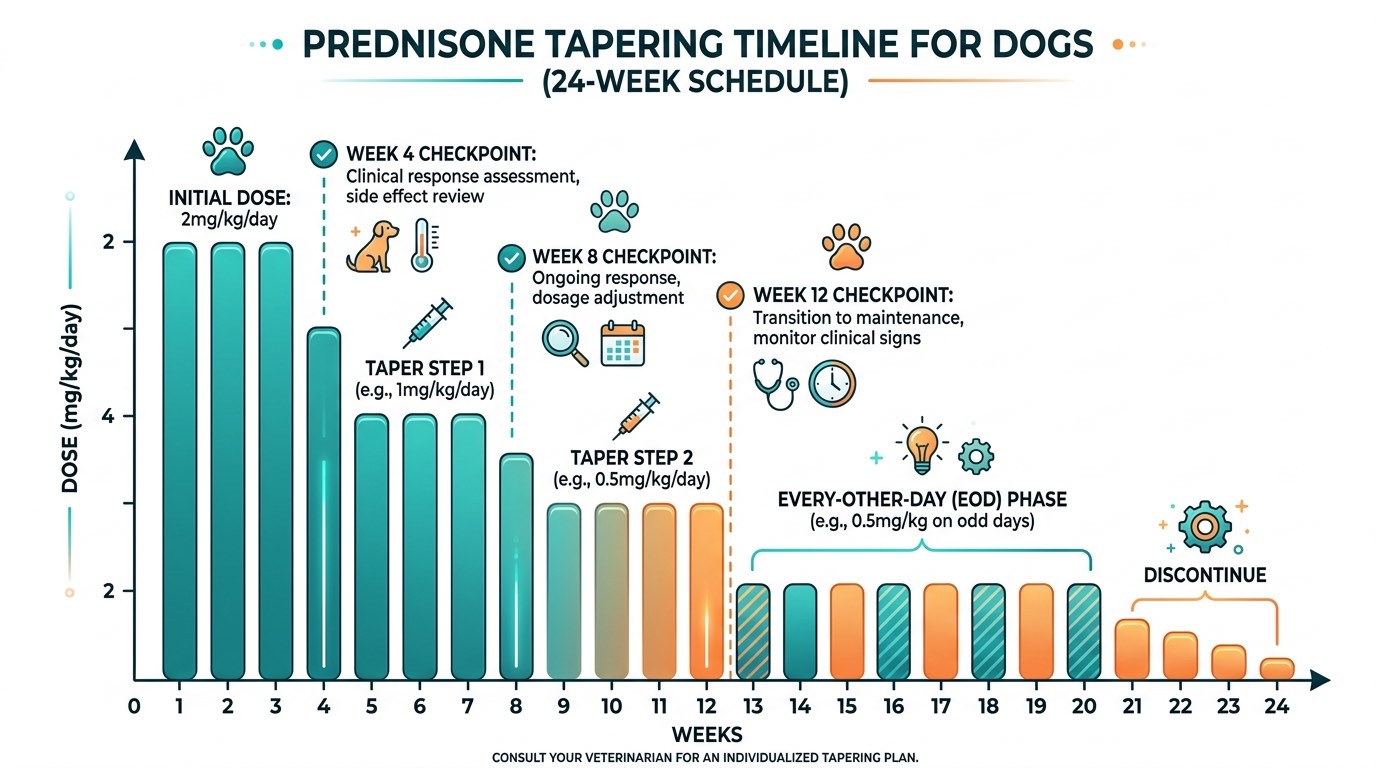
Tapering Protocol IMHA (typical 6-month course)
| Weeks | Dose |
|---|---|
| 04 | 2 mg/kg/day |
| 48 | 1.5 mg/kg/day |
| 812 | 1 mg/kg/day |
| 1216 | 0.5 mg/kg/day |
| 1620 | 0.5 mg/kg EOD |
| 2024 | 0.25 mg/kg EOD |
| Week 24 | Discontinue |
Monitoring During Corticosteroid Therapy
- Baseline: CBC, chemistry, urinalysis (UA), blood pressure (BP)
- Week 24: UA (check for glucosuria, UTI), body weight
- Monthly: Weight, muscle condition score, polydipsia/polyuria assessment
- Every 3 months: CBC, chemistry (blood glucose, liver enzymes), UA, BP
- Long-term: ACTH stimulation test when tapering if HPA recovery suspected insufficient
Side Effects to Monitor
- Polyuria/polydipsia (PU/PD) most common
- Polyphagia and weight gain
- Iatrogenic Cushing's syndrome (ALP elevation, pot belly, thin skin, calcinosis cutis) with prolonged high-dose use
- Glucosuria (transient steroid hyperglycemia) check UA
- GI ulceration (with concurrent NSAIDs avoid combination; use misoprostol or omeprazole if unavoidable)
- UTI (immunosuppression; check UA with culture at each visit for immunosuppressive doses)
Frequently Asked Questions
What is the standard prednisone dose for dogs?
The dose depends on the goal: anti-inflammatory use (allergies, mild IBD) = 0.51 mg/kg/day; immunosuppressive use (IMHA, ITP, pemphigus) = 12 mg/kg/day; physiologic replacement (Addison's disease) = 0.10.2 mg/kg/day. The maximum daily dose is typically 80 mg to avoid excess mineralocorticoid and side effects.
Can you give dogs prednisone or should it be prednisolone?
Either is acceptable in dogs dogs efficiently convert prednisone to its active form prednisolone in the liver. However, prednisolone is strongly preferred for cats (dogs convert efficiently; cats do not). In dogs with severe hepatic disease, using prednisolone directly is safer to avoid relying on hepatic conversion.
How do I taper prednisone in a dog?
Reduce by approximately 2550% every 24 weeks based on clinical response. The final step before stopping should be every-other-day dosing for 24 weeks to allow HPA axis recovery. Never abruptly stop after >2 weeks of therapy adrenal insufficiency and disease relapse are real risks.
What are the signs of prednisone side effects in dogs?
Common: excessive drinking and urination (PU/PD), increased appetite, weight gain. With chronic use: pot belly appearance, thin/fragile skin, muscle wasting, hair thinning, recurrent infections (especially UTI). If these signs appear, discuss dose reduction with your veterinarian.
Can prednisone cause a UTI in dogs?
Yes immunosuppressive doses of prednisone significantly increase susceptibility to urinary tract infections. The dilute urine from PU/PD also reduces antimicrobial properties. Urine culture (not just sediment) should be performed every 48 weeks in dogs on long-term immunosuppressive steroids.
References
- Scott-Moncrieff JC. Hypoadrenocorticism. In: Feldman EC, Nelson RW, eds. Canine and Feline Endocrinology. 4th ed. 2015.
- Giger U. Immune-mediated hemolytic anemia. In: Bonagura JD, Twedt DC, eds. Kirk's Current Veterinary Therapy XIV. 2009.
- Plumb DC. Prednisone / Prednisolone. In: Plumb's Veterinary Drug Handbook. 10th ed. Wiley-Blackwell; 2023.