Quick Answer
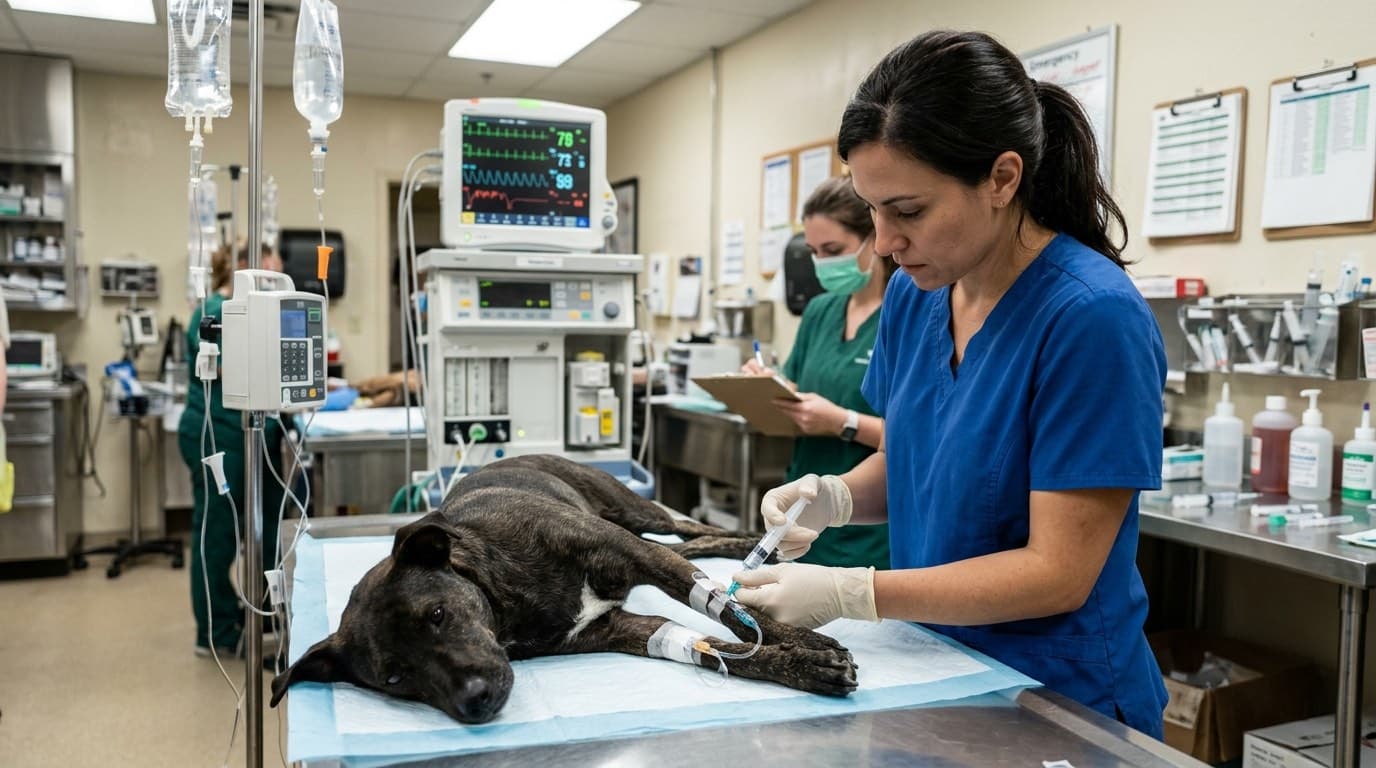
Dexamethasone is a potent, long-acting fluorinated glucocorticoid used in veterinary emergency medicine and diagnostic testing. This guide covers dosing for shock, spinal cord injury, cerebral edema, the LDDS test, and critical differences from prednisone.
Key Takeaways
- ✓Dexamethasone is 25-30x more potent than prednisone; negligible mineralocorticoid activity; lasts 36-54 hours
- ✓Does NOT cross-react with cortisol assays safe to use before/during ACTH stimulation testing (prednisone is NOT safe)
- ✓Emergency doses: anaphylaxis 1-2 mg/kg IV; cerebral edema 0.25-1 mg/kg IV; Addisonian crisis 0.5-1 mg/kg IV
- ✓LDDS test: 0.01 mg/kg IV; post-dex cortisol >1.0 g/dL at 8h = Cushing's; sensitivity ~90-95%
- ✓NOT for chronic use HPA suppression lasts 36-72 hours; use prednisone for recurring dosing needs
- ✓Wait minimum 72 hours after dexamethasone before performing cortisol-based diagnostic tests
Dexamethasone Pharmacology: What Makes It Different
Dexamethasone is a synthetic fluorinated glucocorticoid. The fluorine atom at the C9 position dramatically increases anti-inflammatory potency while virtually eliminating mineralocorticoid activity.
Key Properties vs. Prednisone
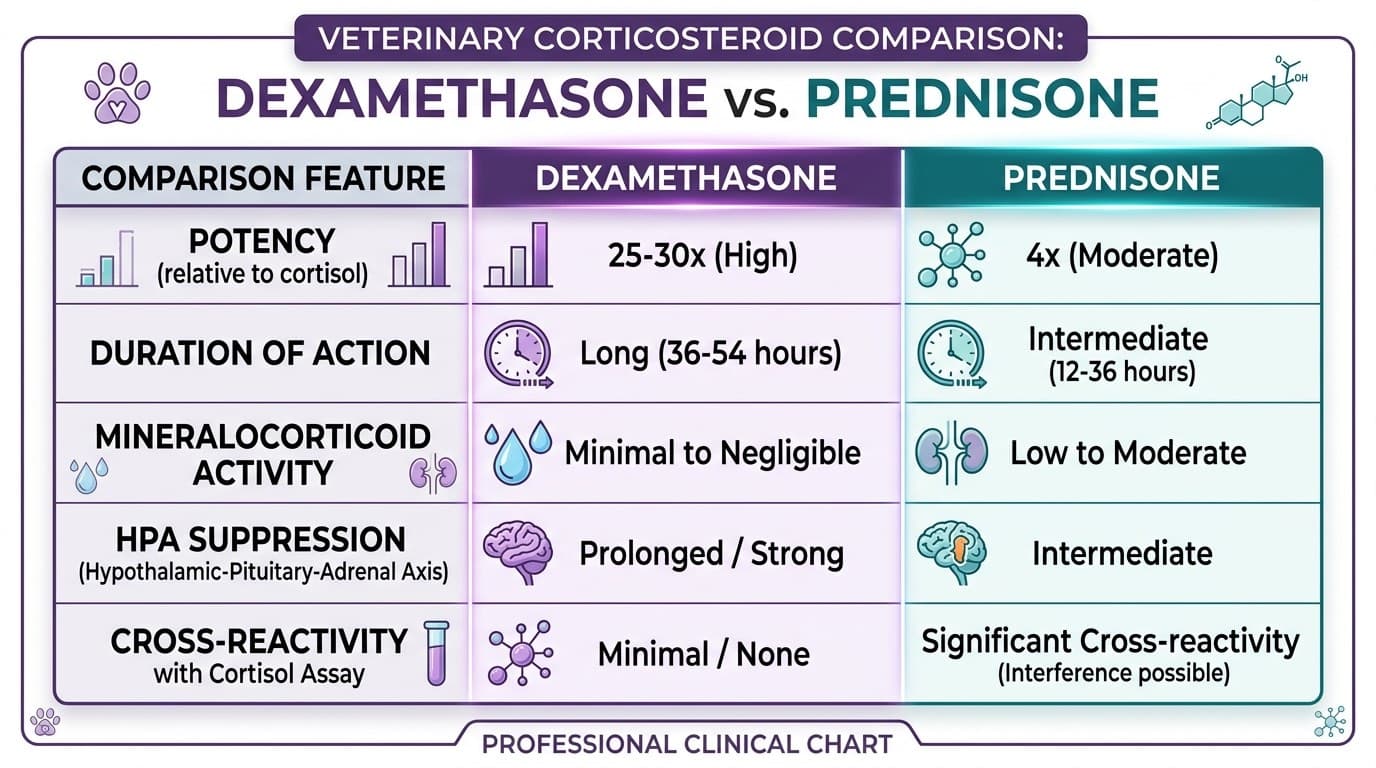
| Property | Dexamethasone | Prednisone/Prednisolone |
|---|---|---|
| Relative anti-inflammatory potency | 2530 | 4 (vs. cortisol) |
| Mineralocorticoid activity | Negligible | 0.8 |
| Duration of action | 3654 hours | 1236 hours |
| HPA suppression | Very prolonged (3672 hrs) | 1236 hours |
| Crosses blood-brain barrier | Yes (excellent) | Moderate |
| Useful for ACTH stim testing | Yes (does not interfere with cortisol assay) | No (prednisone/prednisolone cross-react) |
| Available as IV formulation | Yes | Prednisolone sodium succinate (IV) |
Critical point on testing: Dexamethasone does NOT cross-react with standard cortisol assays (RIA, chemiluminescent). Therefore, dexamethasone can be administered before or during an ACTH stimulation test without affecting cortisol results. Prednisone and prednisolone DO cross-react and will falsely elevate cortisol readings.
Available Formulations
- Dexamethasone sodium phosphate injection: 4 mg/mL (most common IV/IM form)
- Dexamethasone SP: 2 mg/mL
- Oral tablets: 0.25 mg, 0.5 mg, 1 mg, 4 mg
- Topical preparations (ophthalmic, otic)
Emergency and Clinical Dosing Guide
Emergency Dosing by Indication
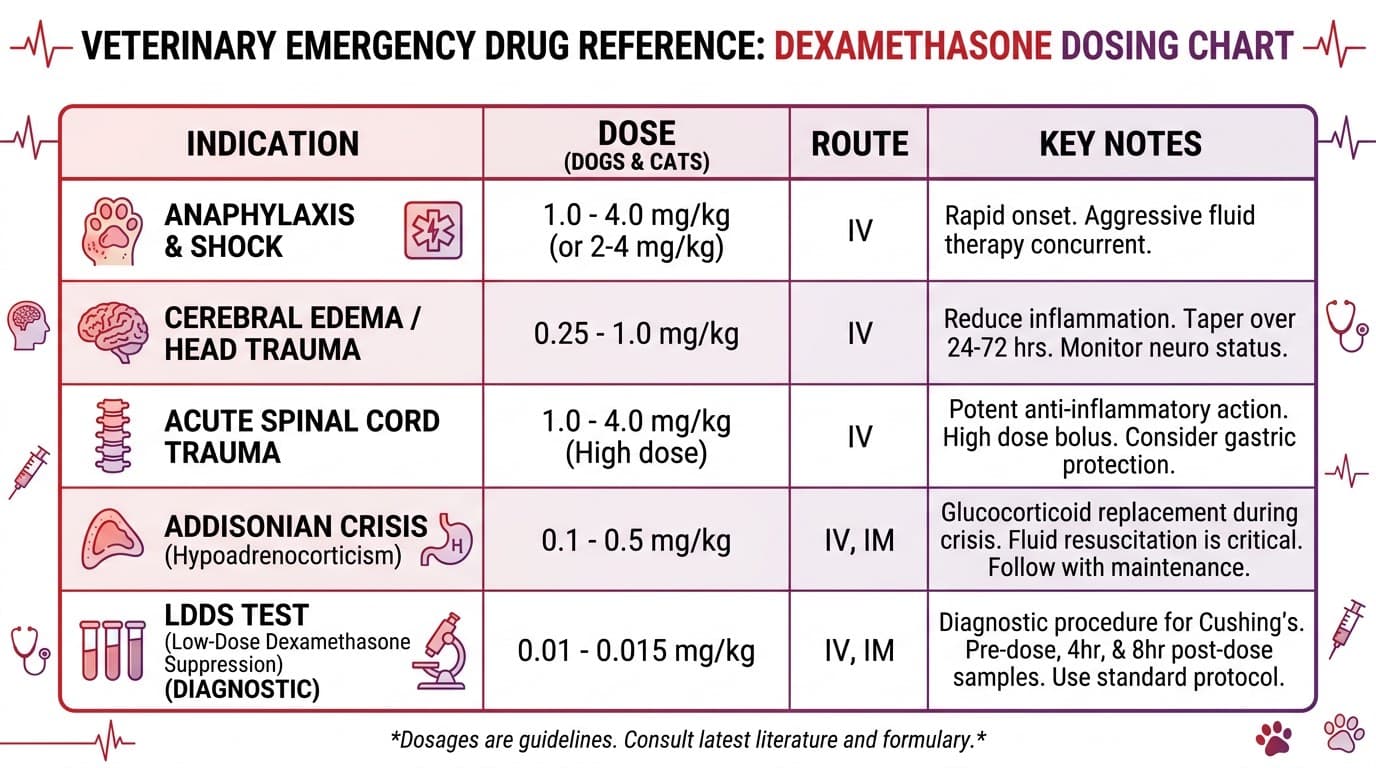
| Indication | Dose | Route | Frequency | Notes |
|---|---|---|---|---|
| Anaphylaxis/shock | 12 mg/kg | IV | Once | Adjunct to epinephrine + fluids |
| Cerebral edema | 0.251 mg/kg | IV, then PO | q1224h | Taper over daysweeks |
| Acute spinal cord injury | 0.10.25 mg/kg | IV | q68h 24h | Controversial; limited evidence |
| Airway inflammation/laryngeal edema | 0.250.5 mg/kg | IV/IM | Once or BID | Rapid onset |
| Anti-inflammatory (acute) | 0.070.15 mg/kg | IV/IM/SQ | q1224h | Short-term only |
| LDDS test (diagnostic) | 0.01 mg/kg | IV | Once | See LDDS protocol below |
| High-dose LDDS | 0.1 mg/kg | IV | Once | PDH vs ADH discrimination |
| Addisonian crisis (glucocorticoid) | 0.51 mg/kg | IV | Once | Does not interfere with ACTH stim |
Dexamethasone in Addisonian Crisis This is a key practical point: when treating an Addisonian crisis, if the ACTH stimulation test has NOT yet been performed, administer dexamethasone (not prednisone/hydrocortisone) for glucocorticoid support. Dexamethasone does not interfere with the cortisol assay, so you can safely give it and still perform the ACTH stim test immediately after.
Protocol: 1. Place IV catheter, draw blood for ACTH stim baseline cortisol 2. Start IV 0.9% NaCl fluids aggressively 3. Administer dexamethasone 0.51 mg/kg IV once 4. Administer cosyntropin (Cortrosyn) 5 g/kg IV 5. Draw 60-minute post-ACTH cortisol 6. Transition to prednisone/DOCP for chronic management
The LDDS (Low-Dose Dexamethasone Suppression) Test
- Dose: 0.01 mg/kg dexamethasone IV
- Sample times: Baseline cortisol (T=0), then cortisol at T=4h and T=8h
- Interpretation: Post-dexamethasone cortisol >1.0 g/dL at 8 hours = failure to suppress = hyperadrenocorticism
- Sensitivity: ~9095% for PDH; slightly lower for ADH
- If T=4h cortisol suppressed but T=8h escapes = consistent with PDH (pituitary-dependent)
Cautions, Contraindications and Side Effects
When NOT to Use Dexamethasone
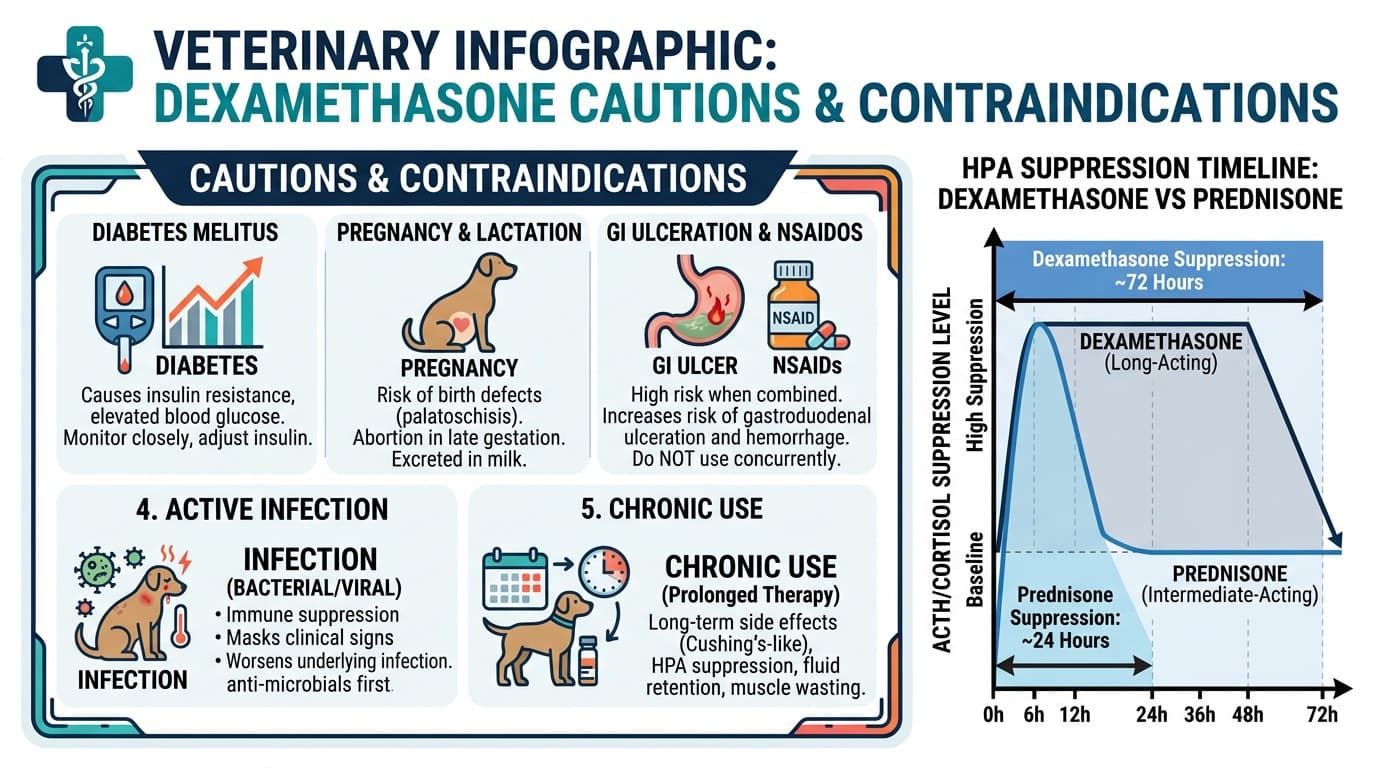
- Diabetes mellitus: Dexamethasone is a potent insulin antagonist. Even a single dose can cause severe hyperglycemia in diabetics. If a corticosteroid is essential in a diabetic, use the shortest-acting, lowest-potency option with intensive glucose monitoring.
- Pregnant animals: All glucocorticoids are teratogenic; dexamethasone crosses the placenta readily. May induce premature labor. Avoid during pregnancy.
- GI ulceration risk: Avoid with NSAIDs (severe GI ulceration). Higher potency = greater GI risk than prednisone at equipotent doses.
- Infections: Immunosuppressive doses contraindicated in active infections (sepsis, fungal disease, demodicosis with secondary pyoderma)
- Do not use for chronic immunosuppression: Due to prolonged and deep HPA suppression (3672 hours per dose), dexamethasone is NOT appropriate for chronic disease management. Use prednisone/prednisolone for chronic conditions requiring repeated dosing.
Prolonged HPA Suppression Warning
- Schedule LDDS or ACTH stim tests before any planned dexamethasone administration
- If dexamethasone has already been given, wait minimum 72 hours before performing cortisol-based tests
Cats and Dexamethasone
- Feline asthma exacerbation: 1 mg/cat IM or dexamethasone inhaler
- Emergency anti-inflammatory: 0.250.5 mg/kg IV/IM
- Anti-emetic adjunct for chemotherapy patients
Frequently Asked Questions
What is dexamethasone used for in dogs and cats?
Dexamethasone is primarily used for acute emergencies: anaphylaxis/shock (1-2 mg/kg IV), cerebral edema (0.25-1 mg/kg IV), airway inflammation, and acute spinal cord injury. It is also the drug used in the LDDS diagnostic test for Cushing's syndrome (0.01 mg/kg IV). It is NOT appropriate for chronic disease management due to prolonged HPA suppression.
How is dexamethasone different from prednisone?
Dexamethasone is 25-30x more potent than prednisone, has negligible mineralocorticoid activity, lasts 36-54 hours per dose (vs 12-36 for prednisone), and does not cross-react with cortisol assays. This last property makes it the preferred steroid when an ACTH stimulation test is planned prednisone would falsely elevate cortisol results.
Can dexamethasone be given before an ACTH stimulation test?
Yes this is a key clinical point. Dexamethasone does not interfere with cortisol immunoassays, so it can be administered even when an ACTH stimulation test is planned (e.g., during an Addisonian crisis). Prednisone and prednisolone cross-react with cortisol assays and must not be given before cortisol testing.
What is the dexamethasone dose for dogs in an emergency?
For anaphylaxis/shock: 1-2 mg/kg IV once (adjunct to epinephrine and fluids). For cerebral edema: 0.25-1 mg/kg IV then taper. For acute airway inflammation/laryngeal edema: 0.25-0.5 mg/kg IV/IM. For Addisonian crisis glucocorticoid support: 0.5-1 mg/kg IV once.
Can dexamethasone be used long-term in dogs?
No dexamethasone is NOT appropriate for chronic management. Its prolonged HPA suppression (36-72 hours per dose) with repeated use causes severe adrenal atrophy and iatrogenic Cushing's faster than prednisone. For chronic conditions requiring steroids, use prednisone or prednisolone, which have shorter HPA suppression duration and more predictable tapering.
References
- Feldman EC, Nelson RW. Canine Hyperadrenocorticism. In: Canine and Feline Endocrinology. 4th ed. Elsevier; 2015.
- Plumb DC. Dexamethasone. In: Plumb's Veterinary Drug Handbook. 10th ed. Wiley-Blackwell; 2023.
- Haskins SC. Glucocorticoids in emergency medicine. Vet Clin North Am Small Anim Pract. 2013.