Quick Answer
Obesity affects approximately 55% of dogs and 60% of cats in the United States and is associated with diabetes, osteoarthritis, respiratory compromise, and reduced lifespan. This guide covers body condition scoring (BCS 9-point scale), resting energy requirement (RER) calculation, target weight setting, and structured weight loss protocols with monitoring.
Key Takeaways
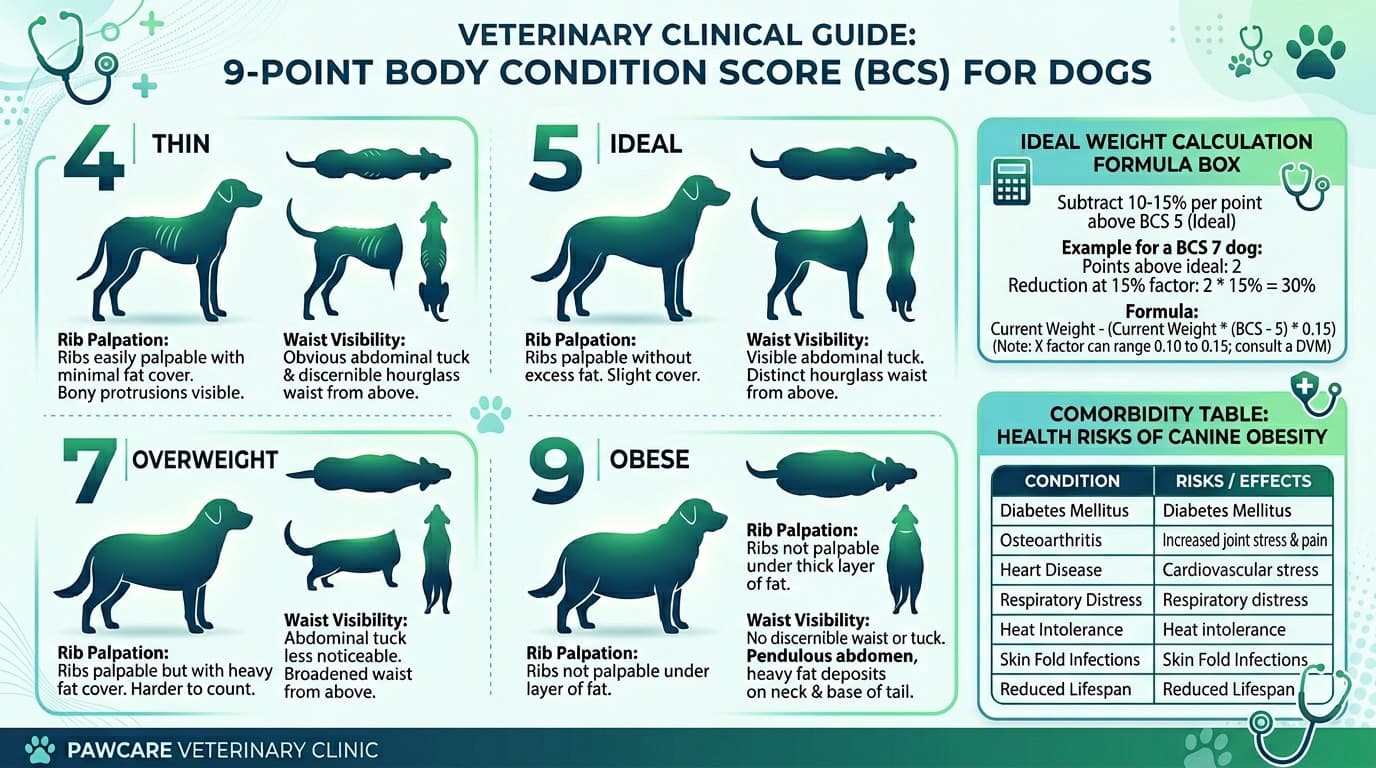
- ✓BCS 5/9 is ideal; each BCS unit above 5 represents approximately 10–15% excess body weight — use this to calculate target weight before setting caloric goals.
- ✓Resting energy requirement for weight loss = 70 × (IDEAL body weight in kg)^0.75, then multiply by 0.8; always base calculations on ideal weight, not current weight.
- ✓Cats must never be restricted below RER — hepatic lipidosis can develop within days of sub-RER feeding, particularly in cats that stop eating entirely due to food changes.
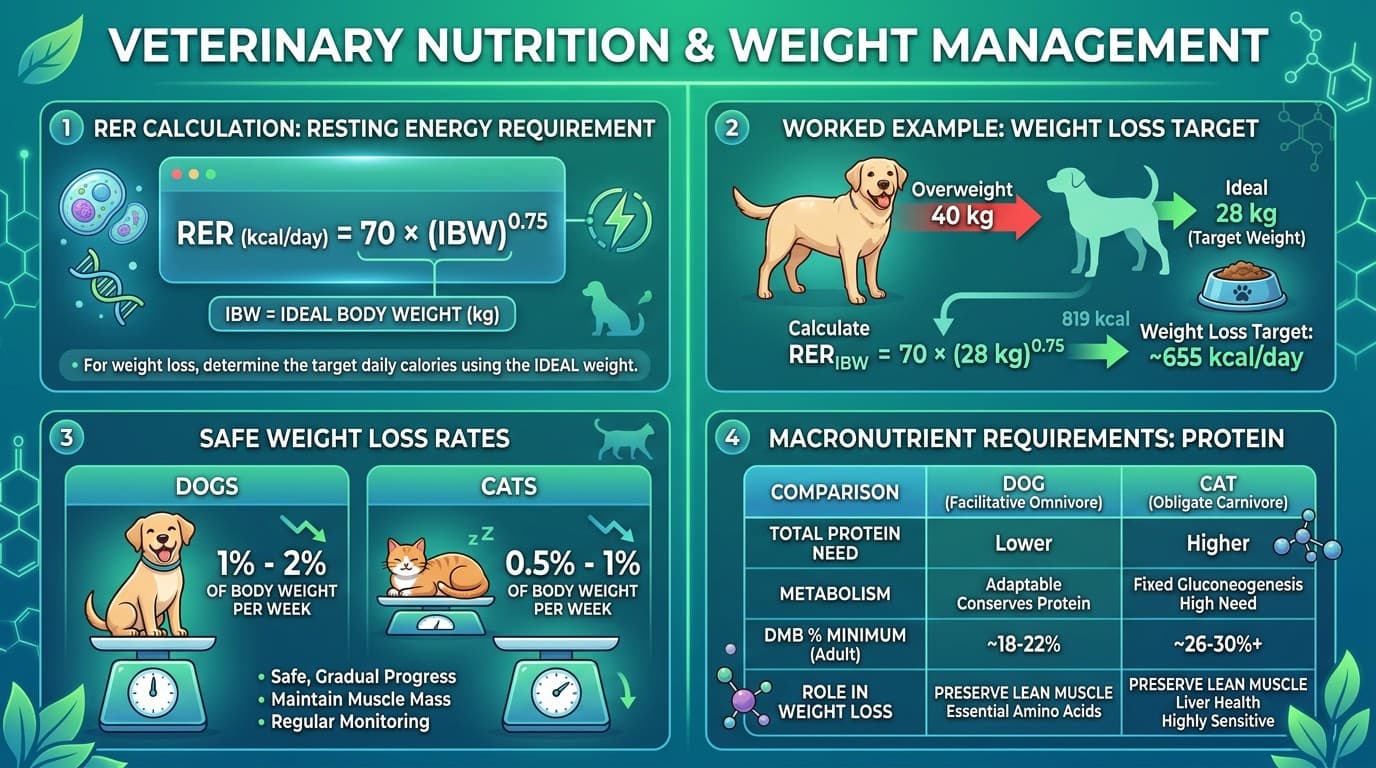
- ✓Target weight loss rate is 1–2% per week for dogs and 0.5–1% per week for cats; monthly rechecks with caloric adjustments double weight loss success rates.
- ✓High dietary protein (>25% DM in dogs, >35% DM in cats) is essential during weight loss to preserve lean muscle mass — this is why prescription weight management diets are preferred over generic light diets.
- ✓Obesity is the primary risk factor for type 2 diabetes in cats; achieving 5–15% body weight loss in obese cats with early diabetes can lead to diabetic remission.
Body Condition Scoring: The 9-Point Scale and Ideal Weight Estimation
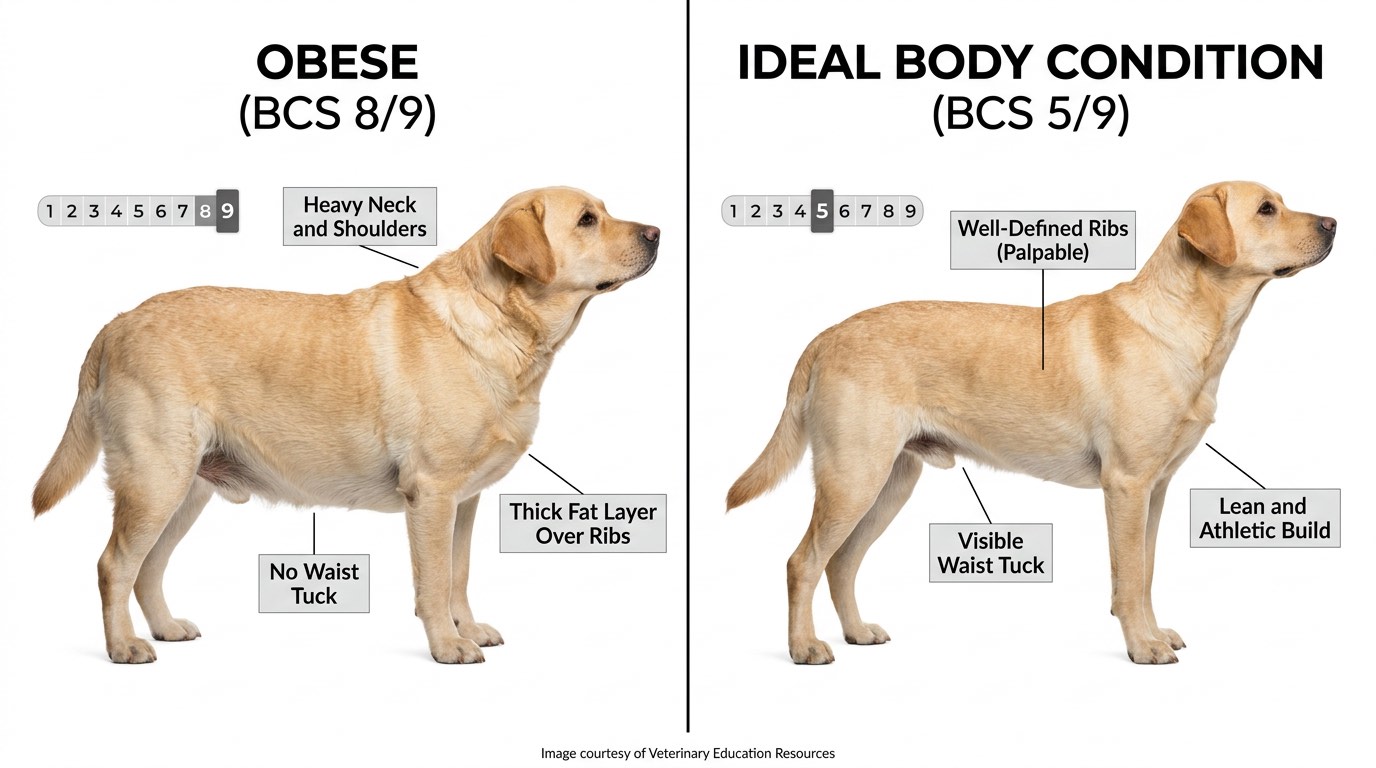
Body condition scoring (BCS) is the primary clinical tool for assessing adiposity in dogs and cats. The 9-point scale (1 = cachectic, 5 = ideal, 9 = morbidly obese) is the most widely used and validated system in veterinary practice.
9-Point BCS Reference
| Score | Description | Ribs | Waist | Abdominal Tuck |
|---|---|---|---|---|
| 1–3 | Underweight | Visible ribs; prominent bones | Extreme tuck | Severe tuck |
| 4 | Thin | Easily palpable ribs; minimal fat | Visible waist | Prominent tuck |
| 5 | Ideal | Palpable ribs with slight fat covering | Visible waist from above | Mild tuck |
| 6 | Overweight | Palpable ribs with slight excess fat | Visible waist but not prominent | No tuck |
| 7 | Overweight | Ribs palpable with difficulty; slight fat pads | Waist barely visible | Fat deposits abdomen |
| 8 | Obese | Ribs difficult to palpate through fat | No waist | Pendulous abdomen |
| 9 | Morbidly obese | Ribs not palpable; massive fat deposits | No waist; neck fat | Heavy pendulous abdomen |
Estimating Ideal Weight from BCS
- BCS 6 → ideal weight = current weight × 0.90
- BCS 7 → ideal weight = current weight × 0.80
- BCS 8 → ideal weight = current weight × 0.70
- BCS 9 → ideal weight = current weight × 0.60
Muscle Condition Score (MCS) Assess alongside BCS: sarcopenic obesity (loss of muscle with excess fat) is common in older cats and is associated with poorer metabolic outcomes. Evaluate temporal muscle, epaxial muscles, and limb musculature on a 0–3 scale (0 = severe loss, 3 = normal).
Obesity-Associated Comorbidities
| Condition | Dogs | Cats |
|---|---|---|
| Osteoarthritis | High risk; weight loss is one of the most effective treatments | High risk |
| Diabetes mellitus | Moderate risk | Very high risk — primary risk factor |
| Respiratory compromise | Brachycephalic breeds especially | High risk |
| Hypertension | Moderate risk | Moderate risk |
| Urinary incontinence | Increased risk in obese spayed females | — |
| Hepatic lipidosis | — | Critical risk during rapid weight loss |
Resting Energy Requirement Calculation and Caloric Restriction
Accurate caloric target-setting is the foundation of a successful weight loss program. Overfeeding by even 10–20% will prevent weight loss. Most pet owners significantly underestimate the caloric content of their pet's diet.
Resting Energy Requirement (RER) Formula
RER (kcal/day) = 70 × (ideal body weight in kg)^0.75
Or the linear approximation for pets 2–45 kg: RER = (30 × ideal body weight in kg) + 70
Weight Loss Caloric Target
| Goal | Formula |
|---|---|
| Weight maintenance at ideal weight | RER × 1.0 (for neutered sedentary pets) |
| Weight loss in dogs | RER × 0.8 (calculated on IDEAL not current weight) |
| Weight loss in cats | RER × 0.8 (calculated on IDEAL weight; do NOT go below RER) |
Critical Note for Cats Never restrict cats below RER — hepatic lipidosis (fatty liver) can develop within days of caloric restriction below basal needs. Target weight loss of no more than 0.5–1% of body weight per week in cats.
Example Calculation
- Obese labrador: current weight 40 kg, BCS 8/9, estimated ideal weight 28 kg
- RER at ideal weight = 70 × (28)^0.75 = 70 × 11.7 = 819 kcal/day
- Weight loss target: 819 × 0.8 = 655 kcal/day
Macronutrient Considerations
| Species | Protein | Fat | Fiber |
|---|---|---|---|
| Dogs | High protein (>25% DM) preserves muscle mass during weight loss | Reduce fat calories | Increased fiber improves satiety |
| Cats | Critical: maintain high protein (>35% DM); deficiency during weight loss causes muscle wasting | Reduce fat | Moderate fiber |
Prescription Weight Loss Diets
- Dogs: Hill's Metabolic, Royal Canin Satiety, Purina Pro Plan Weight Management
- Cats: Hill's Metabolic, Royal Canin Weight Control, Purina Pro Plan Weight Management
Over-the-counter "light" diets are often insufficient; prescription weight management foods are preferred for clinical obesity (BCS ≥7).
Weight Loss Protocol, Monitoring Schedule, and Plateau Management
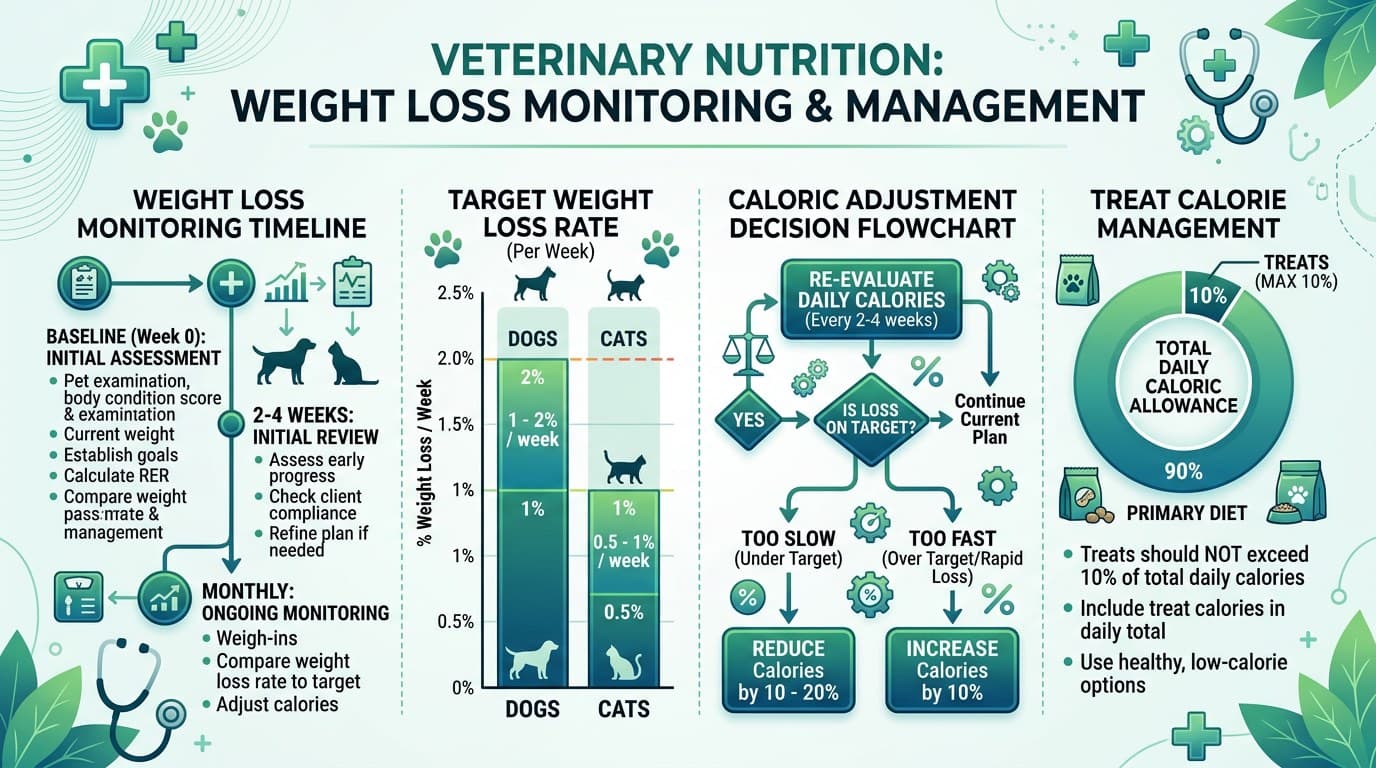
A structured monitoring protocol is essential for weight loss success. Pets that are not rechecked monthly lose approximately 50% less weight than those with regular veterinary follow-up.
Target Weight Loss Rate
| Species | Target Rate | Maximum Rate |
|---|---|---|
| Dogs | 1–2% body weight per week | 3% per week (short-term) |
| Cats | 0.5–1% body weight per week | 1.5% per week absolute maximum |
Monitoring Visit Schedule
| Visit | Timing | Actions |
|---|---|---|
| Baseline | Before diet change | Weight, BCS, MCS, baseline bloodwork (chemistry, T4 if cat) |
| Recheck 1 | 2–4 weeks | Weigh; adjust calories if <0.5% or >3% loss/week |
| Monthly | Ongoing | Weigh; reassess BCS and MCS; update feeding instructions |
| Goal weight reached | — | Transition to maintenance; prevent weight regain |
Adjusting the Plan
If the pet is losing too slowly (<0.5% per week): 1. Verify owner compliance — measure food with a kitchen scale (not cups) 2. Account for all treats and table food — hidden calories are the most common cause of plateau 3. Reduce daily caloric allocation by 10–20% 4. Consider adding exercise (dogs: increase walk duration by 10–15 min/day; cats: interactive play 2× daily)
If the pet is losing too quickly (>2% per week in dogs, >1.5% in cats): 1. Increase daily caloric allocation by 10% 2. Monitor for muscle loss — increase dietary protein
Treat Management
Total treats should not exceed 10% of daily caloric allocation:
- Low-calorie treats: cucumber, baby carrots, green beans (dogs); small pieces of cooked chicken breast (cats)
- Reduce daily food portion by an equivalent caloric amount if treats are given
- Use a portion of the daily kibble ration as treats
Maintaining Weight Loss
- Calculate new maintenance calories = RER × 1.0 (neutered, sedentary) to 1.2 (active)
- Continue monthly weigh-ins for 3 months after goal is reached
- Keep the pet on prescription weight management food during weight maintenance phase until body condition is stable
Frequently Asked Questions
How do I calculate how much to feed my overweight dog?
First estimate the ideal body weight from the BCS (subtract 10–15% per BCS unit above 5). Then calculate RER = 70 × (ideal weight in kg)^0.75. For weight loss, feed 80% of RER calculated on the IDEAL weight. Always weigh food with a kitchen scale — measuring cups are inaccurate for caloric portioning.
How fast should a cat lose weight?
Cats should lose 0.5–1% of body weight per week. Never exceed 1.5% per week. Rapid weight loss in cats causes hepatic lipidosis (fatty liver disease) within days. Never reduce a cat's caloric intake below their resting energy requirement (70 × IBW^0.75 kcal/day).
Do veterinary prescription weight loss diets work better than store-bought light diets?
Yes. Prescription weight management foods have clinically proven higher protein content (to preserve muscle mass), increased fiber (for satiety), and precisely measured caloric density. Over-the-counter light diets often have insufficient protein and variable caloric content. For BCS ≥7, prescription diets are recommended.
What exercises help an overweight dog lose weight?
Low-impact exercise is preferred for obese dogs with concurrent osteoarthritis: leash walks on flat surfaces, swimming, and underwater treadmill therapy. Start with 10–15 minute walks twice daily and increase by 5 minutes per week. High-impact activities (running, jumping) should wait until significant weight loss has reduced joint load.
Can obesity cause diabetes in cats?
Yes. Obesity is the single most significant risk factor for type 2 diabetes mellitus in cats. Excess adipose tissue causes insulin resistance. Achieving weight loss in pre-diabetic or newly diabetic cats is one of the most effective interventions and can lead to diabetic remission in a significant proportion of cases.
References
- German AJ, Holden SL, Moxham GL, et al. A simple, reliable tool for owners to assess the body condition of their dog or cat. J Nutr. 2006;136(7 Suppl):2031S-2033S.
- Laflamme DP. Development and validation of a body condition score system for dogs. Canine Pract. 1997;22(4):10-15.
- Butterwick RF, Hawthorne AJ. Feline nutritional medicine — obesity. J Small Anim Pract. 1998;39(Suppl 1):9-16.