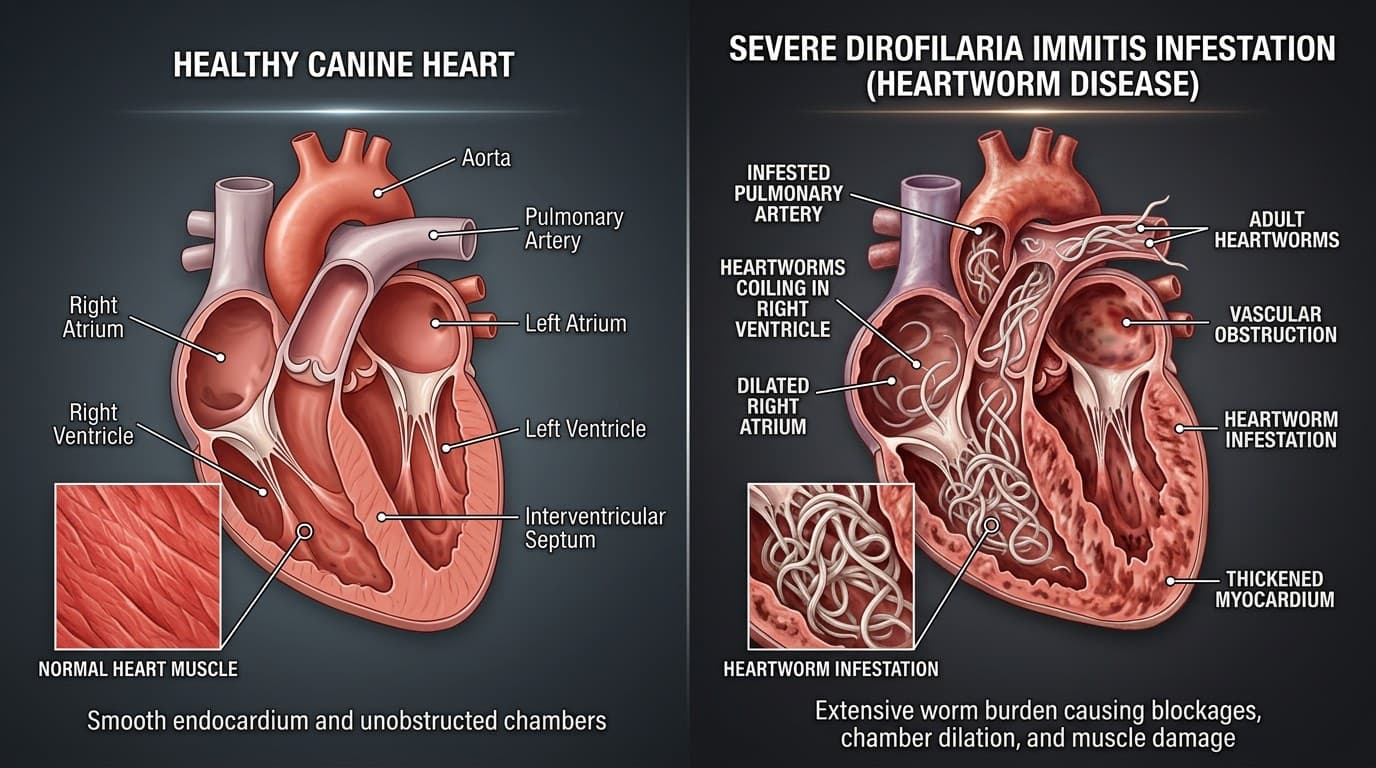
Quick Answer
Heartworm prevention in dogs relies on macrocyclic lactones (ivermectin, milbemycin oxime, moxidectin) that kill L3/L4 larvae within a 30-45 day window. This guide covers product selection, MDR1/ABCB1 mutation considerations in herding breeds, annual testing requirements, and southern resistance concerns.
Key Takeaways
- ✓Macrocyclic lactones (ivermectin, milbemycin, moxidectin) kill L3/L4 heartworm larvae within a retroactive 30-45 day window — monthly compliance is critical
- ✓Dogs MUST test heartworm antigen negative before starting prevention — giving ML to an infected dog does not treat infection and may trigger reactions
- ✓Standard ML prevention doses (ivermectin 6 mcg/kg) are safe even in MDR1/ABCB1 mutation herding breeds — use milbemycin for all high-dose treatments in Collies/Aussies
- ✓Proheart 6 and Proheart 12 injectable moxidectin eliminate monthly compliance issues and are ideal for non-compliant clients or high-risk geographic areas
- ✓Annual antigen testing is required for all dogs on prevention — ML-resistant strains exist in the Mississippi Delta and breakthrough infections occur even in compliant dogs
- ✓Year-round prevention is recommended nationwide — occasional winter mosquito activity and compliance gaps make year-round the standard of care
Macrocyclic Lactone Products, Dosing, and Mechanism
Heartworm prevention relies on macrocyclic lactones (ML) — a class of antiparasitic drugs that kill Dirofilaria immitis larvae (L3 and L4 stages) within a retroactive 30–45 day window after mosquito exposure.
How Prevention Works
- Mosquito deposits L3 larvae when biting → larvae mature to L4 and early L5 over 45–60 days in tissue
- Monthly ML dose kills larvae present from the previous 30–45 days
- The drug does NOT prevent larval deposition — it clears larvae before they become adults
- A missed dose creates a gap where larvae may escape the killing window and mature
Mechanism of Action
- Bind glutamate-gated chloride channels in invertebrate nervous systems
- Causes flaccid paralysis of nematode musculature
- Kills L3/L4 Dirofilaria larvae, not adult worms
- Also kills many intestinal nematodes at higher doses
Available Products and Dosing
| Product | Active Ingredient | Dog Dose | Route | Frequency | Additional Coverage |
|---|---|---|---|---|---|
| Heartgard Plus (Boehringer) | Ivermectin 6 mcg/kg + pyrantel | Per weight chewable | PO | Monthly | Roundworms, hookworms |
| Interceptor Plus (Elanco) | Milbemycin 0.5 mg/kg + praziquantel | Per weight chewable | PO | Monthly | Roundworms, hookworms, whipworms, tapeworms |
| Sentinel (Virbac) | Milbemycin + lufenuron | Per weight | PO | Monthly | Roundworms, hookworms, whipworms, flea egg prevention |
| Proheart 6 (Zoetis) | Moxidectin 0.17 mg/kg | Per weight | SQ injection | Every 6 months | None |
| Proheart 12 (Zoetis) | Moxidectin 0.17 mg/kg | Per weight | SQ injection | Every 12 months | None |
| Advantage Multi (Elanco) | Imidacloprid + moxidectin | Per weight | Topical | Monthly | Fleas, roundworms, hookworms, whipworms |
| Revolution (Zoetis) | Selamectin 6–12 mg/kg | Per weight | Topical | Monthly | Fleas, ear mites, sarcoptes |
| Trifexis (Elanco) | Milbemycin + spinosad | Per weight | PO | Monthly | Fleas, roundworms, hookworms, whipworms |
Minimum Requirements Before Starting Prevention 1. Antigen test must be negative — administering ML to a dog with adult heartworm infection does NOT treat it and may cause reactions 2. Test dogs > 7 months of age (window period for early antigen detection) 3. Microfilaria test in endemic areas before using ivermectin (risk of reaction in microfilaremic dogs)
MDR1/ABCB1 Mutation in Herding Breeds: Safe Drug Selection
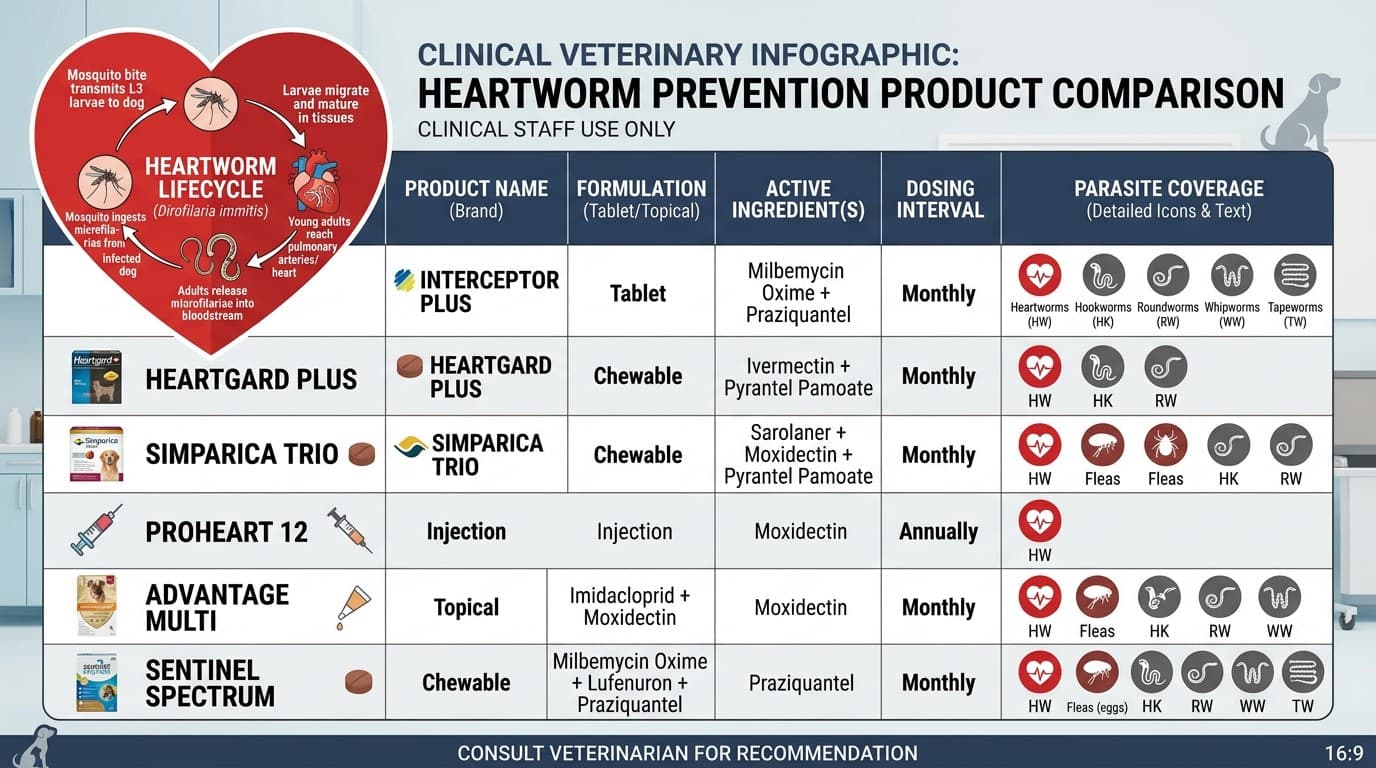
The MDR1 (multidrug resistance gene 1) mutation, also called ABCB1 mutation, affects P-glycoprotein expression — a drug efflux pump in the blood-brain barrier. Dogs with this mutation cannot effectively exclude certain drugs from the CNS, leading to neurotoxicity at doses tolerated by normal dogs.
Breeds at Risk for MDR1 Mutation
| Breed | Estimated Mutation Frequency |
|---|---|
| Collie (rough/smooth) | ~70% affected |
| Australian Shepherd | ~50% affected |
| Mini Australian Shepherd | ~50% affected |
| Shetland Sheepdog (Sheltie) | ~15% affected |
| Border Collie | ~5% affected |
| Old English Sheepdog | ~5% affected |
| German Shepherd | ~10% affected |
| Long-haired Whippet | ~65% affected |
| McNab | ~30% affected |
Drug Safety by MDR1 Status
| Drug | Normal Dog | MDR1/MDR1 (homozygous) | MDR1/normal (heterozygous) |
|---|---|---|---|
| Ivermectin (prevention dose 6 mcg/kg) | SAFE | SAFE | SAFE |
| Ivermectin (antiparasitic dose 0.2–0.4 mg/kg) | SAFE | TOXIC | Caution |
| Milbemycin (prevention dose 0.5 mg/kg) | SAFE | SAFE | SAFE |
| Moxidectin (prevention dose) | SAFE | SAFE | SAFE |
| Selamectin (Revolution) | SAFE | SAFE | SAFE |
| Loperamide (Imodium) | SAFE | TOXIC | Caution |
| Vincristine | Normal | Neurotoxic | Caution |
Key Point: Heartworm Prevention Doses Are Safe in MDR1 Dogs Standard ML prevention doses (ivermectin 6 mcg/kg, milbemycin 0.5 mg/kg) are safe even in homozygous MDR1/MDR1 dogs. The toxic dose for ivermectin in MDR1 dogs is approximately 100 mcg/kg. Prevention doses have a >16x safety margin.
High-dose ivermectin (used for mange, microfilaria treatment, 0.2–0.4 mg/kg) IS toxic in MDR1 dogs and should be replaced with milbemycin or moxidectin for all treatments beyond standard prevention in at-risk breeds.
MDR1 Testing
- Washington State University Veterinary Clinical Pharmacology Lab: MDR1 genotype test from cheek swab ($70–90)
- Or use commercial services (Embark, UC Davis VGL)
- Test once — genotype is permanent
Recommendation for Herding Breeds Use milbemycin-based prevention (Interceptor Plus, Sentinel, Trifexis) as default for herding breeds when high-dose antiparasitic therapy may also be needed. Reserve ivermectin-based products only when MDR1 status is confirmed wild-type.
Resistance Concerns, Annual Testing, and Treatment Before Prevention
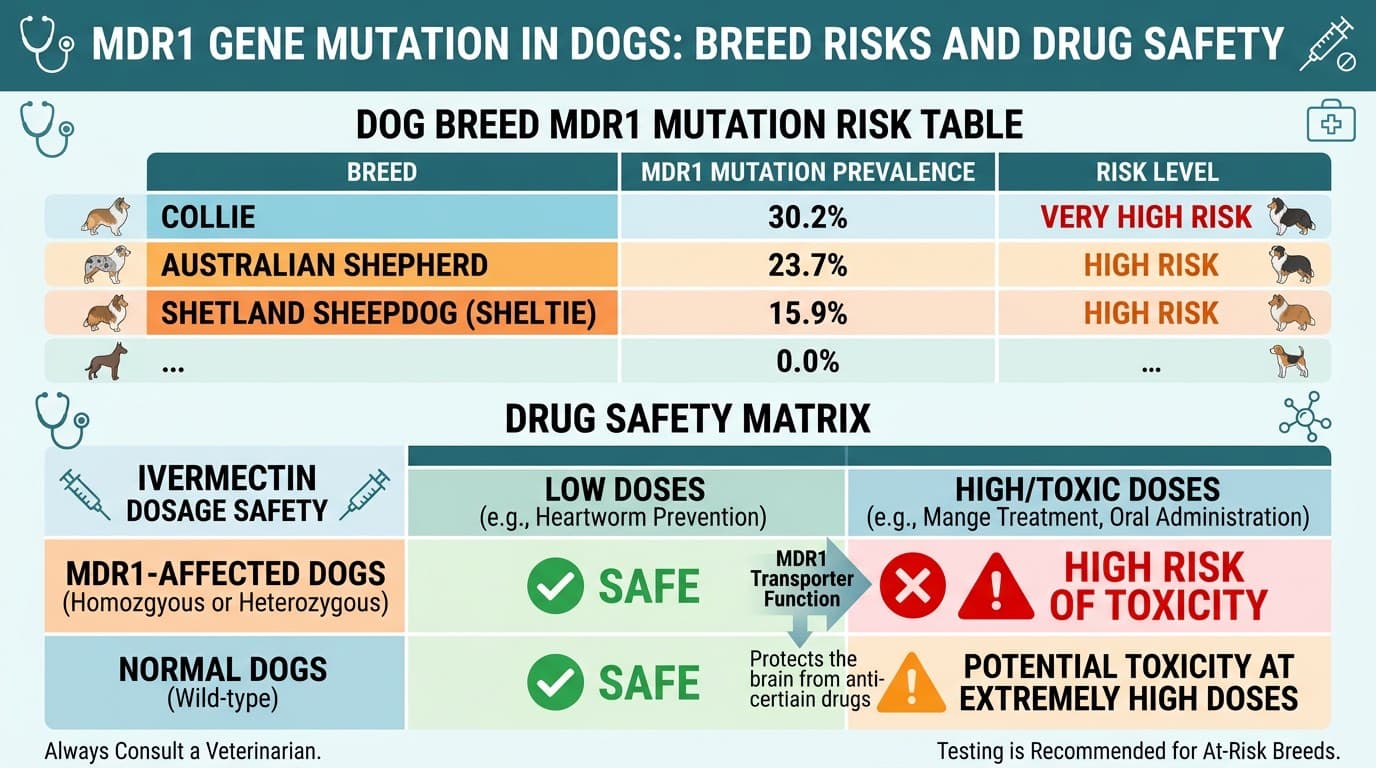
Two critical issues affect heartworm prevention effectiveness that every practitioner must understand: emerging macrocyclic lactone resistance in the Mississippi Delta, and the absolute requirement for antigen testing before initiating prevention.
Macrocyclic Lactone Resistance (MP3 Strain) A population of Dirofilaria immitis with reduced susceptibility to macrocyclic lactones (the "MP3 strain") has been documented primarily in the Mississippi Delta region (Louisiana, Mississippi, Arkansas, Alabama, and adjacent states).
Current Understanding of Resistance
| Factor | Evidence |
|---|---|
| ML-resistant strain confirmed | Yes — molecular markers and bioassays documented |
| Geographic extent | Primarily Mississippi Delta; sporadic nationwide |
| Mechanism | P-glycoprotein overexpression; reduced drug accumulation in larvae |
| Prevention failure rate | Estimated 1–5% in highly endemic areas on prevention |
| AHS position | Year-round prevention; annual testing even in compliant dogs |
Annual Testing Requirement — Non-Negotiable The American Heartworm Society (AHS) requires annual antigen testing for all dogs on prevention — even those 100% compliant with monthly dosing.
Reasons for Annual Testing 1. Owner compliance is often better reported than actual (missed doses, vomiting out the dose) 2. Resistance breakthrough in endemic areas 3. 30-45 day window creates potential exposure gaps at seasonal transitions 4. Early detection allows treatment before severe cardiopulmonary disease develops 5. Infection from prior year may be antigen-negative for up to 6–7 months post-infection
Treatment Before Prevention: Positive Antigen Test Protocol
| Step | Action |
|---|---|
| 1 | Confirm antigen positive with second test (different manufacturer) |
| 2 | Staging: thoracic radiographs, echocardiogram, CBC, chemistry |
| 3 | Restrict exercise (NO off-leash activity) |
| 4 | Doxycycline 10 mg/kg PO BID × 30 days (kills Wolbachia endosymbiont, reduces worm viability) |
| 5 | Prednisolone 1 mg/kg PO SID × 1 week pre-melarsomine (reduce inflammation) |
| 6 | Melarsomine dihydrochloride (Immiticide) 2.5 mg/kg IM × 3 doses (AHS split protocol) |
| 7 | Restart monthly prevention 6 weeks after last melarsomine dose |
| 8 | Retest antigen at 6 months post-treatment |
Proheart Compliance Advantage Proheart 6 (every 6 months) and Proheart 12 (every 12 months) injectable moxidectin eliminate monthly compliance issues entirely. Administered in clinic, these products guarantee continuous protection without owner dependency. Ideal for high-risk geographic areas and known non-compliant owners.
Frequently Asked Questions
What is the best heartworm prevention for dogs?
All AHS-approved macrocyclic lactone products are effective when given correctly. Product choice depends on lifestyle, compliance, and additional parasite coverage needed. Proheart 12 (annual injection) eliminates compliance issues. Interceptor Plus or Heartgard Plus are excellent monthly options. In high-risk tick areas, combining ML prevention with an isoxazoline product provides comprehensive protection.
Is ivermectin safe for Collies?
At standard heartworm prevention doses (6 mcg/kg), ivermectin is safe even for Collies with the MDR1 mutation. The toxic dose is approximately 100 mcg/kg — providing a >16x safety margin over prevention doses. However, HIGH-dose ivermectin (0.2-0.4 mg/kg for mange treatment) IS toxic in MDR1 dogs and should be replaced with milbemycin or moxidectin.
My dog takes heartworm prevention every month — does it still need annual testing?
Yes. The American Heartworm Society recommends annual antigen testing for all dogs regardless of prevention compliance. Reasons include occasional owner compliance lapses, potential ML-resistant strains in endemic areas, and the value of early detection before significant heart damage develops. Testing is a non-negotiable part of the heartworm prevention protocol.
What is Proheart 12 and how does it work?
Proheart 12 (moxidectin) is an injectable heartworm prevention given by a veterinarian once yearly. The drug is in a sustained-release microsphere formulation that provides continuous moxidectin levels for 12 months. It eliminates the monthly compliance problem entirely and is ideal for owners who forget monthly doses or for high-risk endemic areas.
What is heartworm resistance and where is it a concern?
A macrocyclic lactone-resistant strain of Dirofilaria immitis (MP3 strain) has been documented primarily in the Mississippi Delta region. This strain has reduced susceptibility to standard monthly ML prevention, resulting in occasional breakthrough infections in compliant dogs. Annual testing is especially critical in this region. Research into alternative prevention strategies continues.
References
- American Heartworm Society. Current Canine Guidelines for the Prevention, Diagnosis, and Management of Heartworm Infection in Dogs. 2018.
- Bourguinat C et al. Macrocyclic lactone resistance in Dirofilaria immitis. Vet Parasitol. 2011;181(2-4):388-392.
- Prichard RK et al. Identification of markers for macrocyclic lactone resistance in Dirofilaria immitis. Parasit Vectors. 2012;5:251.