
Quick Answer
Heartworm disease is one of the most serious preventable parasitic infections in dogs. This guide covers the complete life cycle, AHS classification, diagnostic interpretation, melarsomine treatment protocols, exercise restriction, and evidence-based prevention.
Key Takeaways
- ✓Antigen tests are positive 6–7 months post-infection — early testing produces false negatives
- ✓The 3-dose melarsomine split protocol is preferred over 2-dose for all AHS classes
- ✓Strict cage rest for 6–8 weeks post-treatment is mandatory — exercise causes fatal pulmonary thromboembolism
- ✓Doxycycline 10 mg/kg BID × 28 days pre-treatment targets Wolbachia and reduces inflammatory complications
- ✓Class IV caval syndrome requires surgical worm extraction before melarsomine — the drug is contraindicated with massive worm burdens
- ✓Year-round prevention is cost-effective and dramatically safer than treatment
Biology and Life Cycle of Dirofilaria immitis
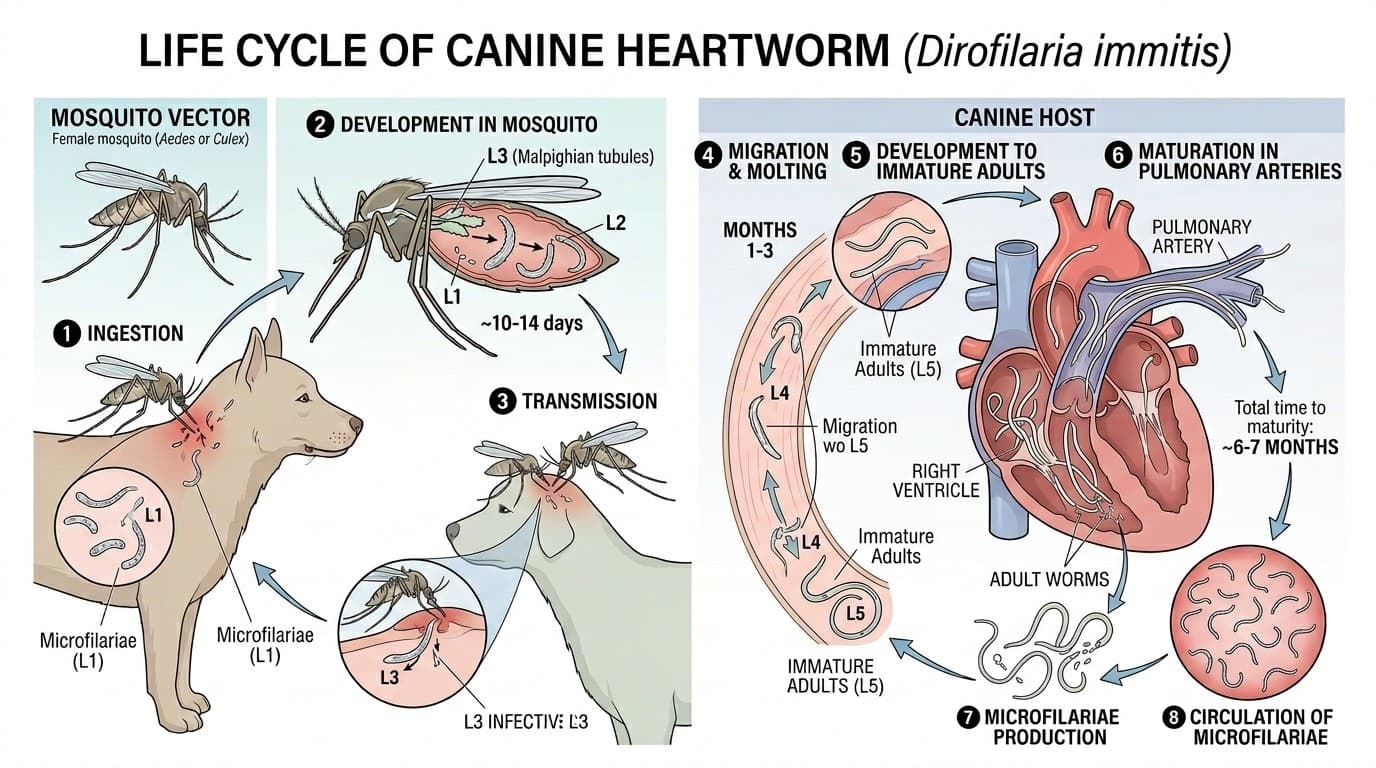
Heartworm disease is caused by Dirofilaria immitis, a filarial nematode transmitted exclusively through mosquito bites. The complete life cycle spans 6–7 months.
Life Cycle Steps:
- Microfilariae (L1) — Adult female worms in infected dogs release microfilariae into the bloodstream, where they circulate for up to 2–3 years.
- Mosquito uptake — A feeding mosquito ingests microfilariae, which develop into infective L3 larvae over 10–14 days (requires sustained temps >57°F/14°C).
- Transmission — L3 larvae are deposited during the mosquito's next feeding and penetrate the bite wound.
- Subcutaneous migration — Larvae develop through L4 stage over 45–60 days, then migrate as juvenile adults to the pulmonary arteries.
- Sexual maturity — Worms reach the pulmonary arteries by days 70–90 and become sexually mature at 6–7 months post-infection — the threshold for antigen test positivity.
- Adult worm lifespan — Adults survive 5–7 years in dogs. Males: 15–18 cm. Females: 25–30 cm. Average worm burden: ~15 worms (range: 1–250+).
Geographic note: Endemic throughout the US, highest in Gulf Coast, Mississippi River Valley, and Atlantic Seaboard. Expanding northward with climate change.
AHS Classification: Staging Disease Severity
The American Heartworm Society classifies disease into four classes that guide treatment decisions.
Class I — Mild Clinical signs: None or occasional cough. Radiographs: minimal changes. Lab: normal. Prognosis: Excellent.
Class II — Moderate Clinical signs: Occasional cough, mild exercise intolerance. Radiographs: mild–moderate pulmonary artery enlargement. Lab: possible mild anemia. Prognosis: Good.
Class III — Severe Clinical signs: Persistent cough, exercise intolerance, dyspnea, weight loss, possible syncope. Radiographs: severe pulmonary artery enlargement, right heart enlargement, diffuse infiltrates. Lab: moderate–severe anemia, elevated BUN/creatinine, elevated liver enzymes. Prognosis: Guarded; requires stabilization before treatment.
Class IV — Caval Syndrome Clinical signs: Cardiovascular collapse, pale mucous membranes, hemoglobinuria (red-brown urine). Echocardiography: worm mass visible in right atrium/caudal vena cava. Management: Surgical worm extraction REQUIRED before melarsomine. Prognosis: Guarded to poor even with surgery.
Diagnosis: Antigen Testing, Microfilaria Detection, Imaging
Antigen Tests (Preferred) Detect female worm proteins. Sensitivity 98–99%, specificity 99%. Positive at 6–7 months post-infection. Consider heat treatment of serum for suspected false-negatives (breaks antigen-antibody complexes).
Microfilaria Detection Modified Knott's test preferred over direct smear. Positive antigen + positive microfilaria = confirmed infection. Positive antigen + negative microfilaria = occult infection (40–60% of cases). Negative antigen + positive microfilaria = consider Acanthocheilonema reconditum (non-pathogenic) or false-negative antigen test.
Thoracic Radiographs Right descending pulmonary artery enlargement (diameter > width of 9th rib at same level), right cardiomegaly, perivascular densities, pulmonary infiltrates.
Echocardiography Visualizes adult worms as parallel hyperechoic lines ("equal signs") in pulmonary arteries and right heart. Essential for Class III–IV staging.
Pre-Treatment Labs CBC, chemistry, urinalysis, UPC ratio. Identifies anemia, azotemia, protein-losing nephropathy, and hepatic changes.
Treatment: Melarsomine Protocol and Exercise Restriction
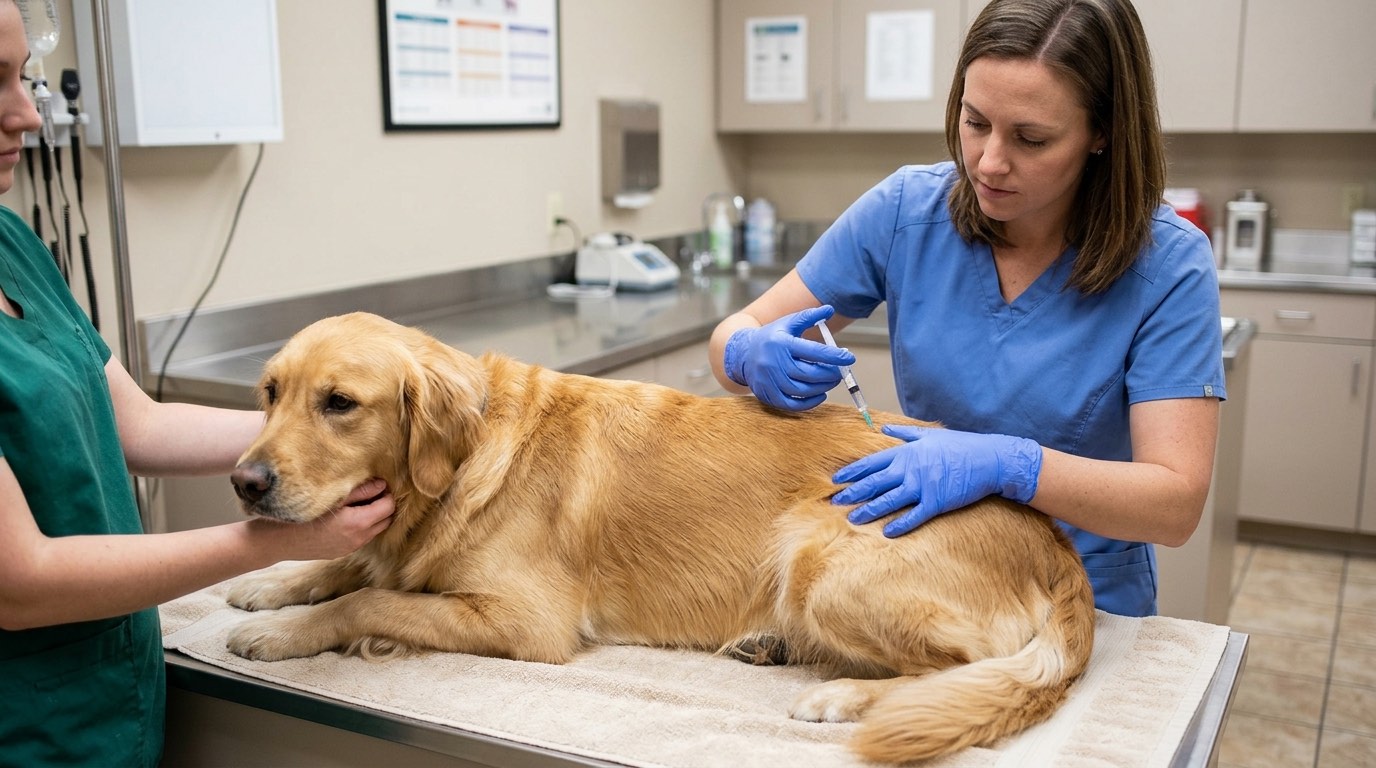
Melarsomine dihydrochloride (Immiticide/Diroban) is the only FDA-approved adulticidal drug. Dose: 2.5 mg/kg deep IM (lumbar musculature L3–L5).
Pre-Treatment Stabilization (Class III)
- Strict cage rest before and during treatment
- Prednisolone 0.5–1 mg/kg/day for 2–4 weeks (reduces pulmonary inflammation)
- Doxycycline 10 mg/kg BID × 28 days (targets Wolbachia endosymbionts, reduces inflammatory response)
- Macrocyclic lactone preventative to kill microfilariae
3-Dose Split Protocol (AHS Recommended) 1. Day 1: Melarsomine 2.5 mg/kg IM 2. Day 30: Melarsomine 2.5 mg/kg IM 3. Day 31: Melarsomine 2.5 mg/kg IM (contralateral side)
The 30-day gap allows partial worm die-off, reducing thromboembolic load from the final two injections.
Exercise Restriction — Non-Negotiable Strict cage rest for 6–8 weeks after the final injection. Dying worms embolize to pulmonary capillaries; even mild activity can cause fatal pulmonary thromboembolism. Leash walks for elimination ONLY. No running, jumping, playing.
Post-Treatment Testing Repeat antigen testing 6 months after final melarsomine injection. Persistent positive = retreatment required.
Prevention: Monthly and Injectable Preventatives
Macrocyclic lactones (ivermectin, milbemycin oxime, moxidectin, selamectin) kill L3/L4 larvae retroactively — eliminating larvae acquired in the past 30–45 days.
Key Preventatives:
- Heartgard Plus (ivermectin + pyrantel): Monthly oral; roundworms, hookworms
- Interceptor Plus (milbemycin + praziquantel): Monthly oral; broad-spectrum intestinal coverage
- ProHeart 6/12 (moxidectin injectable): Veterinarian-administered; removes compliance issues
- Revolution Plus (selamectin + sarolaner): Monthly topical; fleas, ticks, mites
Guidelines:
- Year-round prevention recommended (AHS) regardless of geographic region
- Test before starting: dogs >7 months should test before preventatives (macrocyclic lactones given to microfilaremic dogs can cause anaphylactoid reactions)
- Annual testing even on continuous prevention (compliance gaps, vomiting of oral products)
- MDR1/ABCB1 mutation breeds (Collies, Shelties, Australian Shepherds): standard prevention doses are safe; high-dose ivermectin is not
Frequently Asked Questions
How long after infection does heartworm show on a test?
Antigen tests become positive approximately 6–7 months after infection, when adult female worms are present. Testing before this window produces false-negative results.
Can dogs survive heartworm treatment?
Yes — survival rates exceed 95% for Class I and II dogs and approximately 80–90% for properly stabilized Class III dogs using the 3-dose melarsomine protocol with strict exercise restriction.
Why is exercise so dangerous during heartworm treatment?
Dying worms fragment and embolize to pulmonary capillaries. Increased blood flow from exercise dramatically increases the risk of fatal pulmonary thromboembolism. Cage rest is mandatory for 6–8 weeks after the final injection.
References
- American Heartworm Society. Current Canine Guidelines for the Prevention, Diagnosis, and Management of Heartworm Infection in Dogs. 2020.
- Atkins CE. Comparison of results of three commercial heartworm antigen test kits in dogs with low heartworm burdens. JAVMA. 2003.
- Bowman DD, Atkins CE. Heartworm biology, treatment, and control. Vet Clin North Am Small Anim Pract. 2009.
- Savadelis MD, et al. Assessment of antigen test sensitivity using commercially available heartworm antigen test kits. Parasit Vectors. 2020.