
Quick Answer
Levetiracetam (Keppra) is a second-generation anticonvulsant with a unique mechanism, minimal drug interactions, and excellent safety profile making it valuable as monotherapy or adjunct for epilepsy in dogs and cats. This guide covers standard and extended-release dosing, IV loading for cluster seizures, and practical management alongside phenobarbital.
Key Takeaways
- ✓Levetiracetam binds SV2A — unique mechanism with no hepatic enzyme induction and minimal drug interactions
- ✓Standard-release requires TID dosing in dogs (4-6h half-life); extended-release (XR) allows BID — never crush XR tablets
- ✓No hepatotoxicity risk — liver enzymes remain reliable disease markers; preferred adjunct when phenobarbital hepatotoxicity develops
- ✓As adjunct to phenobarbital in refractory epilepsy: additional 40-60% improvement in seizure control in clinical series
- ✓Behavioral changes (increased anxiety, dysphoria) occur in a subset of dogs — reduce dose or switch to zonisamide if marked
- ✓IV loading 30-60 mg/kg over 5-15 minutes is effective for cluster seizure management in hospital
Mechanism of Action and Clinical Advantages
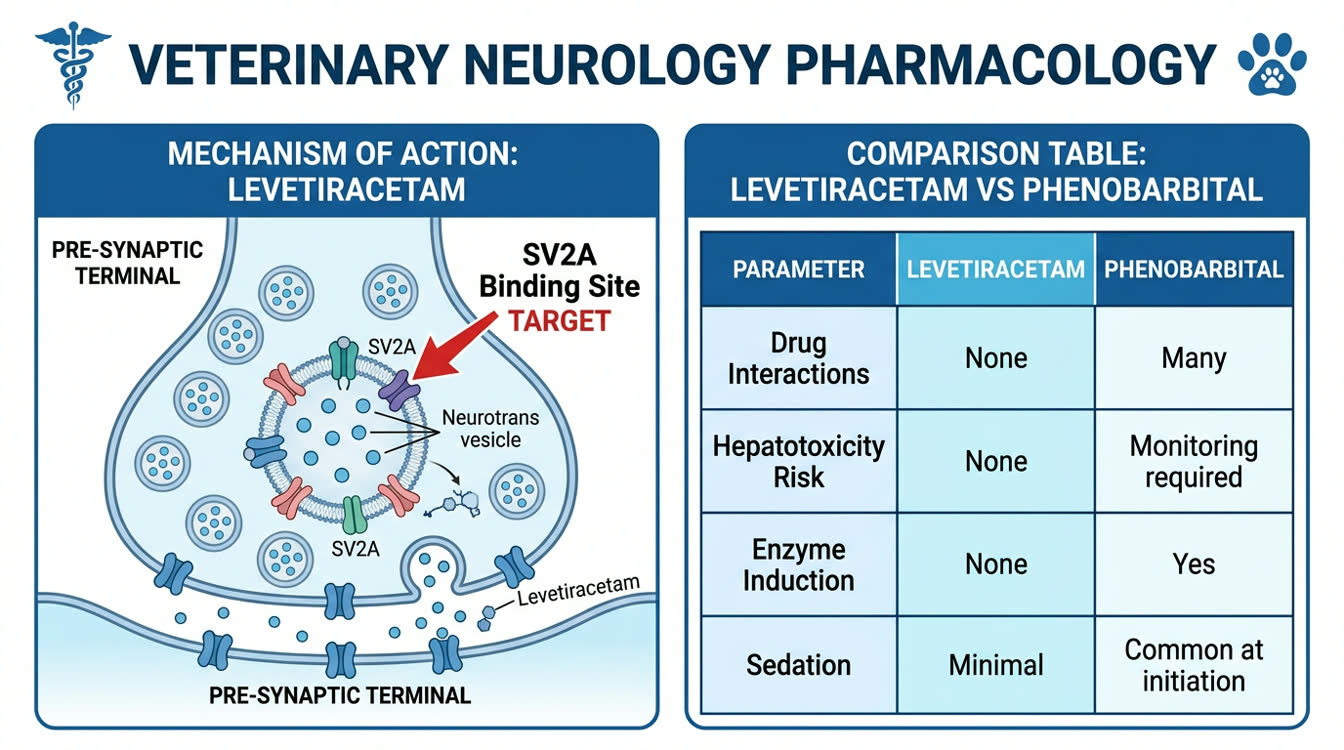
Levetiracetam exerts its anticonvulsant effect primarily through binding to synaptic vesicle protein 2A (SV2A), modulating neurotransmitter release and reducing abnormal synchronous neuronal firing. Unlike traditional anticonvulsants, it does not directly potentiate GABA or inhibit sodium channels. This unique mechanism makes it non-additive with GABAergic drugs in terms of mechanisms, often providing synergistic seizure control when combined with phenobarbital or benzodiazepines.
Key Pharmacologic Advantages:
- No hepatic cytochrome P450 induction or inhibition — minimal drug interactions
- Primarily renally excreted (66% unchanged) — not hepatotoxic
- No effect on ALT/ALP/bile acids — liver enzymes remain reliable indicators of primary liver disease even in patients on levetiracetam
- Broad-spectrum anticonvulsant activity (focal and generalized seizures)
- No sedation or significant cognitive impairment at standard doses
- Available in oral tablets, liquid formulation, and injectable (IV)
Indications in Veterinary Practice: 1. Adjunct anticonvulsant: add-on to phenobarbital when monotherapy is insufficient (most common use) 2. Phenobarbital sparing: allows phenobarbital dose reduction in patients with hepatotoxicity while maintaining seizure control 3. Cluster seizure at-home management: owner-administered IV or rectal levetiracetam to abort cluster episodes 4. Monotherapy consideration: cats (where phenobarbital safety is acceptable but alternatives preferred) and dogs with hepatic disease
Comparison with Phenobarbital as Monotherapy: Phenobarbital achieves seizure freedom or >50% reduction in ~60-70% of dogs as monotherapy; levetiracetam achieves approximately 40-50% response as monotherapy in published veterinary studies. Levetiracetam is generally not preferred as sole first-line agent due to somewhat lower efficacy, but is an excellent second drug and first choice in cats and dogs with liver disease.
Dosing Protocols: Standard, Extended-Release and IV Loading
Standard Release (immediate-release) Dosing:
| Species | Dose | Frequency | Notes |
|---|---|---|---|
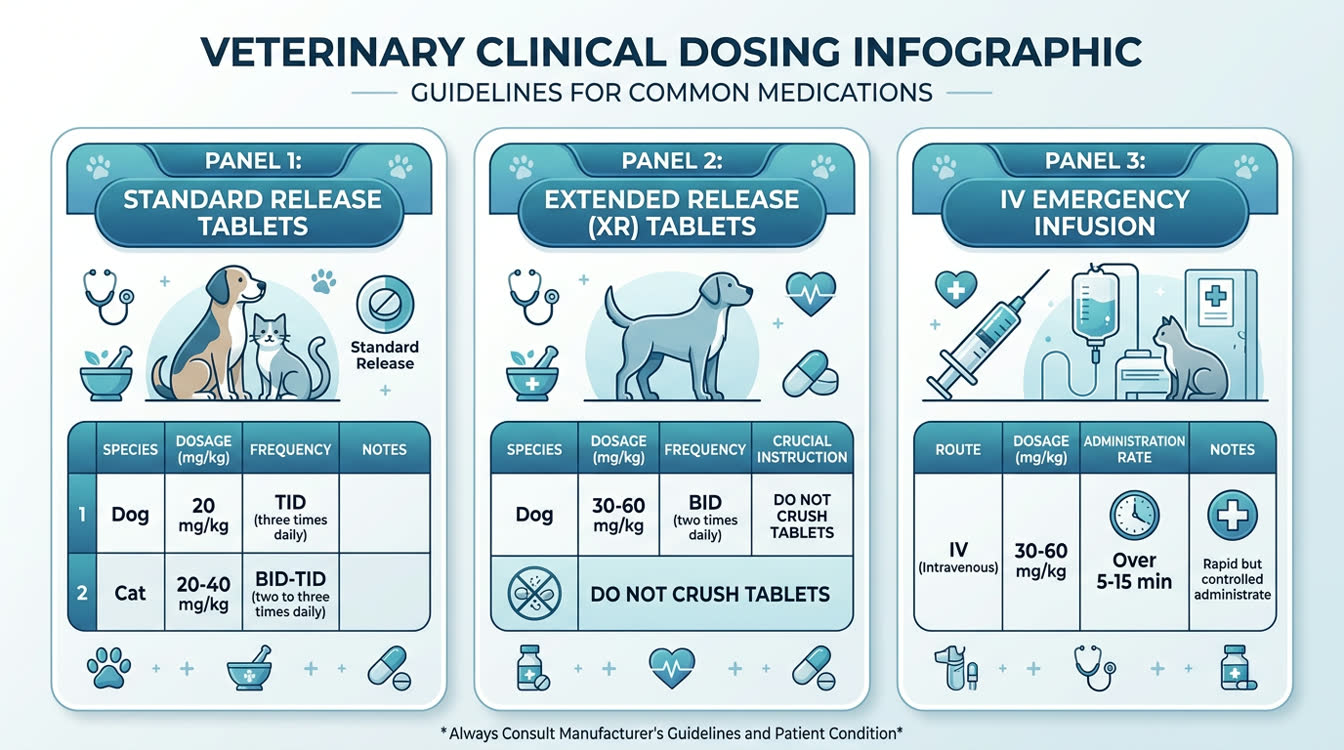
| Dog (adjunct) | 20 mg/kg | TID | TID dosing is required due to 4-6h half-life in dogs |
| Dog (monotherapy) | 20-60 mg/kg | TID | Higher end for refractory epilepsy |
| Cat | 20-40 mg/kg | BID-TID | Cats metabolize levetiracetam somewhat more slowly |
The requirement for TID dosing in dogs is a significant practical compliance challenge. Extended-release formulations address this.
Extended-Release (XR) Levetiracetam (Keppra XR):
Human extended-release tablets (500 mg, 750 mg) can be used in dogs at 30-60 mg/kg PO BID. XR tablets must NOT be crushed or split (destroys the release mechanism). Use whole tablets only. Not appropriate for cats (tablets cannot be accurately dosed for feline weights with available sizes).
Extended-release achieves adequate trough levels with BID dosing in most dogs, significantly improving compliance while maintaining comparable seizure control to TID standard-release.
IV Loading Protocol (Emergency/Cluster Seizures): Levetiracetam injectable (500 mg/5 mL vials): 30-60 mg/kg IV over 5-15 minutes. Can be given as a bolus for cluster seizure management in the emergency room. Rapid effect (onset within 30-60 minutes of IV administration).
Owner-Administered Cluster Seizure Protocol: Some practices prescribe injectable levetiracetam for owner administration (60 mg/kg intranasal or per rectum) to abort cluster seizures at home before the patient can reach the hospital. Provide written instructions and pre-filled syringes. This approach is particularly useful in dogs with documented cluster patterns (e.g., multiple seizures in 24-48 hours every few weeks).
Dose Adjustments: Levetiracetam does not require therapeutic drug monitoring (TDM) in veterinary practice — serum level monitoring is not validated as useful for efficacy or toxicity prediction in dogs and cats. Dose adjustments are guided by clinical seizure frequency and adverse effects.
Combination Protocol with Phenobarbital, Adverse Effects and Monitoring
Levetiracetam as Add-On to Phenobarbital:
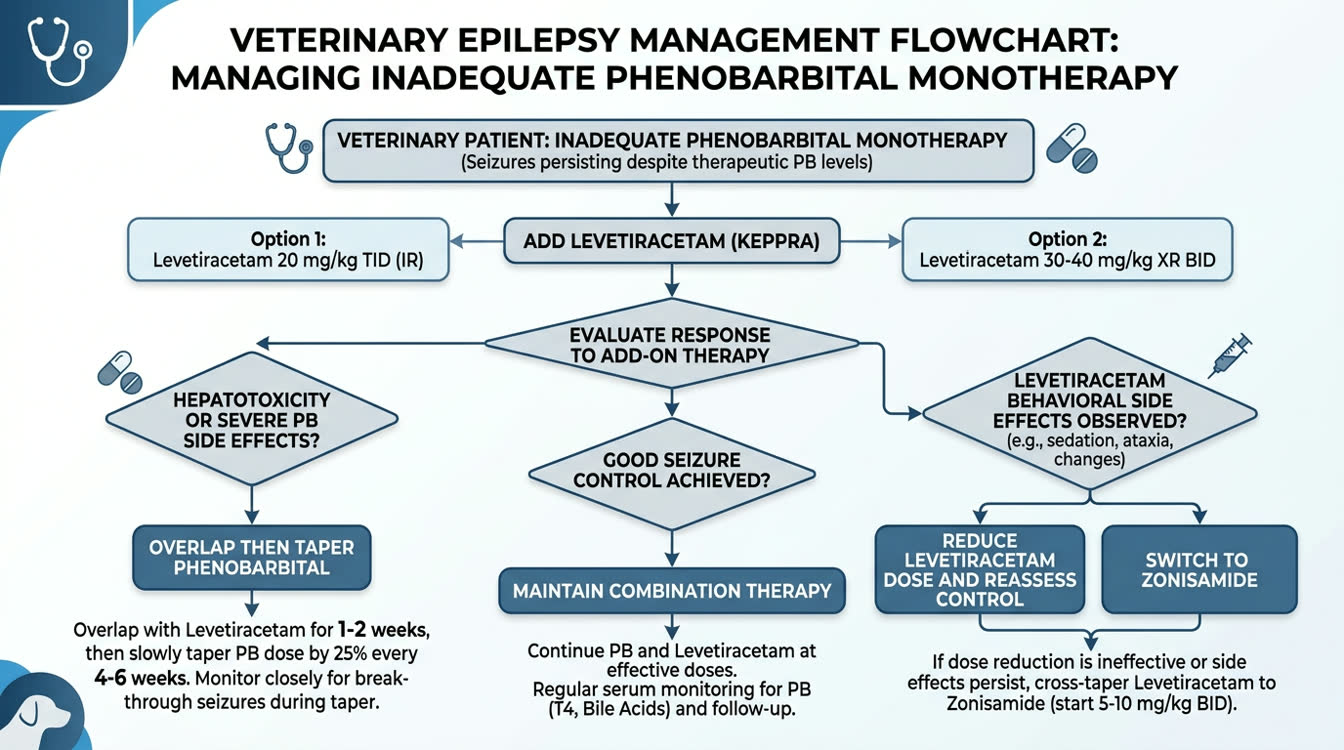
Adding levetiracetam to phenobarbital is the most common escalation strategy for inadequately controlled canine epilepsy. In dogs where phenobarbital alone achieves only partial control (>1 seizure/month despite therapeutic phenobarbital levels), the combination produces an additional 40-60% improvement in seizure control in published clinical series.
Start levetiracetam at 20 mg/kg TID (or 30-40 mg/kg XR BID) while continuing phenobarbital at its current dose. Reassess seizure frequency after 8-12 weeks.
If phenobarbital hepatotoxicity has developed: add levetiracetam first, allow 4-6 weeks for seizure stability, then taper phenobarbital by 25% every 4-6 weeks while monitoring seizure frequency.
Adverse Effects of Levetiracetam: Levetiracetam is remarkably well-tolerated. The most common adverse effects are:
- Sedation/lethargy: mild, transient at initiation; typically resolves within 1-2 weeks
- Behavioral changes: A subset of dogs (particularly anxious breeds) develop increased anxiety, agitation, or dysphoria — described as "Keppra rage" in humans. In dogs, manifests as increased reactivity or personality change. If behavioral adverse effects are marked: reduce dose or switch to zonisamide
- Cats: Occasional hypersalivation and transient anorexia at initiation
- No hepatotoxicity — liver enzymes remain reliable for other diagnoses
No Dose Adjustment Required For: Phenobarbital does NOT significantly alter levetiracetam pharmacokinetics (unlike other drugs). No dose adjustment for the combination is needed based on drug interaction.
Transition from Phenobarbital to Levetiracetam: For dogs with hepatotoxicity: overlap the two drugs for 8-12 weeks while tapering phenobarbital. Abrupt phenobarbital withdrawal during this period risks status epilepticus even if levetiracetam is aboard. Taper phenobarbital no faster than 25% of total daily dose every 4-6 weeks.
When to Refer to a Veterinary Neurologist:
- Status epilepticus unresponsive to standard protocols
- Seizure onset before 6 months or after 7 years (atypical for idiopathic epilepsy — investigate structural cause)
- Progressive neurological deficits between seizures
- Failure to control seizures with two or more anticonvulsants at therapeutic levels
Frequently Asked Questions
Why must levetiracetam be given three times daily in dogs?
Levetiracetam has a short half-life in dogs (approximately 4-6 hours), requiring TID dosing to maintain adequate serum concentrations. Extended-release (XR) formulations allow BID dosing by providing sustained drug release. TID standard-release or BID extended-release are both appropriate; choose based on owner compliance.
Does levetiracetam cause liver damage in dogs?
No. Levetiracetam is primarily renally eliminated and does not cause hepatotoxicity or hepatic enzyme induction. This makes it valuable as an alternative or adjunct in dogs with phenobarbital-induced hepatotoxicity, and liver enzymes remain reliable disease markers in patients taking levetiracetam.
Can I use levetiracetam as the sole anticonvulsant in a dog with new-onset epilepsy?
Levetiracetam can be used as monotherapy, but phenobarbital has higher efficacy data for achieving seizure freedom in most studies (60-70% vs 40-50% response rate with levetiracetam monotherapy). Levetiracetam monotherapy is preferred in dogs with hepatic disease, when owner compliance with TID dosing is a concern (use XR), or when the owner declines phenobarbital.
How do I use levetiracetam for at-home cluster seizure management?
Injectable levetiracetam (60 mg/kg) can be administered rectally or intranasally by owners to abort cluster seizures at home. Provide pre-filled syringes and written action plans. This approach reduces emergency visits and is particularly useful in dogs with predictable cluster patterns (multiple seizures in a short window).
Is extended-release levetiracetam (Keppra XR) safe to use in dogs?
Yes. Human Keppra XR tablets (500 mg or 750 mg) can be used in dogs at 30-60 mg/kg BID. The tablets must not be crushed or split. XR is suitable for dogs weighing >10 kg where tablet sizes allow appropriate dosing. It is not practical for most cats due to tablet size and dosing imprecision.
References
- Hardy BT, et al. "Treatment of idiopathic epilepsy in dogs: A systematic review." Journal of Veterinary Internal Medicine. 2012.
- Charalambous M, et al. "Antiepileptic drugs' tolerability and safety — a systematic review and meta-analysis of adverse effects in dogs." BMC Veterinary Research. 2016;12:79.
- Patterson EE, et al. "Levetiracetam pharmacokinetics in dogs with naturally occurring epilepsy." Journal of Veterinary Pharmacology and Therapeutics. 2009.