Quick Answer
A thorough guide to intervertebral disc disease in dogs — covering Hansen Type I and Type II herniations, the 1-to-5 neurological grading scale, surgical options like hemilaminectomy and ventral slot, conservative management, and rehabilitation strategies for recovery.
Key Takeaways
- ✓IVDD is most common in chondrodystrophic breeds like Dachshunds but can affect any dog — Hansen Type I causes sudden disc rupture while Type II involves gradual bulging.
- ✓Neurological grading from 1 (pain only) to 5 (paralysis without deep pain) determines treatment urgency and prognosis — loss of deep pain perception is a time-critical emergency.
- ✓Surgical decompression (hemilaminectomy or ventral slot) achieves success rates above 90% for Grades 1-4 when performed promptly, while conservative management with strict rest is appropriate for milder cases.
- ✓Rehabilitation including underwater treadmill therapy, therapeutic exercises, and laser therapy significantly improves recovery outcomes after both surgical and conservative treatment.
- ✓Weight management, ramps instead of stairs, and learning to recognize early warning signs are the most impactful steps owners can take to prevent IVDD or catch it early.
What Is Intervertebral Disc Disease?
Intervertebral disc disease (IVDD) is one of the most common neurological conditions in dogs, occurring when the cushioning discs between the vertebrae of the spinal column deteriorate, bulge, or rupture into the spinal canal. These discs normally act as shock absorbers that allow flexible movement of the spine, but when they fail, the displaced disc material compresses the spinal cord and surrounding nerves. The result can range from mild back pain to complete paralysis, depending on the severity and location of the disc herniation.
IVDD is especially prevalent in chondrodystrophic breeds — dogs selectively bred for short legs and long backs — including Dachshunds, French Bulldogs, Beagles, Corgis, Basset Hounds, and Shih Tzus. In Dachshunds alone, the lifetime risk of clinically significant IVDD may be as high as 19 to 24 percent. However, IVDD can affect any breed at any age, and large-breed dogs are susceptible to a distinct, slowly progressive form of the disease.
Early recognition of symptoms and prompt veterinary evaluation are critical because the window for successful treatment — particularly surgical intervention — can be narrow. Understanding how IVDD develops, how veterinarians classify its severity, and what treatment options exist empowers owners to act quickly when it matters most.
Hansen Type I vs. Type II Disc Disease
Veterinary neurologists classify IVDD into two primary forms based on how the disc degenerates and herniates. Hansen Type I disc disease involves acute extrusion of the inner disc material (the nucleus pulposus) through a ruptured outer layer (the annulus fibrosus) and directly into the spinal canal. This type is most common in chondrodystrophic breeds, typically affects dogs between 3 and 7 years of age, and often presents as a sudden-onset emergency — a dog may go from playing normally to unable to walk within hours or even minutes.
Hansen Type II disc disease, by contrast, involves a gradual, chronic bulging of the annulus fibrosus into the spinal canal without a dramatic rupture. This form is more common in large-breed, non-chondrodystrophic dogs such as German Shepherds, Labrador Retrievers, and Doberman Pinschers, and it typically develops in middle-aged to older animals over the course of months or years. Symptoms of Type II disease tend to progress slowly — owners may first notice mild hind-limb weakness, a slightly wobbly gait, or reluctance to jump before more obvious deficits appear.
A third, less common variant — Hansen Type III, sometimes called acute non-compressive nucleus pulposus extrusion (ANNPE) — involves a high-velocity extrusion of disc material that causes a concussive injury to the spinal cord without persistent compression. This type often occurs during vigorous exercise and can affect any breed. Understanding these distinctions matters because the type of herniation directly influences the urgency, treatment approach, and expected prognosis.
Neurological Grading: Stages 1 Through 5
When a dog presents with suspected IVDD, the veterinary neurologist performs a detailed neurological examination and assigns a grade from 1 to 5 that describes the severity of spinal cord dysfunction. This grading system is essential for guiding treatment decisions and predicting outcomes. Grade 1 represents pain only — the dog is neurologically normal but exhibits clear signs of neck or back pain such as yelping, reluctance to move, a hunched posture, or muscle spasms. Grade 2 indicates ambulatory paraparesis — the dog can still walk but shows obvious weakness, wobbliness (ataxia), or incoordination in one or more limbs.
Grade 3 is defined as non-ambulatory paraparesis — the dog has some voluntary motor function in the affected limbs but cannot walk or support its own weight. Grade 4 represents paralysis with intact deep pain perception — the dog cannot move the affected limbs voluntarily, but when the neurologist firmly pinches a toe, the dog consciously perceives it and reacts by crying out or turning its head. Grade 5, the most severe, indicates paralysis with loss of deep pain perception — the dog shows no conscious response to even a strong noxious stimulus applied to the toes of the affected limbs.
The distinction between Grade 4 and Grade 5 is the single most important prognostic indicator. Dogs with Grade 4 IVDD that undergo timely surgical decompression have success rates above 90 percent, while Grade 5 dogs face a significantly reduced prognosis — approximately 50 to 60 percent — and the window for surgical intervention is extremely narrow, often cited as 24 to 48 hours from the loss of deep pain. Owners should understand that a worsening neurological grade is always an emergency that warrants immediate veterinary evaluation.
Surgical Decompression vs. Conservative Management
Treatment of IVDD depends primarily on the neurological grade, the type of herniation, and the location of the affected disc. Conservative (non-surgical) management is typically appropriate for Grade 1 and some Grade 2 cases and involves strict cage rest for 4 to 6 weeks, anti-inflammatory medications (commonly corticosteroids or NSAIDs), pain management with gabapentin or other analgesics, and muscle relaxants as needed. Strict confinement is the cornerstone of conservative treatment — the goal is to allow the ruptured disc material to stabilize and the surrounding inflammation to resolve without further herniation.
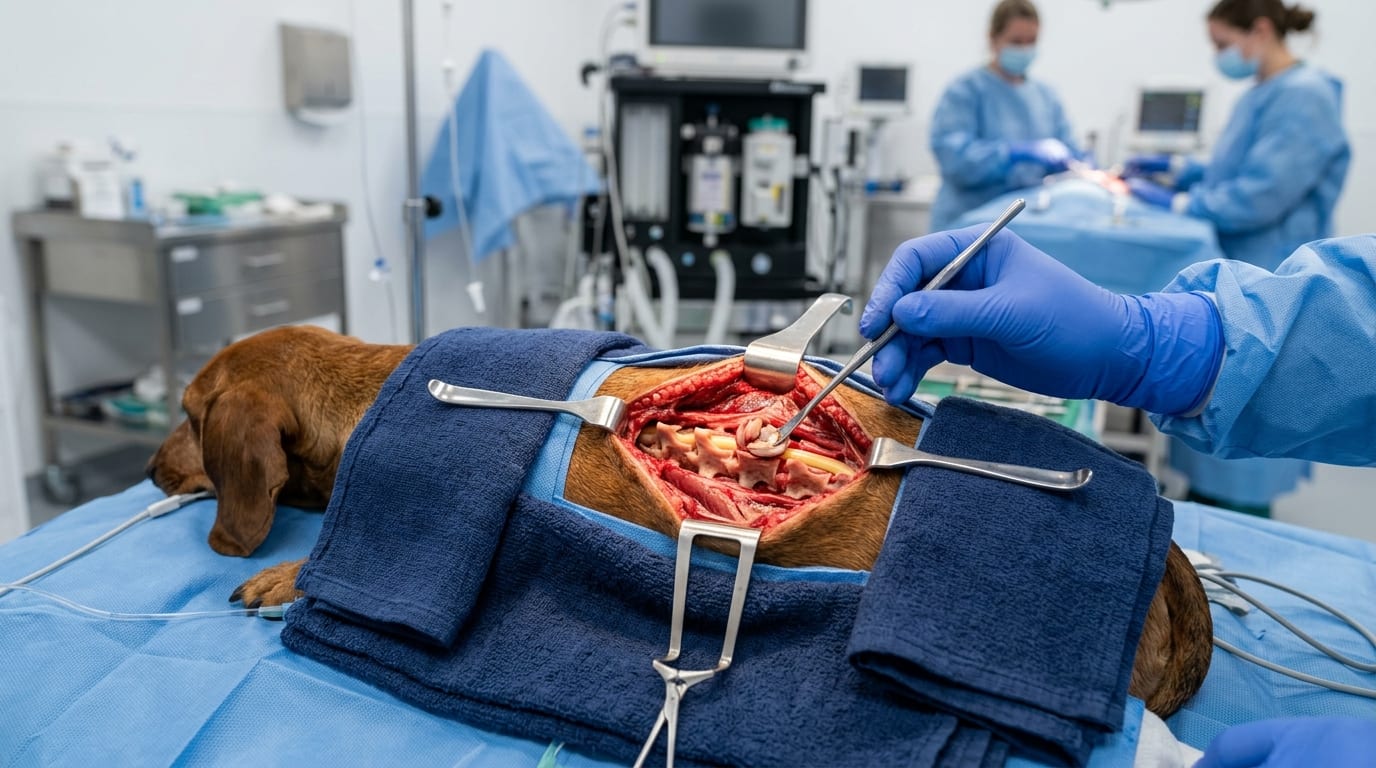
Surgical intervention is generally recommended for Grade 3 through Grade 5 cases and for Grade 2 dogs that fail to improve with conservative management or show signs of worsening. The two most common surgical procedures are hemilaminectomy, used for thoracolumbar (mid-back to lower-back) disc herniations, and ventral slot, used for cervical (neck) disc herniations. In a hemilaminectomy, the surgeon removes a portion of the vertebral bone on one side to access and remove the extruded disc material compressing the spinal cord. In a ventral slot procedure, the surgeon approaches from the underside of the neck and creates a window through the vertebral bodies to decompress the spinal cord.
Advanced imaging — typically MRI, or sometimes CT myelography — is performed before surgery to precisely localize the herniation. Surgical success rates are encouraging: over 90 percent for Grades 1 through 4 when surgery is performed promptly. Cost is a significant consideration, as IVDD surgery including diagnostics and hospitalization typically ranges from $3,000 to $8,000 or more depending on the facility and geographic location. Pet insurance that covers hereditary and congenital conditions can substantially offset these costs if purchased before clinical signs develop.

Rehabilitation and Recovery After IVDD
Whether a dog undergoes surgery or is managed conservatively, rehabilitation plays a vital role in restoring mobility, rebuilding muscle strength, and improving long-term quality of life. Formal rehabilitation — often conducted by a certified canine rehabilitation therapist (CCRT or CCRP) — may include underwater treadmill therapy, which allows dogs to practice walking in a buoyant, low-impact environment that supports their body weight while encouraging active limb movement. Therapeutic exercises such as cavaletti rails, balance board work, and assisted standing help rebuild proprioceptive awareness — the dog's ability to sense where its limbs are in space.
Other modalities commonly used in IVDD recovery include laser therapy (photobiomodulation) to reduce inflammation and promote tissue healing, neuromuscular electrical stimulation (NMES) to prevent muscle atrophy in paralyzed limbs, and manual therapies such as passive range-of-motion exercises and massage to maintain joint flexibility. Acupuncture has also shown promise as a complementary treatment, with several veterinary studies suggesting it may improve neurological recovery when combined with standard care.
The timeline for recovery varies considerably. Dogs with Grade 1 or 2 IVDD often improve within 2 to 4 weeks of strict rest, while those recovering from surgery for Grade 3 or 4 disease may require 6 to 12 weeks of structured rehabilitation. Grade 5 dogs that regain function may need months of dedicated therapy. Throughout recovery, preventing re-injury is paramount — ramps should replace stairs, jumping on and off furniture must be restricted long-term, and maintaining a healthy body weight reduces ongoing stress on the spine.

What You Can Do at Home
If your dog has been diagnosed with IVDD or belongs to a high-risk breed, there are meaningful steps you can take at home to reduce the risk of disc herniation and support recovery if it occurs. Weight management is arguably the single most impactful preventive measure — excess body weight places additional compressive forces on the intervertebral discs with every step, jump, and twist. Work with your veterinarian to determine your dog's ideal body condition score and maintain it through portion control and appropriate exercise.
Environmental modifications are essential for both prevention and post-treatment recovery. Install ramps at all locations where your dog regularly jumps — bed, couch, car, and porch steps. Use baby gates to block staircases, and consider a supportive orthopedic bed that cushions the spine during rest. For dogs recovering from IVDD, a properly sized crate or exercise pen for strict confinement is non-negotiable during the prescribed rest period — even dogs that appear to feel better must complete the full rest protocol, as premature return to activity is a common cause of relapse.
Learn to recognize the early warning signs of IVDD so you can seek veterinary care before the condition progresses: reluctance to jump or climb stairs, a hunched or tense posture, yelping when picked up, trembling, reluctance to lower the head to eat or drink (cervical IVDD), and any change in gait or coordination. If your dog suddenly loses the ability to walk or drags its hind legs, treat this as an emergency and seek veterinary care immediately — time is a critical factor in neurological outcomes. Carrying your dog with full spinal support (one hand under the chest, one under the hips, keeping the spine level) during transport to the veterinarian can help prevent further disc extrusion.

Frequently Asked Questions
What breeds are most at risk for intervertebral disc disease?
Chondrodystrophic breeds — those bred for short legs and long backs — carry the highest risk. Dachshunds are by far the most affected, with a lifetime IVDD risk estimated at 19 to 24 percent. French Bulldogs, Beagles, Corgis, Basset Hounds, Shih Tzus, Cocker Spaniels, and Pekingese are also frequently diagnosed. However, large-breed dogs like German Shepherds and Labrador Retrievers can develop Hansen Type II disease, and any dog can experience a disc herniation.
How quickly does IVDD need to be treated surgically?
The urgency depends on the neurological grade. Dogs with Grade 5 IVDD — paralysis with loss of deep pain perception — are considered surgical emergencies, and most neurologists recommend decompression within 24 to 48 hours of deep pain loss for the best chance of recovery. Dogs at Grades 3 and 4 should also be evaluated for surgery promptly, ideally within the first few days. Delays in treatment can result in permanent spinal cord damage that limits the potential for recovery.
Can a dog fully recover from IVDD without surgery?
Yes, many dogs with Grade 1 or mild Grade 2 IVDD recover well with conservative management, which centers on 4 to 6 weeks of strict cage rest combined with pain medication and anti-inflammatory drugs. Studies suggest that approximately 50 percent of dogs managed conservatively will have a recurrence of clinical signs at some point. Dogs with higher neurological grades generally have better outcomes with surgical intervention.
How much does IVDD surgery typically cost?
The total cost of IVDD surgery — including advanced imaging (MRI or CT), the surgical procedure itself, anesthesia, and post-operative hospitalization — typically ranges from $3,000 to $8,000 or more, depending on the geographic location, the specialty hospital, and any complications. Rehabilitation therapy adds additional cost. Pet insurance policies that cover hereditary conditions can significantly reduce out-of-pocket expenses if purchased before clinical signs develop.
What can I do to prevent IVDD in my dog?
While you cannot change your dog's genetic predisposition, you can substantially reduce the mechanical stress on its spine. Keep your dog at a lean, healthy body weight. Install ramps wherever your dog would otherwise jump — onto furniture, into cars, and up porch steps. Avoid games that involve intense twisting, jumping, or rough play. Use a harness instead of a collar to eliminate neck strain during walks. These measures are especially important for chondrodystrophic breeds.
References
- Brisson, B.A. (2010). Intervertebral Disc Disease in Dogs. Veterinary Clinics of North America: Small Animal Practice, 40(5), 829–858.
- American College of Veterinary Internal Medicine (ACVIM). Canine Intervertebral Disc Disease — Consensus Statements and Clinical Resources. https://www.acvim.org
- Merck Veterinary Manual. Intervertebral Disc Disease in Dogs and Cats. https://www.merckvetmanual.com/musculoskeletal-system/diseases-of-the-spinal-column-and-cord/intervertebral-disc-disease
- Joaquim, J.G.F. et al. (2010). Acupuncture for the Treatment of Intervertebral Disk Disease in Dogs: A Systematic Review. Journal of Veterinary Internal Medicine, 24(6), 1453–1461.