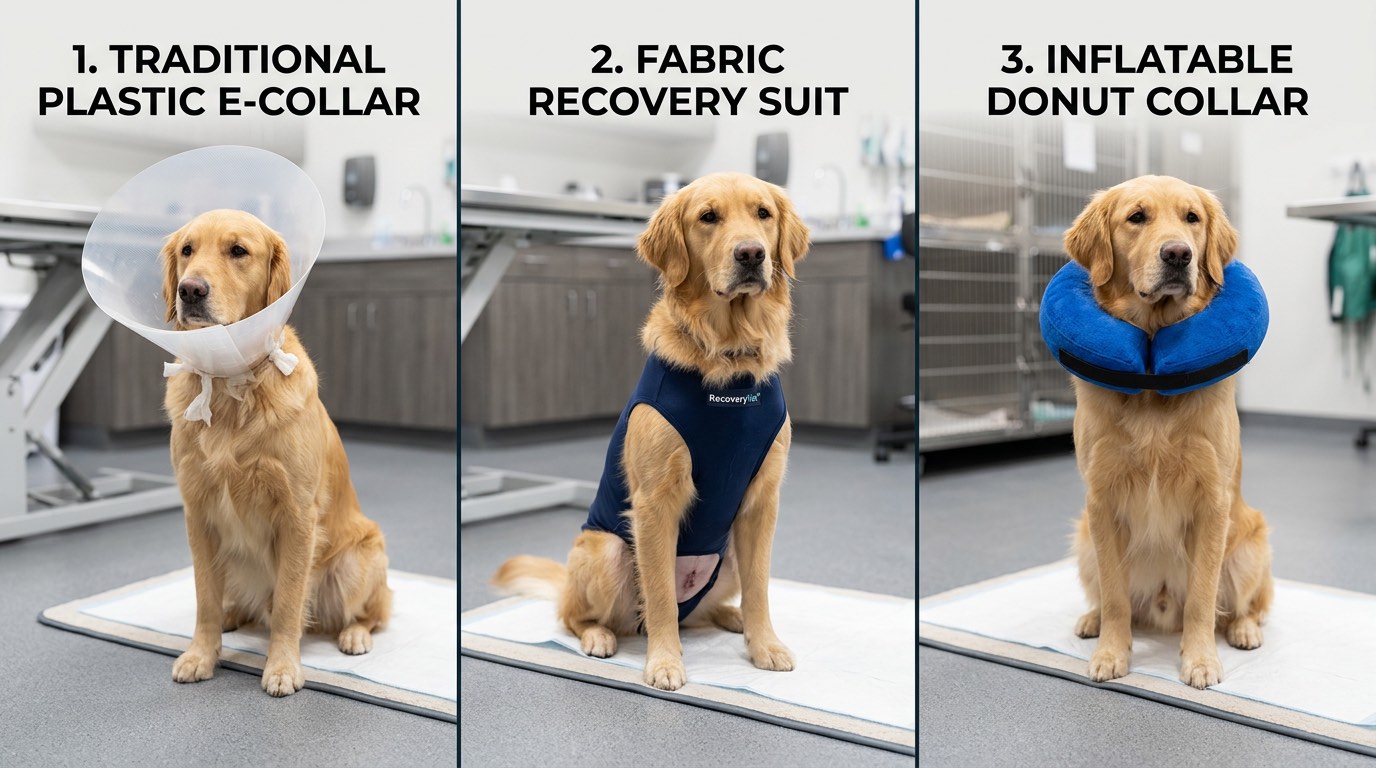
Quick Answer
Proper post-surgical wound protection is essential for preventing dehiscence and infection. This guide covers Elizabethan collar sizing and fitting, soft collar and recovery suit alternatives with evidence review, incision assessment grading criteria, and owner education for home monitoring after surgery.
Key Takeaways
- ✓Rigid plastic E-collars remain the gold standard with 97% wound protection efficacy; alternatives have lower efficacy and should be selected based on wound location and patient compliance.
- ✓E-collar length must extend past the tip of the nose for all wound locations; a 1–2 finger gap at the neck prevents pressure sores and choking.
- ✓Recovery suits provide approximately 90% efficacy for trunk (abdominal, thoracic, flank) incisions and are a reasonable alternative to E-collars in compliant patients.
- ✓Inflatable donut collars provide only 76.8% protection overall and are insufficient for flexible breeds or wounds at body regions accessible by neck bending.
- ✓Normal post-surgical incision appearance includes mild swelling and serosanguineous discharge for the first 1–3 days; purulent discharge, progressive swelling after day 3, or wound gaping requires same-day veterinary assessment.
- ✓Owners should be explicitly counseled that collars must remain on overnight and whenever the patient is unsupervised, and that any contact with the incision is an indication to replace or upgrade wound protection.
Elizabethan Collar: Correct Sizing, Fitting, and When to Use
The traditional plastic Elizabethan collar (E-collar, cone of shame) remains the gold standard for preventing wound interference. When properly fitted, it is more reliable than most alternatives. Poor fitting is the most common cause of treatment failure.
Sizing Principles
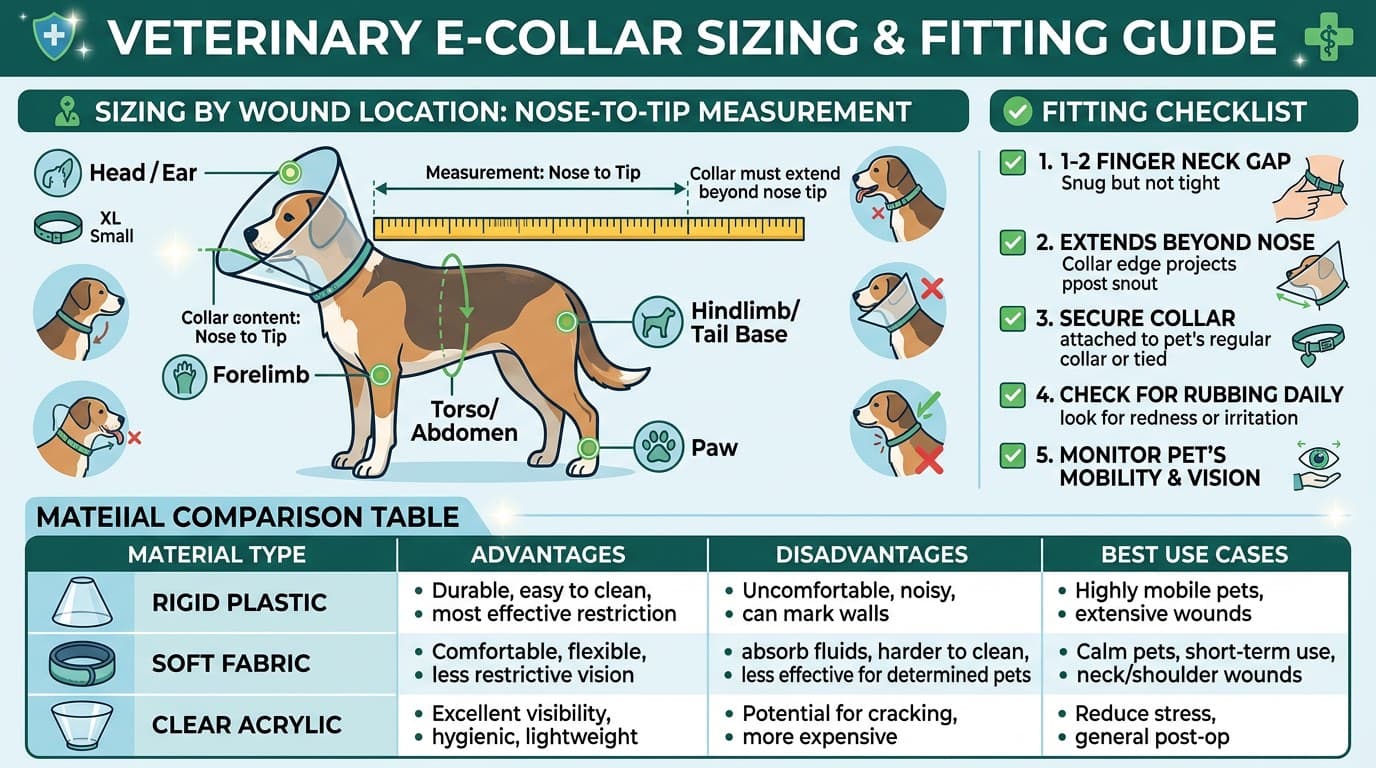
The collar must extend beyond the tip of the nose to prevent the animal from reaching any part of its body with its mouth. The neck circumference must allow 1–2 fingers between the collar and the neck (prevents choking and pressure sores).
| Body Region | Collar Length Required from Neck Base |
|---|---|
| Head wounds | 2/3 of head length beyond nose |
| Neck wounds | Standard fitting (nose-length) |
| Thorax/axilla | Must extend past nose length |
| Abdomen, flank | Must extend past nose length |
| Perineum, tail base | Extended length — longest collar |
| Distal limb | Varies — patient can sometimes reach with head |
Collar Material Options
| Type | Advantages | Disadvantages |
|---|---|---|
| Rigid plastic (standard) | Most reliable; prevents all mouthing | Peripheral vision reduced; noise; stress |
| Soft fabric cone | More comfortable; allows peripheral vision | Can be compressed against body; less reliable for determined patients |
| Clear acrylic | Full vision; rigid protection | More expensive |
Fitting Verification Protocol 1. Attach collar with 1–2 finger gap at neck 2. Have the patient attempt to reach each surgical site 3. Verify the patient cannot make contact even with full neck extension 4. Observe patient walking through doorway — collar should not catch
When E-Collar Is Mandatory
- Any suture line accessible to the patient
- Ophthalmologic procedures (rubbing is as dangerous as licking)
- Any wound with drain placement
- Patients with history of self-trauma
Alternatives: Recovery Suits, Inflatable Collars, and Bandages
Alternative wound protection devices have grown in popularity due to improved patient quality of life and reduced stress. Evidence shows that while alternatives can work well in motivated patients, they require careful monitoring and are not universally interchangeable with rigid E-collars.
Recovery Suits (Body Suits)
Recovery suits cover the trunk and can protect abdominal, flank, thoracic, and perineal incisions. Designed to prevent licking while allowing movement, eating, and drinking.
| Feature | Detail |
|---|---|
| Best for | Abdominal, flank, and thoracic incisions |
| Not suitable for | Limb wounds, head wounds, E-collar-required ophthalmology cases |
| Sizing | Should fit snugly but not restrict breathing or urination/defecation |
| Evidence | Comparable efficacy to E-collar for trunk incisions in compliant patients |
| Key risk | Must be removed for elimination — ensure owner understands |
Inflatable Donut Collar
Inflates to form a ring around the neck; less obstructive than rigid cone.
| Feature | Detail |
|---|---|
| Best for | Patients with mild tendency to lick; short-term |
| Not suitable for | Determined lickers; limb wounds patient can reach by bending neck |
| Key limitation | Does not prevent access to lateral thorax or perineum in flexible dogs |
Evidence Comparison
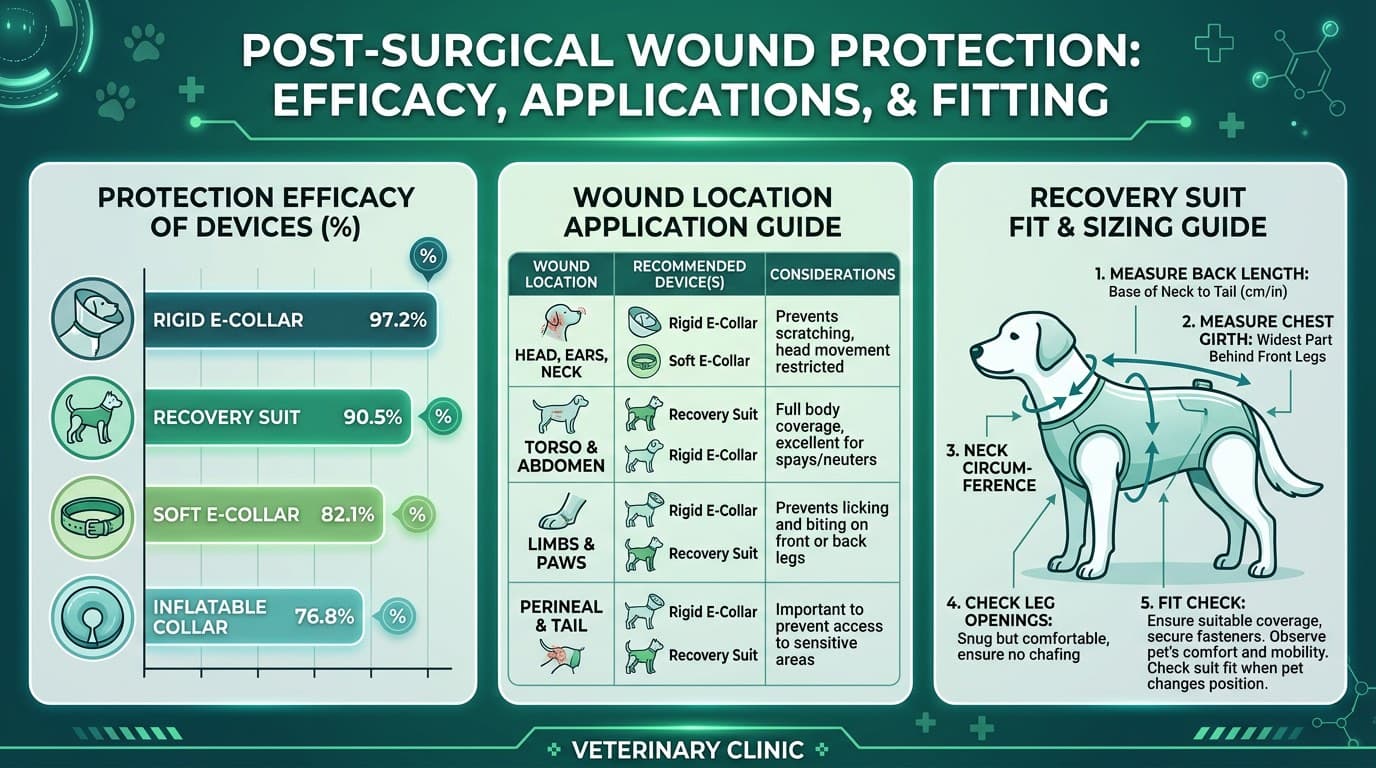
- Rigid E-collar: highest wound protection rate (97.2%)
- Recovery suit (trunk): 90.5% protection for abdominal incisions
- Inflatable collar: 76.8% protection overall; significantly lower for flexible breeds
- Soft E-collar: 82.1% protection; failures in brachycephalic breeds with neck flexibility
Recommendation Summary
| Wound Location | First Choice | Acceptable Alternative |
|---|---|---|
| Abdominal/flank | Rigid E-collar | Recovery suit |
| Perineal/tail | Rigid E-collar | Recovery suit (extended) |
| Distal limb | Rigid E-collar + bandage | Rigid E-collar only |
| Ophthalmologic | Rigid E-collar | None — mandatory |
| Thoracic | Rigid E-collar | Recovery suit |
Incision Assessment and Owner Education for Home Monitoring
Clear owner education about normal vs abnormal incision appearance is essential to prevent delayed presentation of wound complications. Dehiscence and infection are the two most common post-surgical wound complications and are both far more manageable when detected early.
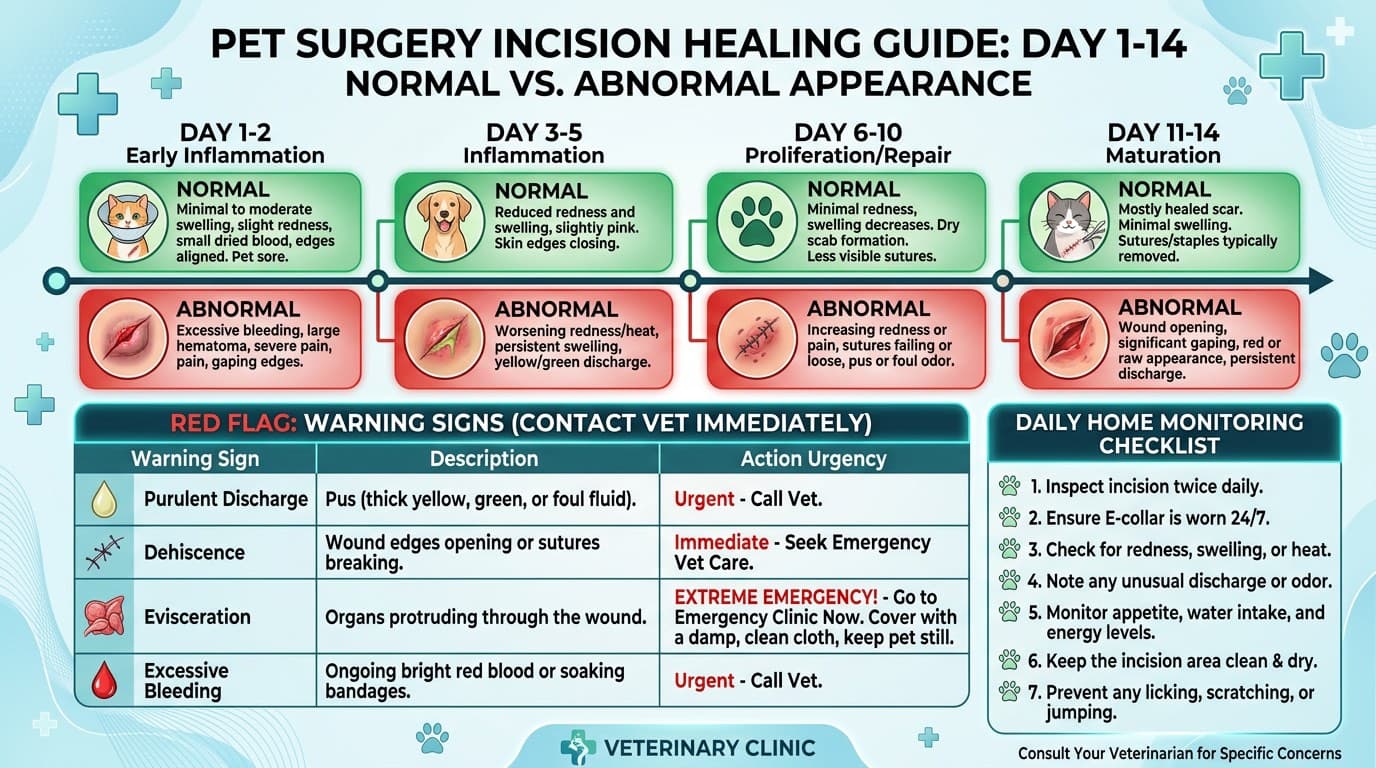
Normal Incision Findings (Days 1–14)
| Timeframe | Expected Appearance |
|---|---|
| Day 1–3 | Mild swelling, bruising, serosanguineous discharge (small amount) |
| Day 3–7 | Swelling subsides; incision closes; mild erythema at edges |
| Day 7–10 | Sutures/staples visible; margins well-apposed; minimal redness |
| Day 10–14 | Epithelial healing complete; suture removal typically 10–14 days |
Concerning Incision Signs Requiring Veterinary Assessment
| Sign | Potential Cause | Action |
|---|---|---|
| Purulent (yellow/green) discharge | Infection | Same-day exam |
| Significant swelling after day 3 | Seroma, hematoma, abscess | Same-day exam |
| Suture gaps (dehiscence) | Self-trauma, tension, infection | Immediate emergency care |
| Foul odor | Anaerobic infection | Same-day exam |
| Redness spreading beyond incision | Cellulitis | Same-day exam |
| Tissue protruding through incision | Evisceration | Emergency — go now |
Owner Monitoring Checklist (Send Home with Discharge Instructions)
Daily assessment at home:
- Inspect incision in good lighting twice daily
- Do not apply any creams, ointments, or sprays unless directed
- Monitor for chewing, licking, or rubbing — replace E-collar immediately if any contact occurs
- Activity restriction: leash walks only; no running, jumping, or stairs for [10–14 days depending on procedure]
- Remove bandages as directed — do not rewrap at home unless specifically trained
- Contact clinic immediately if: sutures missing, wound open, heavy discharge, foul smell, or patient is systemically unwell
Suture Removal Timing
- Skin sutures: 10–14 days
- High-tension areas (joint skin, over orthopedic implants): 14 days
- Facial sutures: 7–10 days
Frequently Asked Questions
How long must a dog wear an E-collar after surgery?
E-collars should remain on until sutures or staples are removed at 10–14 days, or until the incision is fully healed. If the patient is not interfering with the wound when unsupervised, brief collar-free periods under direct observation are acceptable, but the collar must be replaced during alone time, overnight, and whenever the patient is out of sight.
Are recovery suits as effective as E-collars?
Recovery suits provide approximately 90% protection for abdominal and trunk incisions compared to 97% for rigid E-collars. They are an appropriate alternative for motivated patients with trunk incisions, but rigid E-collars remain more reliable, particularly for determined lickers and for incisions at body regions the patient can reach by bending.
My dog seems very distressed wearing the E-collar — what should I do?
Some distress is normal for the first few hours as the patient acclimates. Feed meals with the collar on to associate it with positive experiences. If distress is severe or persistent, discuss alternatives (recovery suit, soft collar) with your veterinarian. Anti-anxiety medication (trazodone, gabapentin) may be appropriate for highly anxious patients.
What does normal incision swelling look like after surgery?
Mild swelling along the incision line in the first 1–3 days is normal due to tissue edema and fluid accumulation. A small amount of serosanguineous (pink-tinged) discharge is also normal in the first 24 hours. Swelling should progressively decrease from day 3 onward. Increasing swelling after day 3, or soft fluctuant swelling (fluid wave), may indicate a seroma or hematoma.
When is wound dehiscence an emergency?
Any opening of the suture line with tissue protruding (evisceration) is an immediate emergency — cover the exposed tissue with a clean moist cloth and go to an emergency clinic immediately. Partial dehiscence without organ exposure is urgent (same day) but not immediately life-threatening if the opening is small and dry.
References
- Sander B, Bell C, Anderson K, et al. A randomized controlled trial comparing different types of wound dressings following canine surgery. BMC Vet Res. 2020;16(1):287.
- Hofmeister EH, Egger CM. Evaluation of medetomidine, acepromazine and buprenorphine as postoperative analgesics in cats. J Am Anim Hosp Assoc. 2004;40(3):216-220.
- Bubenik LJ, Hosgood GL, Waldron DR, Snow LA. Frequency of urinary tract infection in catheterized dogs and comparison of bacterial culture and susceptibility testing results for catheterized and noncatheterized dogs with urinary tract infections. J Am Vet Med Assoc. 2007;231(6):893-899.