Quick Answer
Transitional cell carcinoma (TCC/UC) is the most common urinary tract cancer in dogs. This guide covers the trigone location challenge, CADET BRAF non-invasive urine test, piroxicam 0.3 mg/kg q24h protocol, mitoxantrone combination, Palladia (toceranib), and realistic survival times.
Key Takeaways
- ✓TCC/UC most common in Scottish Terriers (18-20× risk); female dogs 2× more affected than males
- ✓Trigone location in 60-70% of cases makes surgical cure impossible for most dogs
- ✓CADET BRAF urine test: 85% sensitivity, 98% specificity — non-invasive TCC diagnosis
- ✓Piroxicam 0.3 mg/kg PO q24h WITH FOOD + omeprazole GI protection — COX-2 anti-tumor effect unique to TCC
- ✓Piroxicam + mitoxantrone 5 mg/m² IV q3wks: MST 8-10 months; best commonly available protocol
- ✓Palladia 2.75-3.25 mg/kg PO EOD: monitor CBC, biochemistry, BP every 2 weeks initially
TCC/UC in Dogs: Trigone Location, Clinical Signs and CADET BRAF Urine Test
Transitional cell carcinoma (TCC), now more accurately termed urothelial carcinoma (UC), is the most common primary urinary bladder tumor in dogs.
Signalment:
- Middle-aged to older dogs (mean 9–11 years)
- Females affected 2× more than males (opposite to humans)
- Predisposed breeds: Scottish Terrier (18-20× risk), Shetland Sheepdog, Beagle, West Highland White Terrier
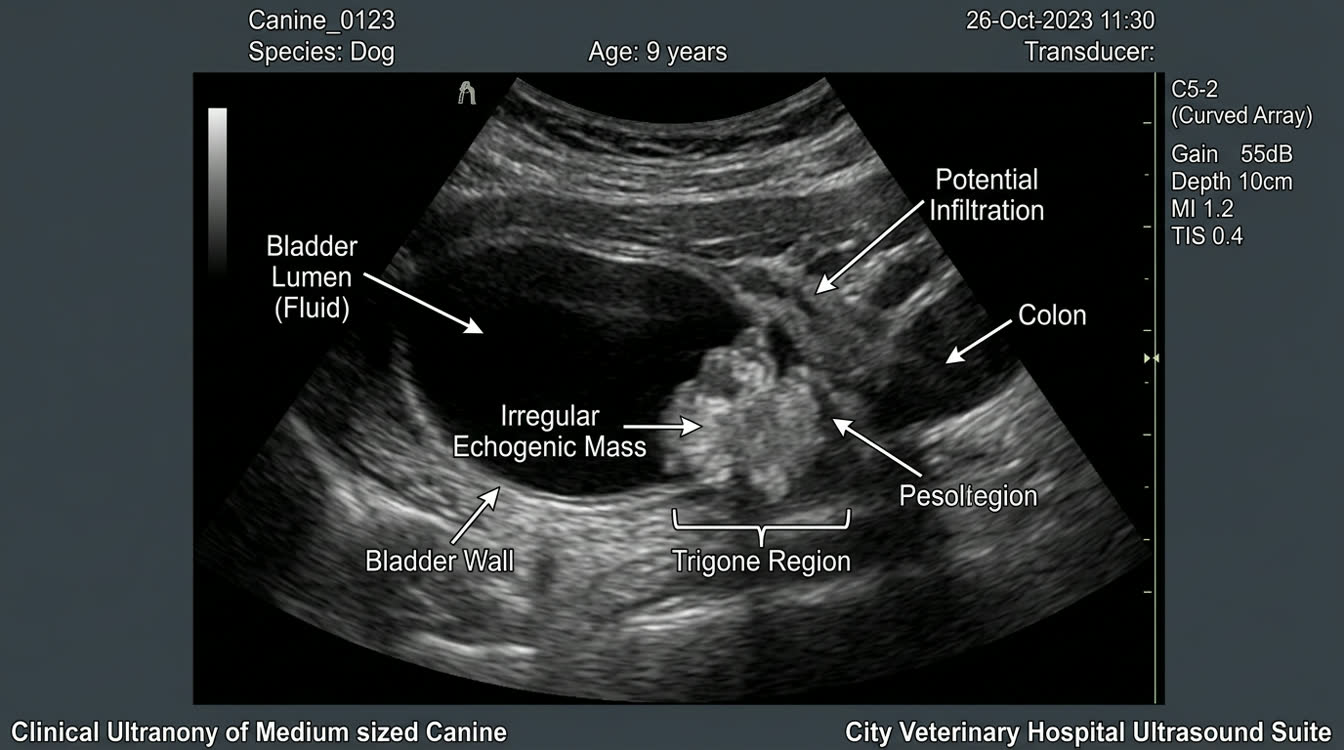
Trigone Location (60–70% of cases)
- Tumor arises at or near the bladder trigone (the triangular region where ureters enter and the urethra exits)
- This location makes surgical excision impractical for most cases — cannot achieve clean margins without sacrificing ureteral orifices
- Can cause bilateral hydroureter, hydronephrosis, and post-renal azotemia as it occludes ureteral openings
Clinical Signs:
- Haematuria (most common presenting complaint)
- Stranguria, pollakiuria, dysuria (lower urinary tract signs mimicking UTI)
- Signs persist or recur despite antibiotic treatment — key red flag
- Rarely: lameness from bone metastases or paraneoplastic hypercalcaemia
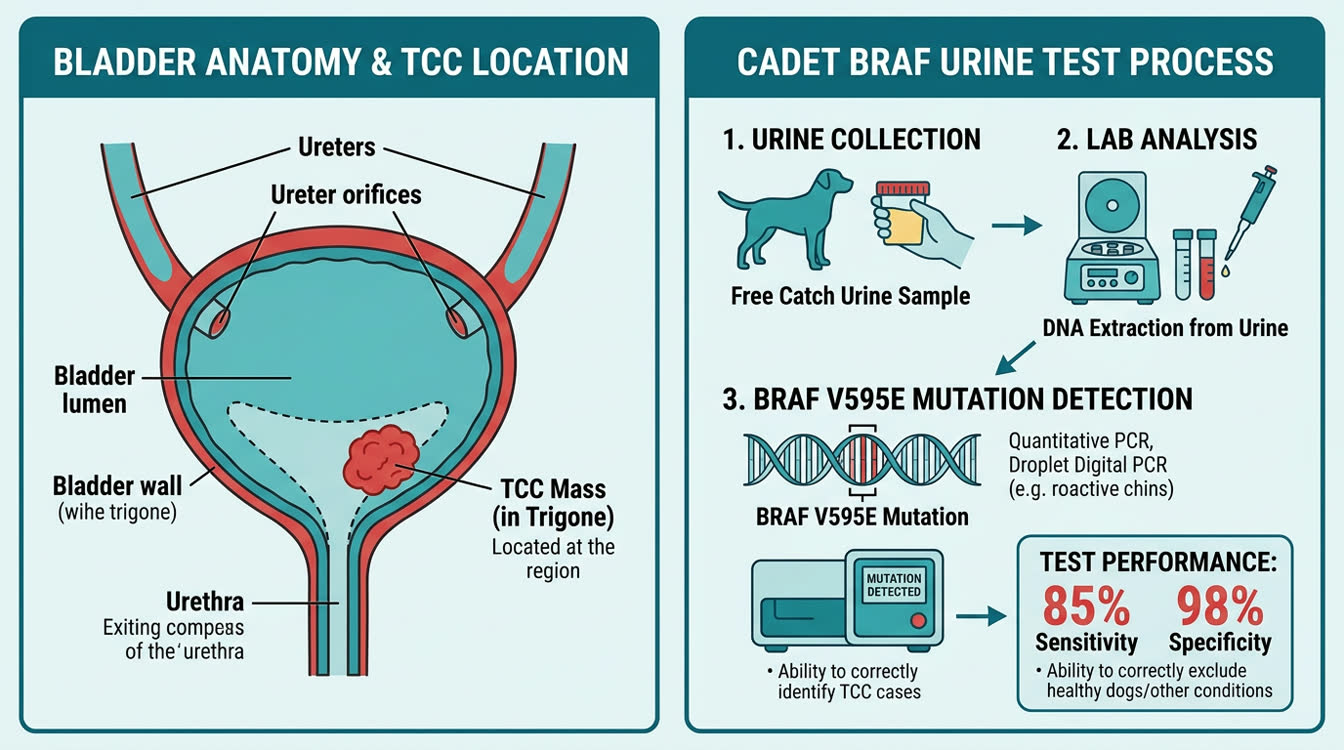
CADET BRAF Urine Test (Non-Invasive Diagnosis)
- Sensitivity: ~85%; Specificity: ~98%
- Non-invasive: urine sample (free-catch or catheter) submitted to Antech Diagnostics
- Eliminates need for traumatic biopsy or cystoscopy in most cases
- A positive BRAF test in a dog with haematuria and bladder mass strongly supports TCC diagnosis
- A negative result does not rule out TCC (15% of TCC are BRAF mutation-negative)
Piroxicam 0.3 mg/kg Protocol and Mitoxantrone Combination Chemotherapy
Piroxicam — First-Line Medical Management
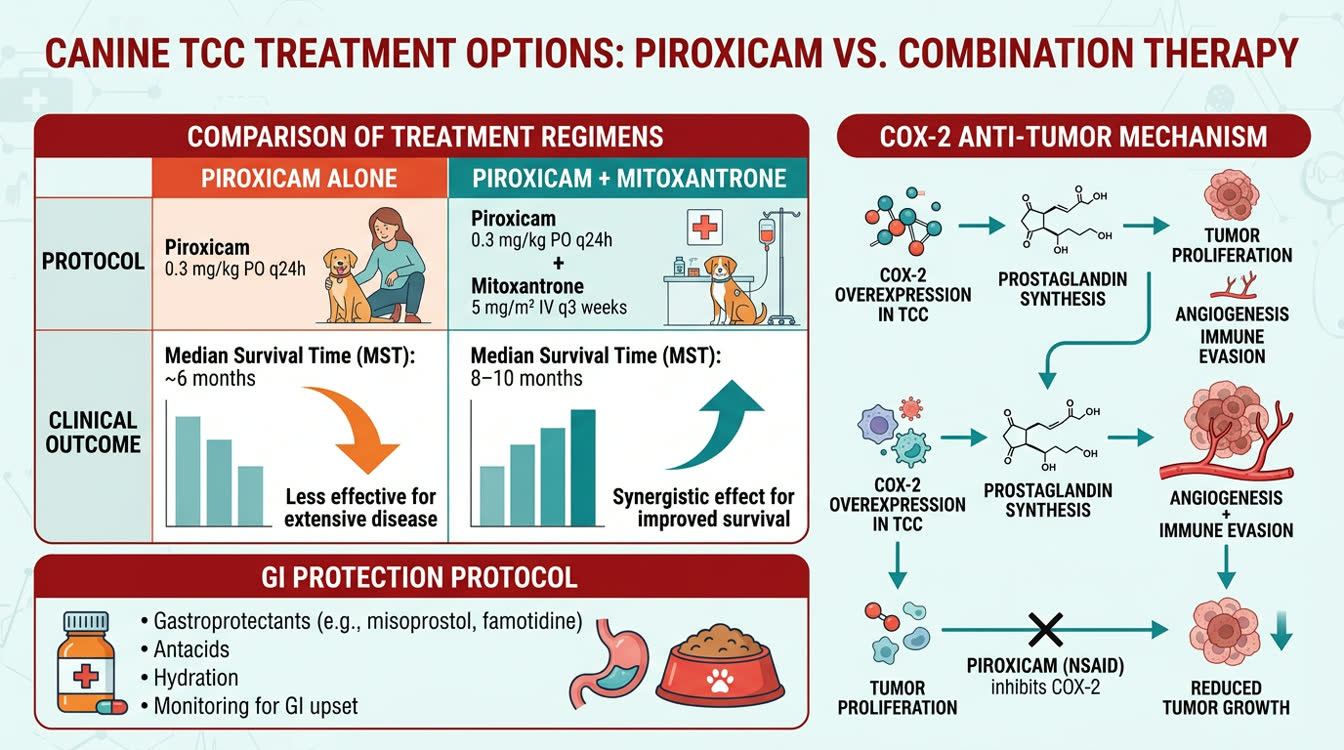
- COX-2 enzyme overexpressed in TCC cells → piroxicam's COX-2 inhibition has direct anti-tumor effects
- Inhibits tumor prostaglandin synthesis, tumor angiogenesis, and promotes apoptosis
Piroxicam Protocol:
- 0.3 mg/kg PO q24h with food (GI protection critical)
- Must give with food or misoprostol to reduce GI ulceration risk
- Concurrent omeprazole 1 mg/kg PO q24h is commonly added
- Avoid combining with other NSAIDs or corticosteroids
- Monitor: renal function (BUN, creatinine) every 4–8 weeks; CBC
Clinical Response to Piroxicam Alone:
- Objective tumor response (partial remission): ~18–20%
- Stable disease: ~60%
- Median survival with piroxicam alone: 6 months
---
Mitoxantrone + Piroxicam Combination
- Mitoxantrone 5 mg/m² IV every 3 weeks × 4–6 cycles
- Combined with piroxicam ongoing
- Response rate: 35% objective response; stable disease ~50%
- Median survival: 8–10 months
Carboplatin Alternatives:
- Carboplatin 300 mg/m² IV q3wks + piroxicam: similar efficacy to mitoxantrone combination
- Gemcitabine emerging as alternative in refractory cases
GI Protection Protocol for Piroxicam:
| Medication | Dose | Indication |
|---|---|---|
| Omeprazole | 1 mg/kg PO q24h | Prophylactic GI protection |
| Misoprostol | 2–5 mcg/kg PO q8h | High-risk patients |
| Give piroxicam | Always with food | Non-negotiable |
Palladia (Toceranib), Surgical Options, Survival Times and Monitoring
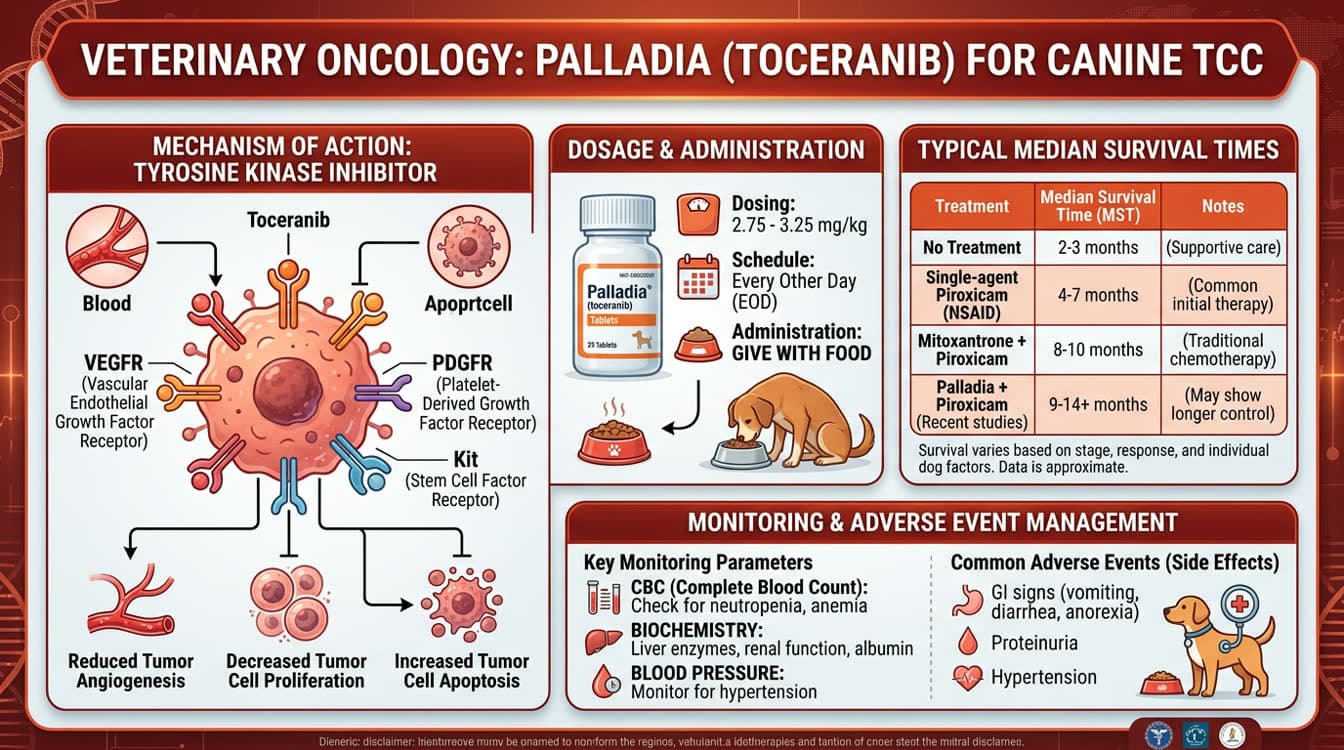
Palladia (Toceranib Phosphate) for TCC Palladia is an oral targeted tyrosine kinase inhibitor (TKI) with multi-receptor activity.
Mechanism: Inhibits VEGFR, PDGFR, Kit, Flt3 — anti-angiogenic and direct anti-tumor effects
Dosing for TCC:
- 2.75–3.25 mg/kg PO every other day (EOD), with food
- Commonly combined with piroxicam (reducing piroxicam to 0.3 mg/kg PO q48h when combined due to GI risk)
- Response in TCC: ~25–30% objective response; median survival with Palladia ± piroxicam ~6–9 months
Monitoring Palladia:
- CBC and biochemistry every 2 weeks initially, then monthly
- Blood pressure monitoring (hypertension)
- Watch for: GI signs (vomiting, diarrhoea), anorexia, neutropenia, elevated hepatic enzymes
- Dose reduce (2.75 → 2.5 mg/kg EOD) if Grade 2+ adverse effects
---
Surgical Options
- Transurethral resection (TUR): endoscopic debulking — palliative, not curative; can improve urinary outflow
- Partial cystectomy: only when tumor is in the bladder apex (away from trigone) — minority of cases
- Tube cystostomy: urinary diversion for urethral obstruction
---
Realistic Survival Expectations:
| Treatment | MST |
|---|---|
| No treatment | 2–4 months |
| Piroxicam alone | 6 months |
| Piroxicam + mitoxantrone | 8–10 months |
| Piroxicam + Palladia | 6–9 months |
Related articles: [Osteosarcoma in Dogs](/articles/osteosarcoma-dogs-treatment) | [Mast Cell Tumors in Dogs](/articles/mast-cell-tumor-dogs)
Frequently Asked Questions
What is the CADET BRAF test for dogs?
The CADET BRAF test detects a specific BRAF gene mutation (V595E) present in approximately 85% of canine transitional cell carcinomas. It uses a free-catch or catheter urine sample submitted to Antech Diagnostics. Sensitivity is ~85%, specificity ~98%. A positive result in a dog with haematuria and bladder mass strongly supports TCC diagnosis without invasive biopsy.
Why is piroxicam used for bladder cancer in dogs?
TCC/UC cells overexpress the COX-2 enzyme. Piroxicam inhibits COX-2, which directly inhibits tumor prostaglandin synthesis, reduces tumor angiogenesis, and promotes tumor cell apoptosis — making it uniquely anti-tumor (beyond just anti-inflammatory). Dose: 0.3 mg/kg PO q24h always with food and GI protection (omeprazole).
What is the survival time for dogs with TCC bladder cancer?
With piroxicam alone: ~6 months MST. Piroxicam + mitoxantrone: 8-10 months. Piroxicam + Palladia (toceranib): 6-9 months. With no treatment: 2-4 months. Some dogs with slow-growing disease or excellent treatment response may live 12-18 months.
Can TCC in dogs be cured surgically?
Surgical cure is rarely possible because 60-70% of TCC arises at the bladder trigone, making complete excision impossible without sacrificing ureteral orifices. Partial cystectomy can be curative when tumors are located at the bladder apex (away from the trigone), but this represents only a minority of cases.
What is Palladia and how does it help dogs with TCC?
Palladia (toceranib phosphate) is an oral targeted tyrosine kinase inhibitor that blocks multiple tumor growth receptors (VEGFR, PDGFR, Kit). Dose: 2.75-3.25 mg/kg EOD with food. It has anti-angiogenic and direct anti-tumor effects in TCC. Response rate ~25-30%. Commonly combined with piroxicam.
References
- Knapp DW, et al. Piroxicam therapy in 34 dogs with transitional cell carcinoma of the urinary bladder. J Vet Intern Med. 1994.
- Henry CJ, et al. Evaluation of a bladder tumor antigen test as a screening test for transitional cell carcinoma of the lower urinary tract in dogs. Am J Vet Res. 2003.
- Schrempp DR, et al. Toceranib phosphate (Palladia) in the management of urinary bladder transitional cell carcinoma in dogs. J Small Anim Pract. 2013.