Quick Answer
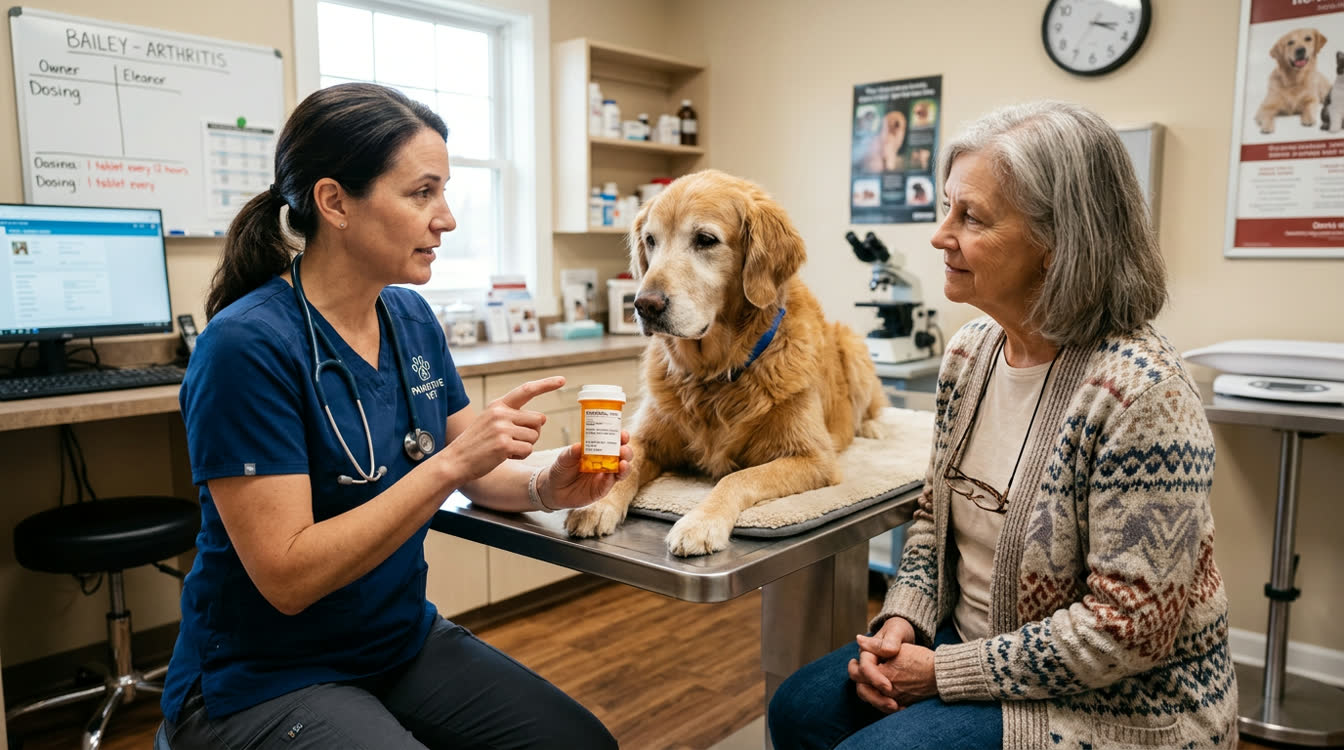
Tramadol is one of the most widely prescribed oral analgesics in veterinary practice for both dogs and cats. This guide covers its dual mechanism of action, species-specific pharmacokinetics (cats metabolize it differently), dosing protocols, and its clinical role in multimodal pain management.
Key Takeaways
- ✓Tramadol has a dual mechanism: weak mu-opioid agonism (via M1 metabolite) and serotonin-norepinephrine reuptake inhibition.
- ✓Dogs produce M1 inconsistently due to CYP2D6 variation — tramadol should not be the sole analgesic for moderate-severe pain in dogs.
- ✓Cats are more consistently analgesed by tramadol due to the SNRI mechanism and longer half-life.
- ✓Standard dosing: dogs 2–5 mg/kg PO q8–12h; cats 2–4 mg/kg PO q12h.
- ✓Avoid concurrent SSRIs or MAOIs — serotonin syndrome risk.
- ✓Best used as part of multimodal analgesia alongside NSAIDs and/or gabapentin.
Dual Mechanism and Species-Specific Pharmacokinetics
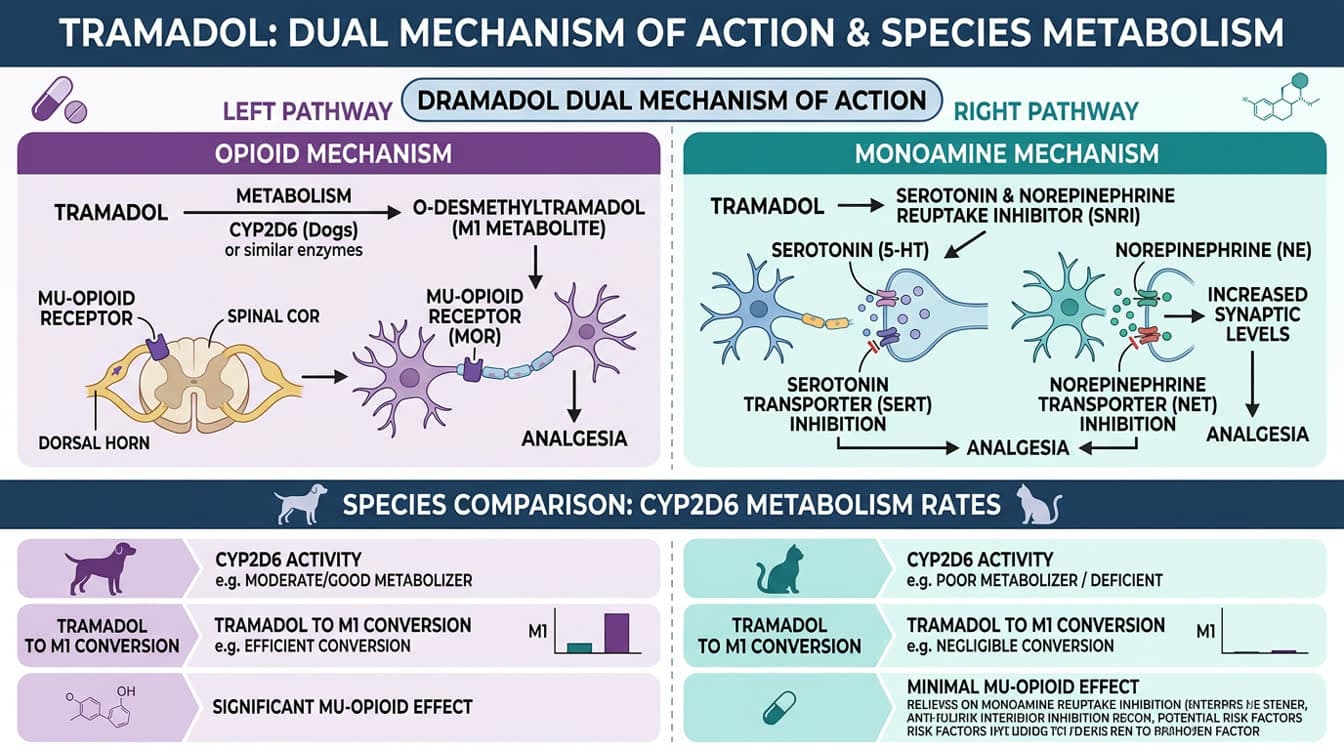
Tramadol exerts analgesic effects through two distinct mechanisms:
1. Weak Mu-Opioid Agonism Tramadol itself is a pro-drug. Its metabolite O-desmethyltramadol (M1) is the primary mu-opioid agonist, with 200x greater affinity for mu receptors than the parent compound.
2. Serotonin-Norepinephrine Reuptake Inhibition Tramadol also inhibits reuptake of serotonin and norepinephrine in the spinal cord, augmenting descending pain inhibitory pathways — contributing particularly to neuropathic pain control.
Species-Specific Pharmacokinetics (Critical Difference)
| Parameter | Dogs | Cats |
|---|---|---|
| Primary analgesic metabolite | O-desmethyltramadol (M1) | Tramadol itself (poor M1 production) |
| CYP2D6 metabolism | Active | Reduced (lower M1) |
| Duration of action | 4–6 h | 6–12 h (longer due to slower metabolism) |
| Bioavailability (PO) | ~65% | ~90% |
| Evidence of efficacy | Moderate (some controversy) | Good for acute pain |
Important note for dogs: Multiple clinical studies show that dogs metabolize tramadol inconsistently and M1 production is variable. Some dogs produce insufficient M1 for effective analgesia — tramadol should not be relied upon as a sole analgesic for moderate-to-severe pain in dogs.
Important note for cats: Cats produce less M1 but tramadol itself provides analgesia via the SNRI mechanism, making it more consistently effective than in dogs.
Dosing by Species, Indication, and Route
Standard Dosing
| Species | Dose | Route | Frequency | Indication |
|---|---|---|---|---|
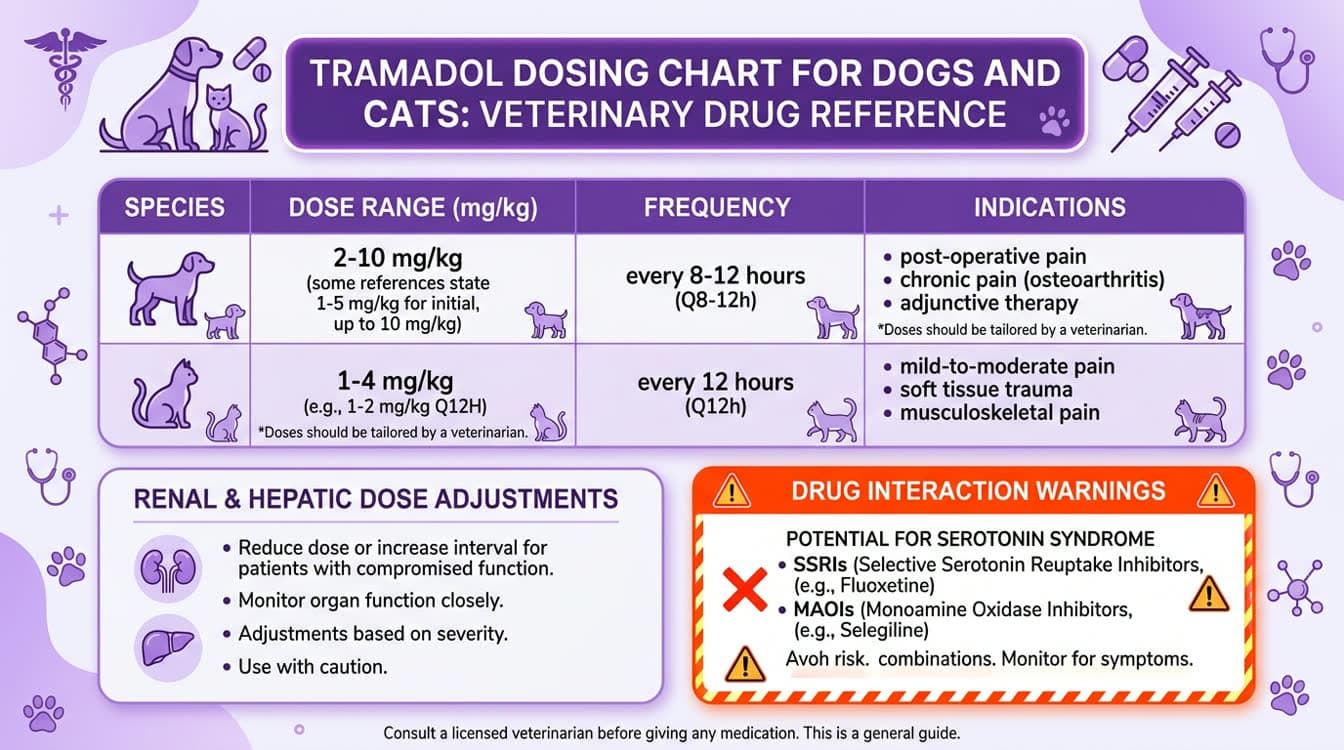
| Dog | 2–5 mg/kg | PO | q8–12h | Mild-moderate acute pain |
| Dog | 2–5 mg/kg | PO | q8h | Chronic pain (osteoarthritis) |
| Cat | 2–4 mg/kg | PO | q12h | Acute or chronic pain |
| Cat | 1–2 mg/kg | PO | q12h | Geriatric or renal impairment |
Clinical Tip — Pill Formulation
- Compound into flavored chewable or transdermal gel (limited absorption data for transdermal)
- Use smallest effective dose in a pill pocket treat
- Consider alternative analgesics (buprenorphine OTM, gabapentin) if repeated refusal
Dose Adjustment for Organ Impairment
| Condition | Adjustment |
|---|---|
| Renal disease (IRIS Stage 3-4) | Reduce to 50% of normal dose; extend interval to q12–24h |
| Hepatic disease | Use with caution; reduce dose 30–50% |
| Concurrent SSRIs | Avoid — risk of serotonin syndrome |
| Concurrent MAOIs | Contraindicated |
| Concurrent TCAs | Use caution — additive serotonin effects |
Maximum Doses
- Dogs: Do not exceed 10 mg/kg per dose; clinical evidence above 5 mg/kg is limited
- Cats: Do not exceed 4 mg/kg per dose; side effects increase significantly above this
Clinical Role in Multimodal Analgesia and Side Effects
Tramadol in the Multimodal Pain Protocol
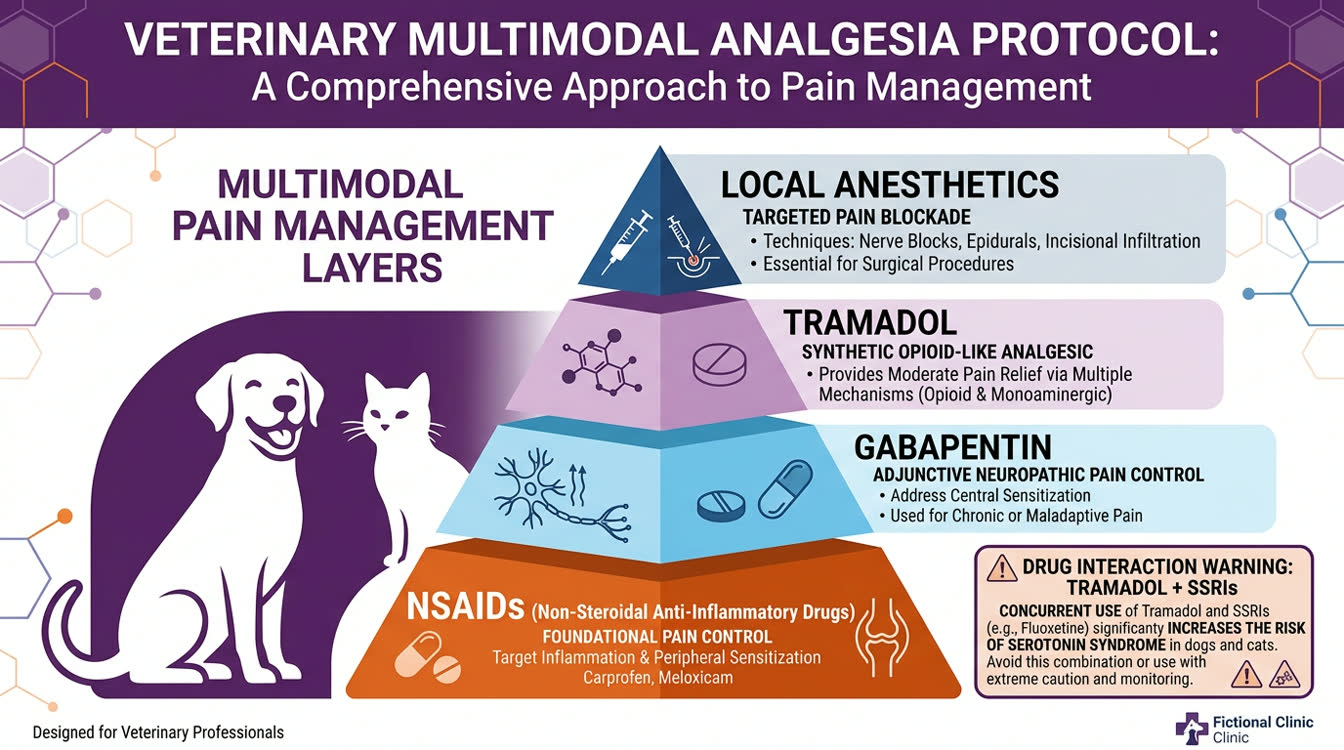
Tramadol is best used as a component of multimodal analgesia — combining it with NSAIDs, gabapentin, or local anesthetics provides superior pain control compared to any single agent alone.
| Condition | Recommended Combination |
|---|---|
| Osteoarthritis (dog) | NSAID (carprofen/meloxicam) + tramadol 2–5 mg/kg PO q8h |
| Post-op pain (dog) | NSAID + tramadol + gabapentin |
| Chronic pain (cat) | Meloxicam 0.025–0.05 mg/kg PO SID + tramadol 2 mg/kg q12h |
| Neuropathic pain | Gabapentin 5–10 mg/kg q8–12h + tramadol |
Side Effects
| Side Effect | Dogs | Cats | Management |
|---|---|---|---|
| Sedation | Common at higher doses | Common | Reduce dose |
| Dysphoria/agitation | Occasionally | Occasionally | Reduce dose or discontinue |
| Vomiting/nausea | Occasional | Less common | Give with food; maropitant |
| Mydriasis | Rare | Occasional | Monitor |
| Serotonin syndrome | Rare (with drug interactions) | Rare | Drug interaction screening |
Serotonin Syndrome Warning Signs
- Hyperthermia, muscle rigidity, tremors, hypersalivation, tachycardia
- Most likely with concurrent SSRI (fluoxetine) use
- Treat with cyproheptadine 1–2 mg/kg PO (serotonin antagonist), supportive care
Clinical Efficacy Reality Check (Dogs) A landmark 2012 study (Budsberg et al.) found no significant difference between tramadol and placebo in dogs with osteoarthritis at standard doses. Dogs requiring reliable oral analgesia should receive an NSAID as the primary agent.
Related Articles: [Fentanyl for Dogs and Cats](/articles/fentanyl-dogs-cats) | [Ketamine Analgesia in Dogs and Cats](/articles/ketamine-analgesia-dogs-cats)
Frequently Asked Questions
Is tramadol effective for dogs with arthritis?
Evidence is mixed. A landmark 2012 study showed no significant benefit over placebo in dogs with osteoarthritis at standard doses (5 mg/kg q8h). Dogs metabolize tramadol unpredictably due to CYP2D6 variation, and many produce insufficient M1 metabolite for effective analgesia. NSAIDs (carprofen, meloxicam) remain the primary evidence-based oral analgesic for canine arthritis, with tramadol used as an adjunct.
Can cats have tramadol?
Yes, tramadol can be used in cats at 2–4 mg/kg PO q12h. Cats actually maintain more consistent analgesia from tramadol than dogs due to the serotonin-norepinephrine mechanism and slower clearance. However, the bitter taste causes frequent refusal — compounded flavored formulations improve compliance.
Can tramadol be combined with NSAIDs?
Yes — tramadol and NSAIDs work by different mechanisms and are commonly combined. The combination provides superior pain relief to either drug alone for moderate-to-severe pain. Do not combine tramadol with SSRIs (fluoxetine) or MAOIs due to serotonin syndrome risk.
How quickly does tramadol work in dogs and cats?
Onset of analgesia is approximately 1 hour after oral administration in both species. Peak effect occurs at 2–4 hours. Duration is 4–6 hours in dogs and 6–12 hours in cats due to slower feline metabolism.
References
- Budsberg SC, Torres BT, Kleine SA, Sandberg GS, Berjeski AK. Lack of effectiveness of tramadol hydrochloride for the treatment of pain and joint dysfunction in dogs with chronic osteoarthritis. J Am Vet Med Assoc. 2018;252(4):427-432.
- Pypendop BH, Ilkiw JE. Pharmacokinetics of tramadol, and its metabolite O-desmethyltramadol, in cats. J Vet Pharmacol Ther. 2008;31(1):52-59.
- Mastrocinque S, Fantoni DT. A comparison of preoperative tramadol and morphine for the control of early postoperative pain in canine ovariohysterectomy. Vet Anaesth Analg. 2003;30(4):220-228.