Quick Answer
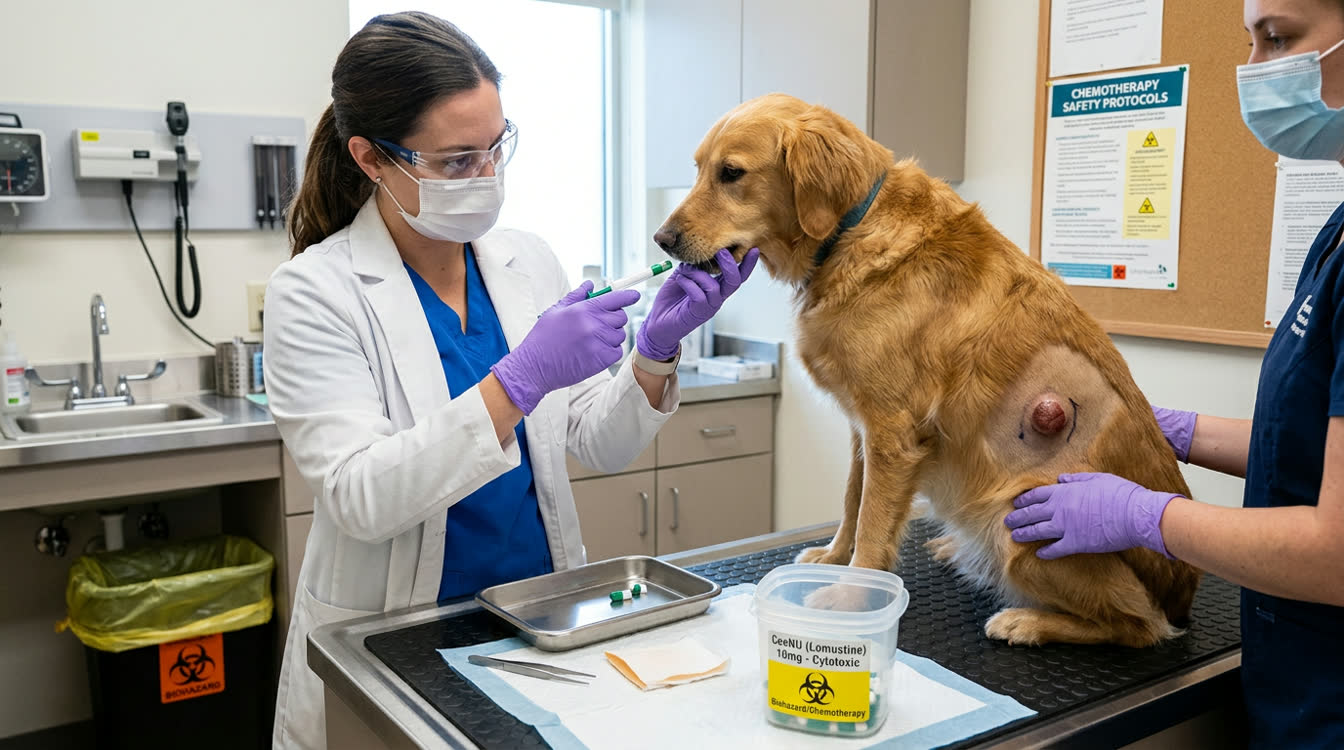
Lomustine (CCNU, CeeNU) is a nitrosourea alkylating agent used in veterinary oncology for mast cell tumors, brain tumors, and lymphoma rescue. This guide covers dosing, the unique delayed biphasic myelosuppression pattern requiring CBC monitoring at day 7 AND day 21, and hepatotoxicity monitoring.
Key Takeaways
- ✓Lomustine's unique biphasic myelosuppression requires CBC at BOTH day 7 and day 21 — the day 21 nadir is often deeper.
- ✓Dose: 60-70 mg/m² PO q3-4 weeks in dogs; 40-60 mg/m² q4-6 weeks in cats; give on empty stomach.
- ✓Hepatotoxicity is a cumulative concern — monitor ALT/ALP before each cycle; consider SAMe hepatoprotectant.
- ✓Lomustine is highly lipophilic and crosses the blood-brain barrier — this makes it uniquely useful for CNS tumors.
- ✓Mast cell tumor response rate ~40-50%; lomustine is often used after surgery for systemic or metastatic MCT.
Mechanism of Action and Indications
Mechanism of Action Lomustine (1-(2-chloroethyl)-3-cyclohexyl-1-nitrosourea, CCNU, CeeNU) is a lipophilic nitrosourea alkylating agent.
Key properties:
- Highly lipophilic: crosses the blood-brain barrier (BBB) — critical for CNS tumor treatment
- Alkylating agent: cross-links DNA strands, preventing replication and inducing apoptosis
- Cell-cycle non-specific: acts in all phases
Clinical Indications
| Indication | Species | Protocol |
|---|---|---|
| Mast cell tumor (MCT) — grade 2/3 | Dog | Single agent q3-4 weeks; or with prednisolone |
| MCT rescue after CCNU-naive disease | Dog | First-line after surgery when systemic treatment needed |
| Glioma, meningioma, other brain tumors | Dog, Cat | Post-radiation or palliative |
| Lymphoma rescue (relapsed/refractory) | Dog, Cat | MOPP rescue with procarbazine, vincristine |
| Histiocytic sarcoma | Dog | Part of combination or single agent |
| Anaplastic astrocytoma/GBM | Dog | Palliative; post-radiation |
Mast Cell Tumor (MCT) — Primary Use
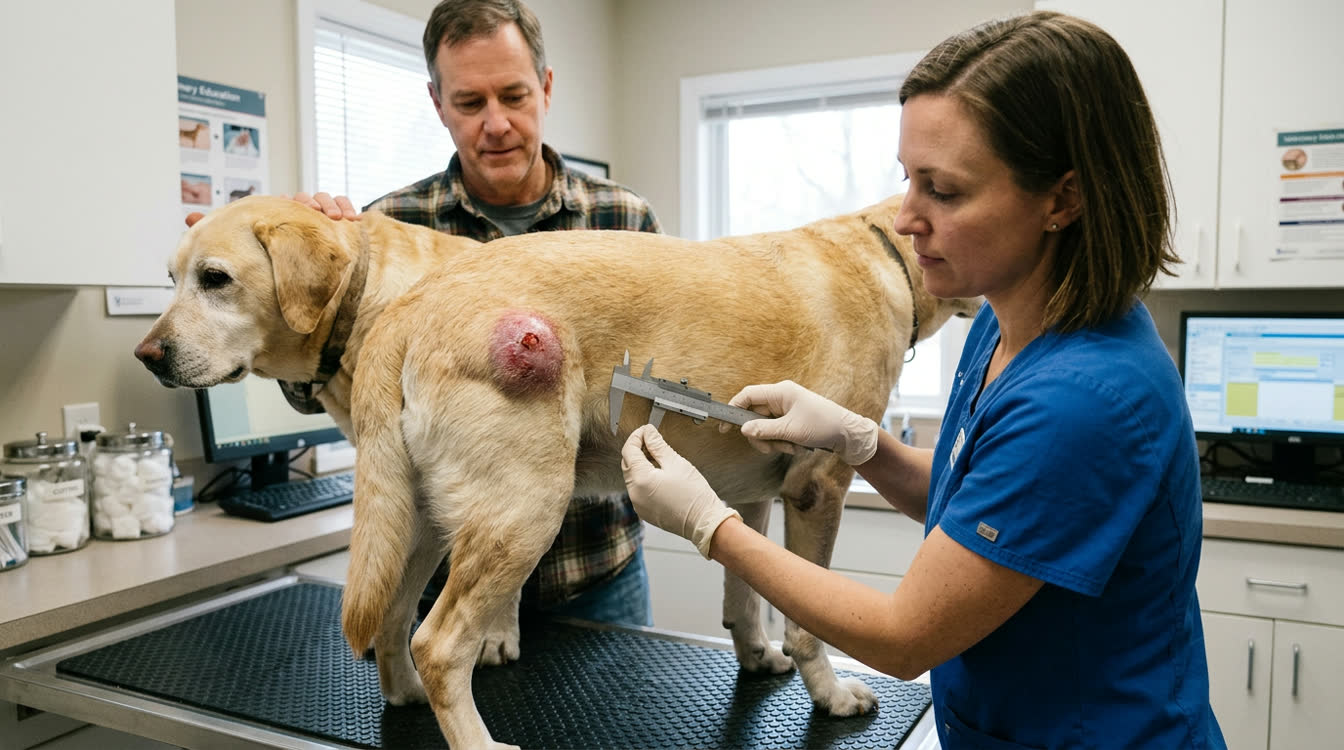
- Dogs with visceral MCT or unresectable/metastatic MCT: lomustine provides partial or complete remission in 40-50% of cases
- Toceranib (Palladia, KIT inhibitor): now first-line for metastatic MCT in many practices; lomustine used as rescue or combination
- Combination: lomustine + prednisolone shows additive benefit for systemic MCT
- Dose: 60-70 mg/m² PO q3-4 weeks
Dosing and Critical CBC Monitoring at Day 7 and Day 21
Dosing
| Species | Dose | Route | Frequency |
|---|---|---|---|
| Dogs | 60-70 mg/m² | PO | q3-4 weeks |
| Cats | 40-60 mg/m² | PO | q4-6 weeks (more sensitive; longer interval) |
Administration
- Oral capsules: 10, 40, and 100 mg available
- Give on an empty stomach — food reduces absorption
- Capsule should NOT be opened — lomustine is highly cytotoxic; if patient cannot swallow, use compounded liquid in closed-system syringe
- Nitrile chemotherapy gloves mandatory for handling; cytotoxic for 48h post-dose in urine/feces
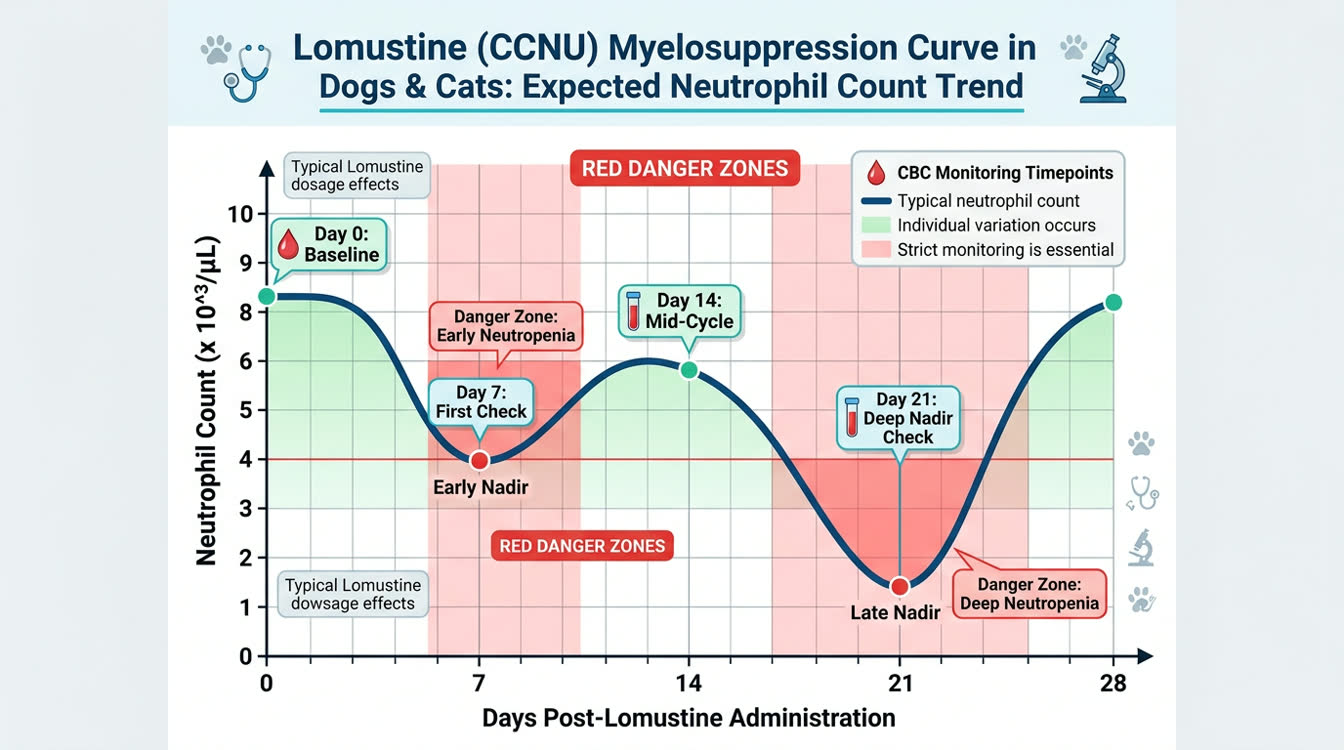
CRITICAL: Biphasic Delayed Myelosuppression Lomustine has a unique and dangerous myelosuppression pattern — DOUBLE NADIR: 1. Early nadir: Day 7 — rapid neutrophil and platelet drop 2. Late nadir: Day 21 — second, often deeper myelosuppression
This is different from most chemotherapy agents (single nadir day 7-10). Failure to check the day 21 CBC is a common and potentially fatal error.
Mandatory CBC Schedule
- Baseline: day 0 (treatment day) — must have neutrophils ≥3,000/uL and platelets ≥75,000/uL to treat
- Day 7 CBC: assess early nadir
- Day 21 CBC: assess late nadir (often the deeper trough)
- Treatment day (q21 or q28): re-baseline before next dose
Dose Modification Guidelines
| Neutrophils (nadir) | Platelets (nadir) | Action |
|---|---|---|
| ≥3,000/uL | ≥75,000/uL | Proceed at same dose |
| 2,000-3,000/uL | 50,000-75,000/uL | Reduce dose 25% |
| 1,000-2,000/uL | 25,000-50,000/uL | Reduce dose 50%; delay 1 week |
| <1,000/uL | <25,000/uL | Hold treatment; supportive care |
Febrile Neutropenia Management
- Hospitalize, IV antibiotics (enrofloxacin 5-10 mg/kg IV q24h + ampicillin-sulbactam 22 mg/kg IV q8h)
- Colony-stimulating factor: filgrastim (G-CSF) 5 mcg/kg SQ q24h x 3-5 days
- Blood transfusion if platelets <10,000/uL with active bleeding
Hepatotoxicity, Long-term Monitoring, and Outcomes
Hepatotoxicity — Cumulative Concern
- Mechanism: toxic metabolites accumulate with repeated dosing; direct hepatocellular injury
- Incidence: clinically significant hepatotoxicity in 10-20% of dogs with repeated dosing
- Monitoring: ALT and ALP before each treatment cycle
- Action thresholds:
Hepatoprotectant Supplementation
- SAMe (S-adenosylmethionine): 18-20 mg/kg PO q24h on empty stomach — antioxidant hepatoprotectant
- Milk thistle (silymarin): 50-70 mg/kg PO q24h — clinical evidence limited but widely used
- Vitamin E (alpha-tocopherol): antioxidant support
Pulmonary Fibrosis (Rare)
- Nitrosourea-induced lung toxicity reported in humans; less documented in dogs
- If progressive dyspnea develops on lomustine, consider chest radiographs
Prognosis by Indication
| Indication | Response Rate | Median Survival |
|---|---|---|
| MCT (systemic, first-line) | 40-50% partial or complete | 100-150 days (MCT responds to surgery; systemic MCT has guarded prognosis) |
| MCT rescue post-toceranib | 20-30% | Variable |
| Brain tumor (glioma/meningioma) | 30-50% stabilization | 4-8 months post-RT + CCNU |
| Lymphoma rescue | 30-40% CR | 60-90 days (rescue protocols) |
| Histiocytic sarcoma | 25-30% | 100 days |
Practical Monitoring Schedule
| Time | Tests |
|---|---|
| Before treatment (day 0) | CBC, chemistry panel (ALT, ALP, bilirubin) |
| Day 7 | CBC (early nadir) |
| Day 21 | CBC (late nadir) — mandatory |
| Before next cycle | CBC, chemistry panel |
Related Articles:
- [Vincristine in Dogs and Cats](/articles/vincristine-dogs-cats)
- [Doxorubicin in Dogs and Cats](/articles/doxorubicin-dogs-cats)

Frequently Asked Questions
Why does lomustine need CBC checks at both day 7 AND day 21?
Lomustine has a unique biphasic myelosuppression pattern with two nadirs — an early one at day 7 and a later, often deeper one at day 21. Most chemotherapy drugs have only one nadir around day 7-10. If you only check day 7 and the count is acceptable, the dog may still have severe myelosuppression appearing at day 21. Missing the day 21 CBC is a common error that can be life-threatening.
Can lomustine be used with toceranib (Palladia) for mast cell tumors?
The combination of toceranib and lomustine has been studied and can provide improved responses for high-grade or metastatic MCT. However, combination chemotherapy increases toxicity risk — closer monitoring is required, and doses may need to be reduced. This combination should be managed by a veterinary oncologist with frequent CBC and chemistry monitoring.
How should I handle lomustine capsules at home?
Always wear nitrile gloves when handling lomustine capsules. Do not open or crush the capsule. Give on an empty stomach with a small amount of water. Dispose of the packaging and gloves in a sealed plastic bag. Handle your pet's litter and feces with gloves for 48 hours after dosing. Keep the medication away from children and pregnant women.
What liver enzyme values should trigger stopping lomustine?
Hold lomustine if ALT exceeds 5x the upper reference range, or if the patient shows clinical signs of liver disease (jaundice, vomiting, loss of appetite). For ALT 3-5x upper normal, reduce dose 25% and recheck the enzyme in 2 weeks. Many oncologists add SAMe (18-20 mg/kg/day) as a hepatoprotectant throughout lomustine therapy.
References
- Rassnick KM, et al. Use of lomustine for treatment of mast cell tumors in dogs. J Vet Intern Med. 1999;13(6):601-605.
- Heading KL, et al. CCNU (lomustine) toxicity in dogs. Aust Vet J. 2011;89(7):278-281.
- Vail DM, Thamm DH, Liptak JM, eds. Withrow and MacEwen's Small Animal Clinical Oncology. 6th ed. Elsevier; 2020.